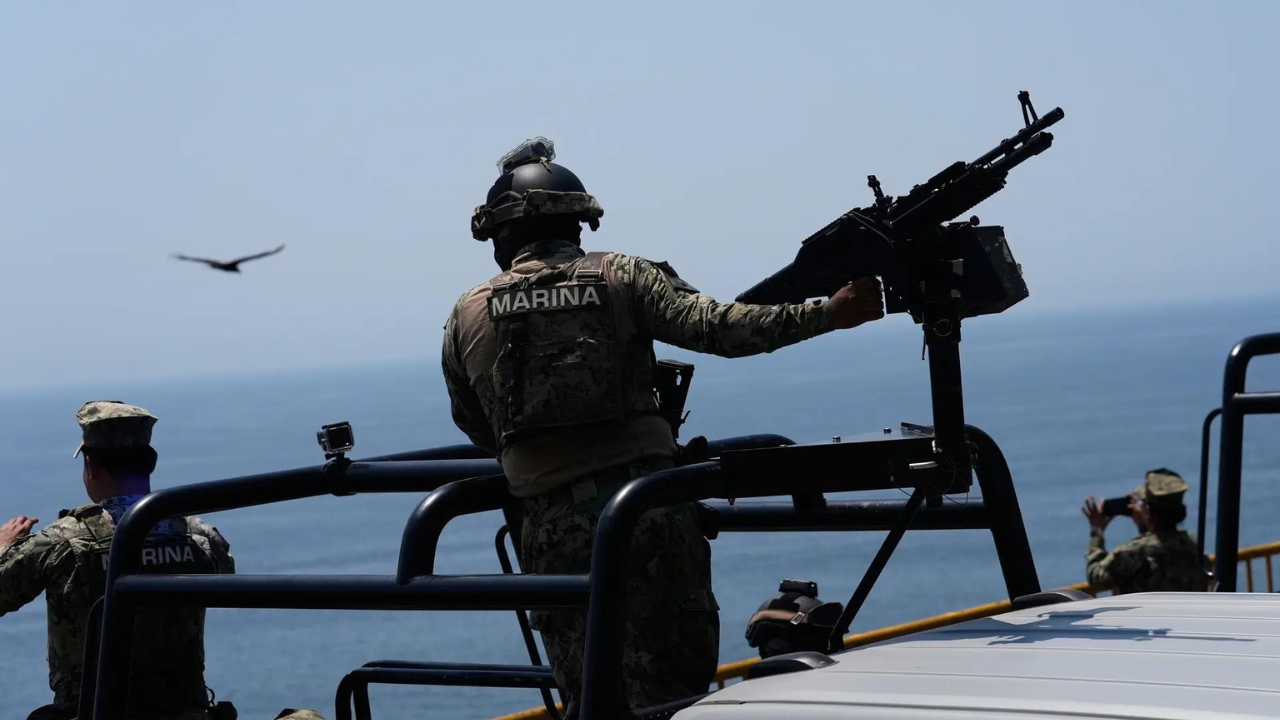
Another day, another official report detailing a "successful" operation in northwest Mexico. The body count is eleven. The weapons seized are "high-caliber." The government press release reads like a victory lap.
But if you’ve spent a decade tracking the shifting geography of the Sinaloa and Sonora corridors, you know this isn't a victory. It’s a maintenance fee.
The media loves a body count. It provides a tangible metric for a conflict that is otherwise incomprehensible to the average observer. When eleven suspected gunmen fall in a hail of lead, the narrative is simple: the state is winning, the bad guys are losing, and the "anti-cartel operation" is working. This is a lie. It’s a comfortable, bureaucratic lie that masks a fundamental misunderstanding of how modern narco-insurgencies actually function.
Counting bodies in the Mexican drug war is like counting grains of sand in a desert storm. It tells you the wind is blowing, but it doesn't tell you where the dunes are moving.
The Body Count Fallacy
Mainstream reporting treats these operations as if they were conventional military engagements. In a conventional war, killing eleven combatants and seizing a cache of rifles reduces the enemy's operational capacity. In the asymmetric reality of the Mexican northwest, it’s merely a job opening.
The "lazy consensus" suggests that attrition works. It doesn't.
Since the start of the militarized offensive in 2006, the logic of "neutralizing" targets has produced a hydra effect. You cut off one head, and three more—younger, more violent, and less disciplined—spring up to take its place. When an official announces that eleven men were killed, they are actually announcing a temporary vacancy in a franchise. The infrastructure of the cartel—the routes, the political protection, the financial laundering—remains entirely untouched.
I’ve sat in rooms with analysts who still believe that high-value targeting (HVT) is the gold standard. They are wrong. Every time a "plaza boss" or a tactical unit is wiped out, the resulting power vacuum triggers a spike in local homicides as subordinates fight for the remains. The "anti-cartel operation" didn't make northwest Mexico safer; it just made the next month of local life more unpredictable.
Kinetic Success is Strategic Failure
We need to talk about the $100,000 problem.
Each of those eleven men likely represented a negligible investment for their organization. A few months of training, a cheap rifle, and a steady supply of synthetic stimulants. The Mexican state, conversely, spent millions on the intelligence, the transport, the specialized training, and the political capital to execute this raid.
If your opponent can replace their entire tactical loss for the price of a mid-range SUV, and it costs you the equivalent of a small hospital to remove them, you aren't winning. You are being bled dry.
The "Official" version of this story ignores the economic reality of the northwest. In towns where the cartel is the primary employer, an operation that kills eleven locals doesn't breed gratitude toward the state. It breeds resentment. It provides the cartel with a fresh batch of martyrs to use for recruitment.
True authority isn't found at the end of a barrel; it’s found in the person who provides the paycheck, the protection, and the "justice" that the formal government has long since abandoned. By focusing on kinetic operations—bullets and bodies—the government admits it has no actual control over the territory. It can only visit the territory with violence.
The Fragility of the "Northwest" Label
Generalizing "northwest Mexico" is a tactical error made by journalists who can’t find Caborca on a map.
The dynamics in Sonora are not the dynamics in Sinaloa. The operation mentioned in the recent reports likely touched on the splintering of the Gente Nueva or the ongoing friction between the "Chapitos" and the "Mayo" factions. When the state enters these conflicts, they are rarely a neutral arbiter of law. They are, intentionally or not, a variable in a larger chess match.
If the state kills eleven members of Group A, Group B doesn't celebrate the return of the rule of law. Group B moves into the vacant territory. The government has effectively acted as the enforcement arm for a rival criminal enterprise. This isn't "anti-cartel" work; it’s unintentionally subsidized market consolidation.
Stop Asking if the Operation was "Successful"
People always ask: "Was the operation successful?"
It’s the wrong question. It’s a question designed for a world that no longer exists.
A "successful" operation in the modern context shouldn't be measured by the number of bodies on a dusty road. It should be measured by:
- The stability of the local price of basic goods (which cartels now tax).
- The decrease in forced displacement of local populations.
- The integrity of the local judicial system.
By those metrics, every kinetic raid in the last five years has been a catastrophic failure. We are obsessed with the "cinematic" version of the drug war—the night-vision goggles, the helicopter extractions, the piles of confiscated cash. It’s theater. It’s a performance for an international audience and a domestic voting bloc that needs to believe the state still has a monopoly on violence.
The Professionalization of Chaos
I have seen the aftermath of these "clean" operations. They are never clean.
They leave behind fractured command structures. A disciplined cartel is a business. A fractured cartel is a street gang with military-grade hardware. When the state kills the "professionals," they leave the territory to the "amateurs." The amateurs are the ones who kidnap civilians for ransom because they don't have the connections to move tons of product. The amateurs are the ones who spray-paint their territory with the blood of bystanders because they lack the "prestige" of the old guard.
The status quo says: "Kill the criminals."
The counter-intuitive truth says: "The killing is what’s making the criminals more dangerous."
The Real Cost of Seized Hardware
Officials love to display the "high-caliber" weapons seized during these raids. It makes for a great photo op.
What they don't tell you is that the supply chain for these weapons is so robust that the loss of fifty rifles is a rounding error. As long as the border remains a sieve for iron and the southern route remains a sieve for chemicals, seizing hardware is a purely symbolic act. It’s like trying to stop a flood by catching raindrops in a teaspoon.
To actually disrupt the cartel, you don't need soldiers in the northwest; you need forensic accountants in Mexico City, Los Angeles, and London. But accountants don't look good in tactical gear, and "We froze three shell company accounts" doesn't make for a "breaking news" headline.
The Myth of the "Anti-Cartel" Label
The term "anti-cartel" implies a binary. State vs. Criminal.
This ignores the reality of "co-governance." In many parts of the northwest, the line between the municipal police, the state officials, and the cartel is non-existent. When an operation like this occurs, it is often a sign that a specific deal has broken down. Perhaps the "rent" wasn't paid. Perhaps a new commander took over and wanted to prove his "toughness" before negotiating his own cut.
If we treat these eleven deaths as a victory for justice, we ignore the high probability that they were a casualty of a bureaucratic dispute within a corrupt system.
Stop Reading the Body Count
The next time you see a headline about an "operation" in Mexico, ignore the number of dead. It’s a distraction.
Instead, look for the data on who replaces them. Look for the movement of the fentanyl precursor prices. Look for the local election results in the region six months later.
If you want to understand the conflict, you have to stop looking at the sparks and start looking at the fuel. The Mexican state is addicted to the optics of the raid because it cannot face the reality of its own obsolescence in the mountains of the northwest.
Killing eleven men is easy.
Building a state that makes those eleven men irrelevant is the work they aren't willing to do.
The "Official" report isn't a summary of progress. It’s a confession of a stuck gear, grinding away at the same failed strategy, producing nothing but more ghosts.
The war isn't being won. It's being advertised.