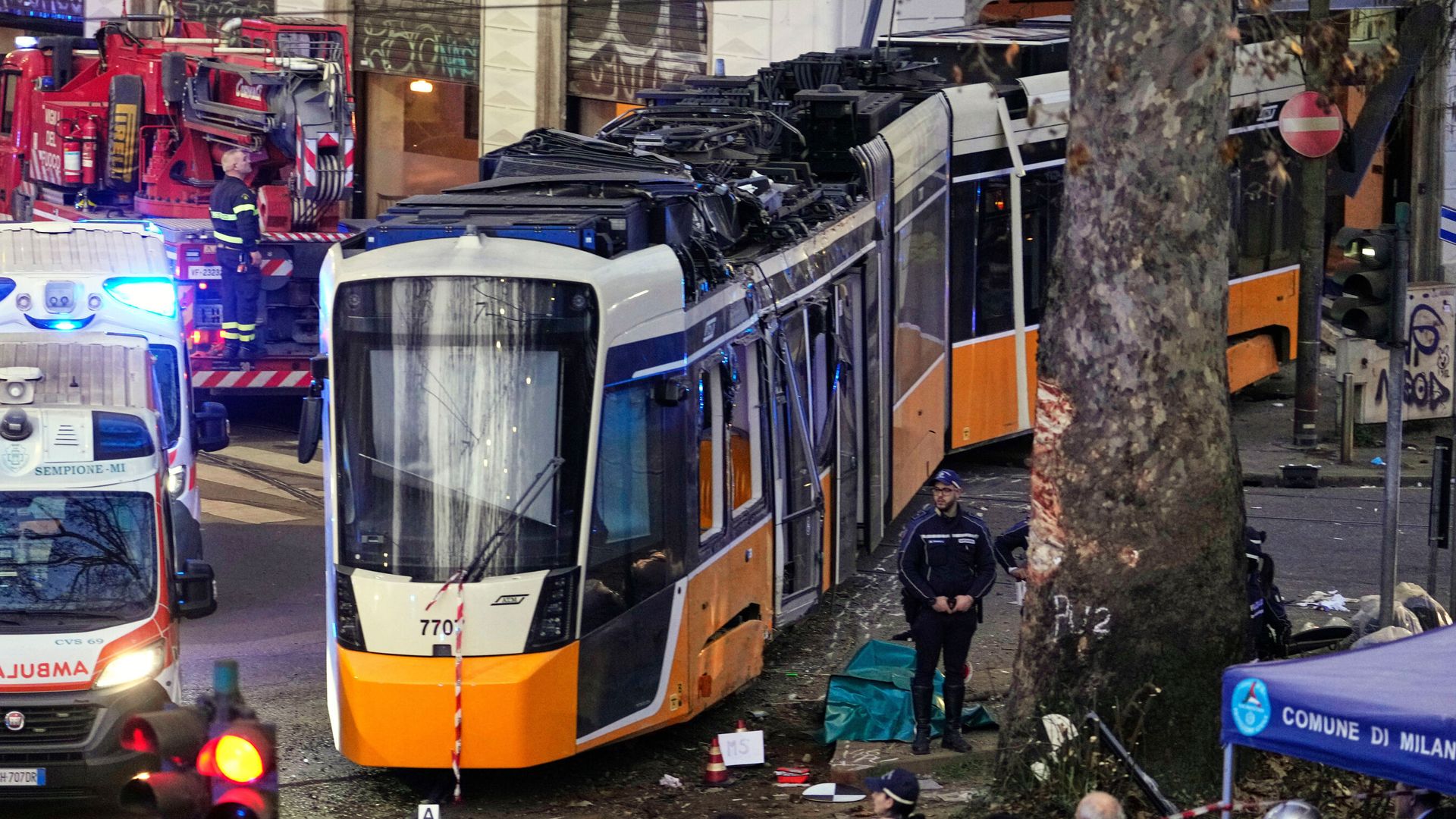
The coffee was still warm in Elena’s travel mug when the world tilted forty-five degrees to the left.
It is a mundane thing, a commute. We treat it as a dead space between the life we live at home and the work we do for a paycheck. We stare at the backs of strangers' heads, scrolling through digital feeds, oblivious to the fact that we are hurtling through a city in a steel box balanced on narrow strips of iron. On Tuesday morning, for sixty-two passengers on the Route 7 line, that dead space became a boundary between the "before" and the "after."
The physics of a tram derailment are deceptively simple and violently fast. When a vehicle designed to stay on a fixed path suddenly finds its own direction, the results aren't just a mechanical failure. They are a physical betrayal.
Imagine the sound first. Not a crash—not yet—but a high-pitched, tooth-rattling scream of metal grinding against stone as the wheel flanges jump their tracks. For Elena, a hypothetical but representative commuter based on the typical morning demographic of this line, it sounded like the earth itself was tearing open. Then came the weight. The centrifugal force threw bodies against the glass, turning the interior of the carriage into a chaotic centrifuge of limbs, bags, and shattered expectations.
Two people did not get back up.
We often see numbers in a headline—"two dead"—and our brains categorize them as statistics. We process them as a tragedy in the abstract. But the reality is far more intimate. One was a man in his sixties, a grandfather who likely had plans for dinner. The other was a woman in her twenties, perhaps just beginning to figure out who she was supposed to be. Their lives ended not on a battlefield or in a hospital bed, but on a linoleum floor covered in commuter dust and broken safety glass.
The invisible stakes of public transit safety are rarely discussed until the blood is on the tracks. We trust the infrastructure. We trust the maintenance schedules. We trust that the person behind the controls isn't fatigued, distracted, or pressured by a ticking clock. When that trust breaks, the city feels smaller. Frightening.
Rescue workers arrived within seven minutes, but for those trapped inside, time didn't function by the clock. It functioned by the pulse. One witness described the silence that followed the initial impact as the most terrifying part. It was a heavy, thick silence, broken only by the hiss of hydraulic fluid and the first, tentative moans of the injured.
Thirty-eight people were taken to local hospitals. Some had broken ribs from the force of the seats tearing loose. Others had "minor" injuries—a term that does a poor job of describing the psychological scar of being tossed like a ragdoll while the world screams around you.
Why does a tram leave the tracks?
The investigation will look at the technicalities. They will measure the wear on the rail. They will check the braking system for internal faults. They will analyze the speed data from the "black box" recorder. These are the "hows" of the situation. But the "whys" often go deeper into the marrow of how we run our cities. Is the pressure to maintain a high-frequency schedule leading to corner-cutting? Is the infrastructure, built for a smaller population, buckling under the weight of a modern metropolis?
Consider the curve where it happened. It’s a sharp turn, a place where every driver knows to shave off speed. If the investigation finds human error, we blame the individual. If it finds a mechanical flaw, we blame the manufacturer. But the systemic reality is that every piece of technology we rely on is a compromise between cost, speed, and safety. Usually, the compromise works. Until it doesn't.
The impact ripples outward, far beyond the yellow tape and the flashing blue lights. It hits the families who receive the phone call no one is ever prepared for. It hits the regular commuters who now stand on the platform with their hearts in their throats, eyeing the tracks with a new, cold suspicion. It hits the city's psyche, reminding us that the thin veneer of order we rely on is held together by bolts and welds that we never bother to check ourselves.
Elena walked away with a bruised shoulder and a ruined coat. She stood on the sidewalk for an hour, watching the paramedics work, her thumb hovering over her phone screen. She wanted to call someone, but she didn't know how to explain that her morning had disappeared into a screech of metal.
She eventually walked the rest of the way to her office. She sat at her desk. She tried to type. But the ghost of the vibration was still in her bones. She kept waiting for the floor to tilt.
In the coming weeks, there will be a report. There will be a spokesperson in a suit standing in front of a microphone, offering "deepest sympathies" and promising a "thorough review of protocols." These words are a ritual. They are meant to patch the hole in the public's confidence.
But for the families of the two who were lost, no protocol review brings back the sound of a key in the front door. For the dozens recovering in hospital beds, the "thorough review" doesn't take away the recurring nightmare of the world turning upside down on a Tuesday morning.
The tram is back in the depot now, a mangled heap of yellow paint and twisted steel. The tracks have been cleared. The glass has been swept away. From a distance, the street looks exactly as it did twenty-four hours ago.
The city moves on because it has to. The gears must turn. The commuters must commute. But underneath the pavement, the vibration of the next approaching tram feels a little different now. It feels less like a convenience and more like a reminder. We are all just passengers, holding on to a strap, hoping the metal holds.
A lone shoe remained on the tracks long after the ambulances left, a scuffed sneaker pointing toward a destination it would never reach.