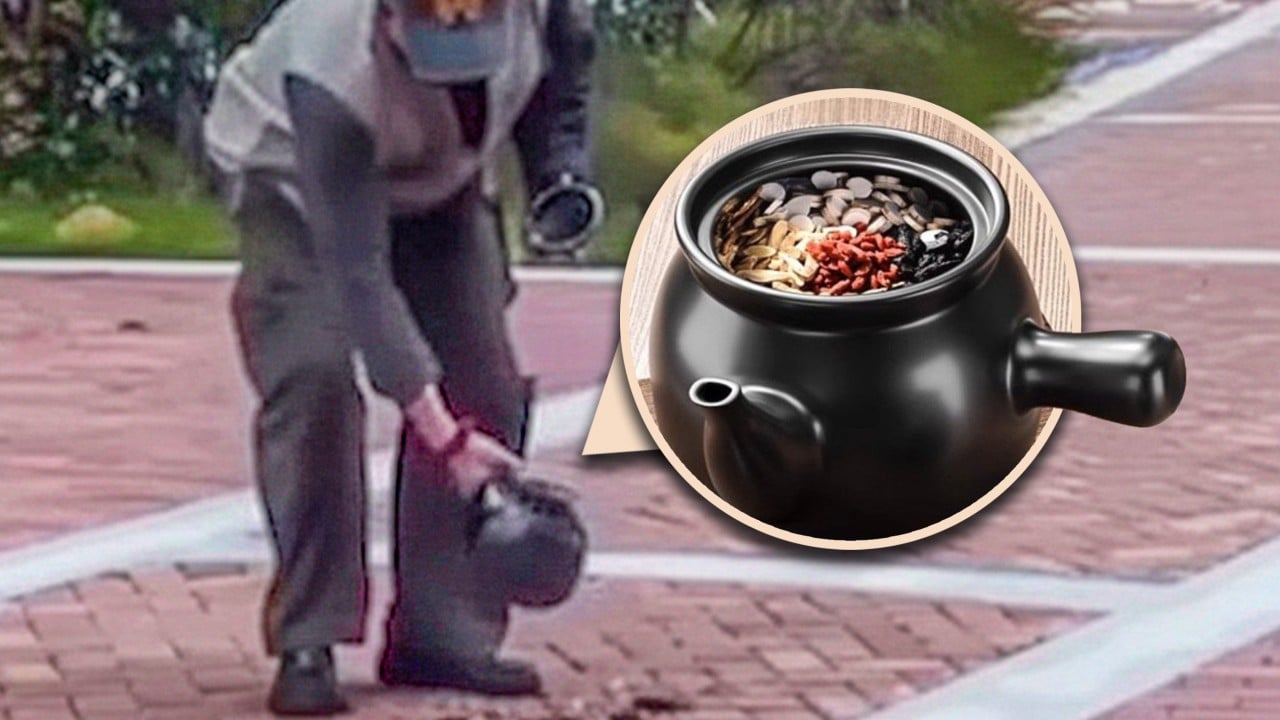
Traditional Chinese Medicine (TCM) operates on a logic of systemic balance where illness represents a tangible accumulation of "pathogenic factors" (Xie Qi) within the biological host. When a patient recovers, the residual decoction—the dregs of the herbs used to absorb and neutralize these factors—is not viewed merely as biological waste but as a concentrated vessel of displaced misfortune. The ritualized act of pouring this liquid onto public roads, specifically at intersections or high-traffic pathways, functions as a primitive but logically consistent mechanism for the redistribution of negative externalities. This behavior is governed by a framework of "transference through contact," where the kinetic energy of strangers walking or driving over the medicine is believed to disperse the lingering illness away from the original sufferer.
The Kinetic Dispersal Framework
The decision to discard TCM dregs on a public road rather than in a private waste stream is a calculated move to utilize the "crushing force" of the collective. The logic follows a three-stage progression: Also making headlines lately: NYC Snow Days Are a $500 Million Marketing Lie.
- Isolation: The medicine has successfully extracted the "toxicity" from the patient. The dregs now contain the essence of the ailment.
- Externalization: By placing the dregs in a transitional space (a road), the owner moves the misfortune from the private sphere to the public commons.
- Neutralization via Scale: The belief holds that the more people who step on or drive over the medicine, the more the "bad luck" is fragmented. If one person takes the full weight of the dregs, they might fall ill; if ten thousand people roll over it, the misfortune is diluted into insignificance.
This is a classic "Tragedy of the Commons" in a spiritual context. The individual reduces their own risk of a relapse by imposing a marginal, almost imperceptible "spiritual cost" on the general public.
Spatial Variables and Site Selection
The efficacy of the ritual is perceived to be directly proportional to the volume of traffic at the disposal site. Not all roads are equal in the eyes of this tradition. Practitioners prioritize three specific spatial archetypes: Further information on this are covered by Apartment Therapy.
- Intersections (The Four-Way Split): These are preferred because they represent the maximum number of potential vectors for the illness to travel. At a crossroad, the misfortune can be carried away in four different directions, ensuring it does not "find its way back" to the source.
- Thresholds: Areas where people transition from one state to another (entering or leaving a village or neighborhood) are seen as "leaks" in the local energy field where waste is easily swept out.
- High-Velocity Corridors: Modern adaptation has shifted the preference toward paved roads where cars, rather than pedestrians, do the work. The higher the velocity of the vehicle, the more "violently" the misfortune is shredded and scattered.
The Economic of Superstition: Risk Mitigation vs. Social Friction
From a strategy perspective, this behavior is a low-cost insurance policy for the practitioner. The cost of pouring liquid on a road is near zero, while the perceived benefit—preventing the return of a chronic or life-threatening illness—is infinite. However, this creates a distinct social friction.
The conflict arises from a misalignment of "Value Systems." To the practitioner, the road is a cleansing machine. To the urban manager or neighbor, the road is a public utility being degraded by slip hazards and biological waste.
The Variable of "Shadow Costs"
While the practitioner sees no cost, the community incurs:
- Safety Risks: Wet herb dregs create slick patches on asphalt, increasing the probability of motorbike or bicycle skids.
- Sanitation Loads: Municipal workers must expend labor hours to clear organic debris that could have been disposed of in a standard bin.
- Psychological Tax: For those who believe in the ritual but are the ones doing the "stepping," there is a perceived risk of "catching" the bad luck, leading to avoidance behaviors and detour-related inefficiencies.
Institutional Resistance and Modern Friction
Governmental and medical institutions in mainland China and across the diaspora have attempted to counteract this practice through two primary levers: scientific education and administrative penalty. Yet, the persistence of the "Road Pouring" ritual suggests these levers are misaligned with the root cause.
Educational campaigns focus on the biological inertness of the herbs once boiled. They argue that the "medicine" is just cellulose and tannins. This fails because the practitioner isn't disposing of biological matter; they are disposing of a symbolic proxy for suffering. Logic-based appeals fail to address the metaphysical anxiety of the patient.
Administrative penalties, such as fines for littering, are more effective but suffer from high enforcement costs. Since the act is performed quickly and often at night or dawn, the "Success Rate" of the ritual (getting the medicine on the road) remains high compared to the "Risk of Capture" (getting a ticket).
The Cognitive Architecture of "Stepping Over"
For the passerby, the sight of TCM dregs on the road triggers a specific set of defensive maneuvers. This creates a fascinating behavioral loop:
- Detection: Identifying the dark, fibrous pile of herbs.
- Assessment: Determining if the pile is fresh (high potency of misfortune) or dried/crushed (low potency).
- Evasion: Altering the path of travel.
This evasion is the "Market Response" to the practitioner's "Externalization." If everyone avoids the pile, the practitioner's goal—dispersal via contact—is thwarted. This leads to a strategic escalation where practitioners try to spread the dregs thinner or disguise them in shadows to ensure contact occurs before the passerby can react.
Strategic Transition for Public Health Management
To effectively manage or phase out this ritual, urban planners and community leaders must stop treating it as a littering issue and start treating it as a waste-management ritual vacancy.
The current system provides no "approved" ritual for the disposal of "spiritually charged" medical waste. Standard trash cans are seen as stagnant; they keep the "illness" near the home. To shift behavior, the "Out-of-Sight, Out-of-Mind" (OSOM) principle must be replaced with a "Movement and Dispersal" (MD) principle that satisfies the practitioner's psychological requirements without damaging public infrastructure.
Communities that have successfully reduced this behavior typically employ a "Replacement Ritual" strategy. This involves:
- Flowing Water Alternatives: Encouraging the disposal of dregs in designated moving water (where ecologically safe), which satisfies the logic of "carrying the illness away" without creating road hazards.
- Burial Frameworks: Re-framing the earth as a "neutralizer" that can swallow misfortune, moving the disposal from the surface of the road to the subsurface of a garden or forest.
- Pre-Processing: Hospitals providing dissolvable or powder-based TCM that leaves no physical dregs, effectively removing the "vessel" of misfortune from the equation entirely.
The persistence of pouring medicine onto roads is not a sign of irrationality, but a sign of a deeply embedded risk-management logic that prioritizes the family unit over the anonymous public. Until the "cost" of the ritual (social stigma or legal penalty) outweighs the "perceived benefit" (protection from illness), or until a superior ritualistic alternative is provided, the intersections of major cities will continue to serve as the unintended theaters of metaphysical sanitation.
Municipal authorities should prioritize the deployment of high-pressure street cleaning in known ritual hotspots during peak TCM consumption seasons (winter and spring) while simultaneously partnering with TCM clinics to provide "Ritual Disposal Bags"—biodegradable liners that re-brand the act of throwing dregs in the trash as "sealing the illness" rather than simply discarding it. This shifts the narrative from dispersal to containment, leveraging the same superstitious fear to achieve a pro-social outcome.