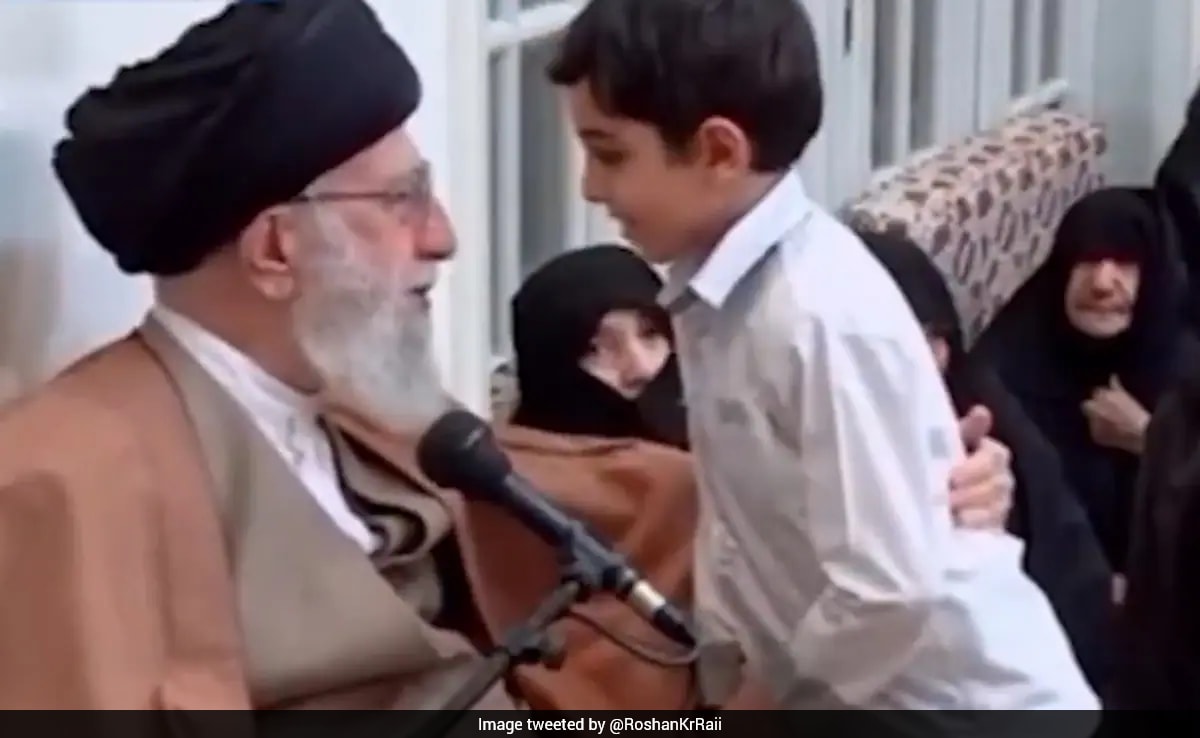
The intersection of state-sponsored theology and youth psychological development creates a specific rhetorical pipeline designed to ensure long-term institutional survival. When a video of Iran’s Supreme Leader Ali Khamenei responding to a child’s expressed wish for "martyrdom" goes viral, the public discourse often focuses on the emotional optics. However, a structural analysis reveals a sophisticated redirection of radical energy into state-building utility. The exchange is not a simple interaction; it is a live-action demonstration of Narrative Recalibration, where the state converts a terminal ideology (death) into a functional asset (scientific expertise).
The Three Pillars of State Narrative Reorientation
The core of this viral interaction rests on three distinct logical pivots that transition the subject from a passive religious aspiration to an active state-interest objective.
1. The Survival-Utility Conversion
Traditional martyrdom narratives rely on the glorification of the end-state. From a strategic consulting perspective, this represents a "loss of human capital." A state cannot sustain influence if its most devoted demographic seeks immediate exit from the labor and defense markets. Khamenei’s response—telling the child to "become a scientist" instead—executes a conversion of Potential Energy (religious zeal) into Kinetic Energy (technological advancement).
By reframing martyrdom not as a singular event of death, but as a "living sacrifice" through intellectual labor, the leadership solves a critical retention problem. The state preserves the ideological fervor while redirecting it toward the nuclear, medical, and military-industrial sectors where it is pragmatically required.
2. The Validation Loop
The child’s request serves as a diagnostic tool for the state's indoctrination efficacy. It confirms that the base-level messaging—the glorification of sacrifice—has been successfully internalized by the youngest cohort. The leader’s role then shifts from teacher to optimizer. By validating the sentiment but correcting the methodology, the leader establishes a hierarchy of sacrifice where intellectual contribution is positioned as the superior form of devotion.
3. Institutional Continuity through Youth Engagement
Viral media serves as a force multiplier for domestic and international signaling. Domestically, it reinforces the image of a paternalistic, accessible leader. Internationally, it attempts to soften the perception of radicalism by layering "scientific pursuit" over "militant aspiration." This creates a dual-track perception where the state appears both ideologically firm and modernistically inclined.
The Cost Function of Ideological Extremism
In any closed ideological system, there is a measurable cost to radicalization. When the "Martyrdom Wish" becomes a prevalent cultural trope, the state faces a diminishing return on its human resources.
- Brain Drain vs. Devotional Drain: High-IQ individuals in these systems often face a choice between secular emigration and radical immersion.
- The Expertise Gap: If the most loyal subjects focus solely on the afterlife, the technical infrastructure of the state falls to pragmatists or opportunists who may lack ideological loyalty.
- The Mitigation Strategy: Khamenei’s redirection is a calculated hedge against the expertise gap. By sanctifying the role of the "Scientist-Martyr," the state creates a pathway for loyalists to enter high-complexity fields without feeling they have compromised their religious integrity.
Deconstructing the Viral Mechanism
The "viral" nature of this footage is rarely organic. It follows a specific distribution logic intended to saturate different demographic segments.
Segment A: The Loyal Base
For the domestic supporter, the video reinforces the Continuity of Command. It shows the leader shaping the next generation, ensuring that the "Revolution" does not die with the current aging technocracy. The emotional weight of a child discussing death is used to anchor the more boring, utilitarian message of "go to school and study."
Segment B: The Foreign Observer
For the external critic or analyst, the video is a Rorschach test. Some see the chilling indoctrination of a minor; others see an unexpected emphasis on education over violence. This ambiguity is a strategic asset, as it complicates the international narrative of the state as a one-dimensional actor.
Segment C: The Regional Competitor
To regional rivals, the message is one of Resilience. It signals that the state has an unlimited supply of motivated youth who are being directed into the very fields—cybernetics, physics, and engineering—that determine regional hegemony.
The Behavioral Economics of "Living Martyrdom"
The shift from "dying for the cause" to "living for the cause" changes the incentive structure for the individual.
- Status Acquisition: In the traditional model, status is posthumous. By pivoting to science, the state allows the individual to acquire high social status, financial stability, and political influence within their lifetime, all while maintaining the "Martyr" label.
- Risk Mitigation: The state reduces the immediate risk of civil unrest by providing a structured, high-effort path for youthful energy.
- Long-term ROI: The "Martyrdom-through-Science" model produces a tangible return on investment in the form of patents, defense systems, and economic self-sufficiency.
Logical Framework: The Martyrdom-Science Synthesis
This synthesis can be expressed as a functional requirement for state longevity. If $M$ is the ideological motivation and $T$ is technical capability, the state’s Power ($P$) is not the sum, but the product of the two:
$$P = M \times T$$
If $T$ approaches zero because $M$ is focused entirely on non-temporal goals, $P$ collapses. Therefore, the leadership must intervene to ensure $T$ is maximized by leveraging $M$ as the primary fuel source. Khamenei’s interaction with the child is a manual adjustment of this equation. He is essentially informing the demographic that $M$ is useless to the state unless it is applied to the variable of $T$.
Strategic Limitations and Systemic Fragility
While this narrative recalibration is effective in the short term, it contains inherent structural risks that a strategy consultant must identify.
- The Secularization Trap: As the state pushes its most loyal youth into rigorous scientific disciplines, it exposes them to empirical logic and global data sets. There is a non-zero probability that the technical training will eventually undermine the ideological foundation it was meant to serve.
- The Expectations Mismatch: If the state promises the prestige of "living martyrdom" through science but cannot provide the laboratory infrastructure or economic rewards due to sanctions or mismanagement, the resulting frustration can lead to internal volatility.
- The Successor Problem: This specific brand of narrative steering relies heavily on the personal authority of the Supreme Leader. The transition of this "Scientific Martyrdom" mandate to a successor may lack the same psychological weight, leading to a decoupling of the two concepts.
The state’s ability to maintain this synthesis depends entirely on its capacity to monopolize the definition of "science" as a tool of faith rather than a tool of inquiry. The viral video is a tactical success in this monopoly, but the long-term viability of the strategy remains tethered to the state's ability to keep its "Scientist-Martyrs" within a closed intellectual loop.
The strategic play here is to monitor the enrollment and output of the state’s elite technical universities. An increase in technical output coupled with a decrease in overt radical rhetoric does not signify a move toward Western-style liberalism; rather, it indicates the successful maturation of the "Living Martyr" protocol. Future geopolitical assessments should treat Iranian scientific advancement not as a separate entity from its theological core, but as the primary vehicle through which that core now seeks to project power.