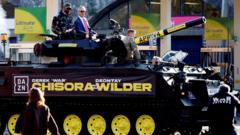
The arrival of Dereck Chisora at the Deontay Wilder vs. Zhilei Zhang weigh-in, flanked by Nigel Farage and transported via an armored personnel carrier, represents a calculated breach of traditional athletic promotion in favor of a hybrid attention-capture model. This maneuver shifts the focus from physical preparation to psychological and political adjacency, utilizing a three-factor framework of high-impact imagery, incongruous demographic overlap, and the deliberate manufacturing of media friction. By analyzing this event through the lens of audience acquisition costs and brand positioning, we can identify how specific personas utilize political polarization as a low-cost distribution channel for sports entertainment.
The Triad of Disruptive Logistics
The selection of an armored vehicle serves as more than a visual gimmick; it functions as a physical anchor for a specific brand of "warrior" narrative that resonates with the heavy-weight boxing demographic. This choice operates on three distinct levels of logistical signaling:
- Industrial Intimidation: The vehicle provides a tangible manifestation of power that bypasses verbal posturing. In a saturated market where verbal insults have reached a point of diminishing marginal returns, the physical presence of military-grade hardware resets the visual baseline for dominance.
- Resource Signaling: The logistical coordination required to deploy such a vehicle in a public urban setting signals a level of backing and organizational capability that suggests a "major player" status, regardless of the athlete’s current ranking or win-loss record.
- Memetic Surface Area: The sheer size and oddity of the vehicle increase the likelihood of organic social media distribution. It creates a "scroll-stop" moment that forces the viewer to process the image for a duration longer than the standard 1.5-second social media impression.
Strategic Demographic Mergers: The Farage-Chisora Paradox
The presence of Nigel Farage introduces a political variable into an ostensibly athletic event. This is not an endorsement of ideology but an exercise in audience hybridization. By aligning with a polarizing political figure, the Chisora brand accesses a demographic that may be indifferent to boxing but is highly engaged with populist rhetoric and "anti-establishment" sentiment.
The Conversion of Political Capital into Pay-Per-View Revenue
Political figures bring a pre-built, highly loyal, and reactionary audience. When Farage appears alongside Chisora, the event is immediately indexed by news outlets that typically ignore sports media. This creates a secondary distribution loop:
- Primary Loop: Sports fans watching for the Wilder-Zhang technical matchup.
- Secondary Loop: Political followers of Farage who engage with the content due to personality loyalty.
- Tertiary Loop: Detractors of Farage who engage with the content through "hate-sharing" or criticism, which paradoxically increases the total reach of the promotional event.
This mechanism relies on the Outrage Coefficient. In the current attention economy, negative engagement (controversy) often yields higher algorithmic weight than positive sentiment. By introducing a figure who triggers immediate emotional responses across the political spectrum, the event ensures it dominates the news cycle through friction rather than consensus.
Measuring the Return on Spectacle
The effectiveness of this arrival strategy must be measured against the cost of traditional advertising. If a standard 30-second commercial during a high-profile broadcast costs hundreds of thousands of dollars, the cost of renting a tank and coordinating a high-profile guest appearance represents a significantly higher return on investment (ROI).
The "Cost per Impression" (CPI) for this stunt is effectively lowered because the media provides free coverage of the spectacle. Each news report, tweet, and YouTube breakdown acts as a force multiplier for the initial investment. This is a shift from Paid Media (commercials) to Earned Media (newsworthiness), a transition that is critical for aging athletes or those whose competitive peak may be behind them but whose brand value remains salvageable.
The Psychological Anchoring of the "Chisora" Brand
Dereck Chisora has transitioned from being a contender to a "heritage brand" within the boxing ecosystem. At this stage of an athletic career, the goal is no longer purely competitive; it is the maintenance of relevance. The Farage/Tank arrival utilizes Psychological Anchoring, where the audience begins to associate the athlete with "unpredictability" and "rebellion" rather than just technical boxing proficiency.
This branding strategy creates a safety net for the athlete’s marketability. If the performance in the ring is subpar, the brand remains intact because the audience is not just buying a fight; they are buying into a persona who disrupts social and media norms. The spectacle becomes the primary product, and the fight becomes the secondary justification for the spectacle.
Operational Risks of Brand Dilution
While effective for short-term visibility, this strategy carries two primary risks:
- Alienation of the Core Fanbase: Hardcore boxing fans who prioritize the "Sweet Science" may view such stunts as a mockery of the sport, leading to a loss of credibility within the niche community that provides the foundation for the athlete's career.
- The Saturation Threshold: Once an athlete uses a tank, the next arrival must be more extreme to achieve the same neurological impact on the audience. This creates an escalation trap where the cost and complexity of stunts must rise exponentially to maintain the same level of attention.
Structural Incentives for Extreme Promotion in Riyadh
The location of the event—Saudi Arabia—provides a specific context for these maneuvers. The Kingdom’s investment in sports is designed to maximize global visibility. Promoters and athletes who provide high-value "moments" are essentially following the incentives set by the organizers. A quiet, professional arrival offers zero "social currency" for the hosting nation’s digital footprint. In contrast, a tank-driven political crossover provides exactly the type of viral, high-definition content that justifies the massive capital expenditures associated with these international events.
The "Wilder vs. Zhang" event is a product in a global marketplace. By injecting a high-variance element like the Chisora/Farage arrival, the organizers ensure that the event’s reach extends beyond the boxing "bubble" and into the broader cultural conversation. This is not accidental theater; it is a sophisticated application of Attention Theory designed to maximize the economic output of a temporary gathering of high-profile assets.
The Mechanism of False Dichotomy in Promotion
Media coverage of this event typically falls into two camps: those who find it entertaining and those who find it distasteful. From a strategy perspective, this is a false dichotomy. Both groups are equally valuable because both groups are generating the metadata required to keep the event trending. The only "loss" in this scenario is silence.
The integration of Farage specifically targets the "anti-woke" or "populist" sentiment that is currently trending across Western digital spaces. By positioning Chisora within this aesthetic, the strategy taps into existing tribal loyalties. The tank is the hardware; the political alignment is the software. Together, they run a program designed to extract maximum engagement from a fragmented audience.
Optimizing the "Pre-Fight" Narrative
The traditional "head-to-head" press conference has lost much of its potency due to over-saturation and scripted hostility. The "Chisora Tank" model offers a blueprint for the future of combat sports marketing:
- Diversification of Influence: Bringing in non-sporting figures to bridge demographic gaps.
- Visual Dominance: Using physical props that demand full-screen attention.
- Controversy as a Utility: Treating outrage as a measurable asset rather than a PR liability.
For a strategy consultant, the takeaway is clear: the fight is no longer the event. The event is a multi-platform content engine where the physical bout is merely the final chapter. The real economic activity happens in the week leading up to the bell, driven by calculated disruptions that force the world to look in a specific direction.
The long-term viability of this approach depends on the athlete's ability to maintain a baseline of competitive competence. If the "show" becomes too detached from the "skill," the brand risks becoming a parody. However, in the high-stakes, high-capital environment of current heavyweight boxing, the risk of being ignored is far greater than the risk of being ridiculed. The tank and the politician are not just a ride and a guest; they are the gears of a machine designed to convert public attention into a tangible, high-value asset.
To sustain this level of market presence, the athlete must now focus on diversifying these high-impact appearances across different cultural friction points. Relying solely on political controversy will eventually lead to audience fatigue. The next logical evolution is the integration of technology-driven stunts or "cross-reality" experiences that blend the physical spectacle of an armored arrival with digital exclusivity, ensuring that the brand remains at the intersection of power and cultural relevance without becoming a one-note caricature.