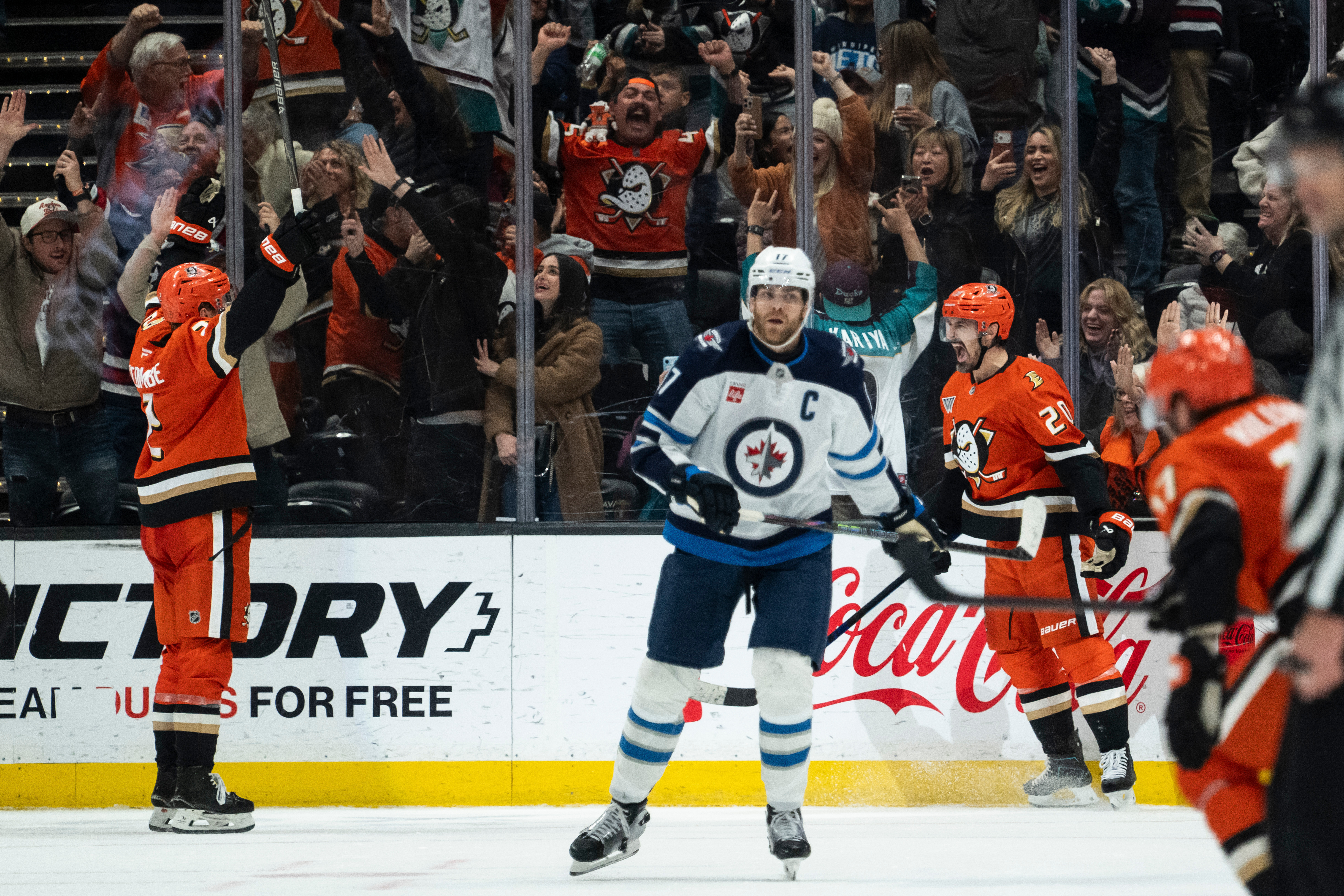
The collapse of a multi-goal lead in the third period is rarely a product of "bad luck" or a single missed assignment; it is a systemic failure of defensive structural integrity and puck management under high-pressure constraints. When the Winnipeg Jets surrendered a two-goal advantage to fall 5-4 in overtime to the Anaheim Ducks, the result was a direct consequence of a shift from proactive neutral-zone disruption to a reactive low-zone collapse. This shift allows an opponent to maximize offensive zone time, effectively increasing the probability of "garbage" goals and high-danger scoring chances through sheer volume. Analyzing this failure requires deconstructing the transition from a structured 1-3-1 neutral zone trap to a disorganized defensive shell, a phenomenon that creates a bottleneck of tired defenders and high-velocity shooting lanes.
The Mathematics of the Two-Goal Lead
In professional hockey, a two-goal lead in the third period is statistically significant, but it introduces a psychological and tactical trap. Coaches often revert to "safe" play, which inadvertently cedes the most valuable commodity in the game: puck possession.
The failure of the Jets can be categorized into three distinct operational breakdowns:
- Passive Forechecking (The Primary Breach): Instead of pressuring the Ducks' breakout, the Jets' forwards retreated into a passive defensive posture. This allowed Anaheim's defensemen to exit their zone with clean possession, eliminating the need for contested dump-ins.
- Neutral Zone Compression: By failing to challenge the blue line, the Jets allowed the Ducks to enter the offensive zone with speed. Speed at the entry point forces defenders to back up, creating a gap between the defense and the forwards. This gap is the "Kill Zone," where late-arriving trailers (like Anaheim's defensemen) can find open space for high-danger shots.
- Cyclical Fatigue and Recovery Time: When a team fails to clear the puck on the first attempt, the defensive unit stays on the ice longer. Every additional 10 seconds of defensive zone time exponentially increases the likelihood of a goal as cognitive function and physical reaction times degrade.
The Anatomy of the Collapse
The Ducks’ comeback was not a series of highlight-reel plays, but rather a methodical exploitation of the Jets' inability to manage the "Slot Margin." The Slot Margin is the difference between shots taken from high-danger areas (the "home plate" area in front of the net) versus shots taken from the perimeter.
In the first two periods, Winnipeg controlled the slot. In the third, the Ducks inverted this. By crowding the crease and utilizing "screen-and-roll" tactics, they obscured the goaltender’s vision. Once a goaltender is "blind" to the point of release, his save percentage drops from a league average of approximately .915 to below .500. This is not a failure of goaltending talent; it is a failure of the defensive "box" to clear the sightline.
Behavioral Economics in Game Management
The Jets' performance in the final ten minutes reflects a classic case of Loss Aversion. In behavioral economics, the pain of losing something one already "possesses" (the lead) is greater than the joy of gaining something (an additional goal). This leads to risk-averse behavior.
- Chip-and-Chase vs. Controlled Entry: The Jets began "chipping" the puck out of the zone instead of making short, high-percentage passes. While this seems "safe," it immediately returns the puck to the opponent.
- The Sunk Cost of the Shell: Once a team enters a "defensive shell," it is incredibly difficult to pivot back to an aggressive offensive stance. The momentum shift is not mystical; it is a physical reality of line changes, heart rates, and defensive positioning.
Defensive Structural Integrity and the Overtime Pivot
The transition to 3-on-3 overtime changes the fundamental physics of the game. It moves from a game of systems and grit to a game of "Controlled Chaos" and gap management.
In the 5-4 overtime loss, the Jets' failure was rooted in a botched 2-on-1 recovery. In 3-on-3 play, the margin for error is non-existent. The defensive player must prioritize the "passing lane" over the "shooting lane" because a cross-crease pass in a 3-on-3 scenario results in a goal 75% of the time, whereas a direct shot from an angle has a much higher probability of being stopped. The Ducks exploited a defender who over-committed to the puck carrier, leaving the back door open for the game-winner.
Quantifying the Failure of the Penalty Kill
A critical component of this collapse was the Jets' inability to kill momentum through disciplined play. When a leading team takes a penalty in the third period, they are not just fighting a man-advantage; they are fighting the "Momentum Coefficient."
The Ducks utilized a 1-3-1 Power Play formation, designed to pull the Jets' diamond-shaped penalty kill out of position. By moving the puck rapidly between the "bummper" (the middle player) and the flanks, Anaheim forced the Jets' defenders to rotate faster than their physical capacity allowed. This created a "seam," a direct line of sight from the shooter to the net, bypassing all four defenders.
Tactical Vulnerabilities in the Winnipeg Roster
The Jets' roster construction relies heavily on top-tier goaltending and a "heavy" game. When the pace of the game increases—as it did during the Ducks' third-period surge—Winnipeg’s larger, slower defenders struggle to maintain "gap control."
Gap control is the distance between a defender and the attacking forward. In the third period, this gap widened from the ideal 1.5 meters to nearly 3 meters. This extra space gave the Ducks' playmakers enough time to scan the ice and execute precise passes.
The Cost of Transition Errors
Every goal scored by Anaheim during the comeback originated from a Winnipeg turnover at either the offensive or defensive blue line. These are "High-Leverage Turnovers."
- Blue Line Turnovers: A turnover at the blue line is catastrophic because the defensive team is usually in "transition mode," meaning their bodies are moving toward the opponent's net. Reversing that momentum to defend a sudden rush takes more time than a stagnant start, giving the attacker a half-second advantage.
- Puck Support Deficiencies: In the final minutes, the Jets' puck carrier often found himself isolated. Without a "safety valve" (a trailing teammate to pass to), the carrier was forced into a low-percentage play, directly leading to the Ducks' transition goals.
Systemic Recommendation for Lead Preservation
To prevent a recurrence of the Anaheim collapse, the Jets must adopt a "Pressure-Neutral" strategy. Rather than retreating into a low-zone shell, the team must maintain a "High F3" (the third forward in the offensive zone). The High F3 stays above the circles, acting as a buffer against counter-attacks while still pressuring the opponent’s breakout.
Furthermore, the coaching staff must implement a "Two-Pass Minimum" rule during lead protection. Instead of blindly clearing the puck, the team must prioritize at least two short-range passes to exit the zone. This forces the opponent to respect the Jets' ability to counter-attack, preventing them from committing all five players to a full-court press.
The strategic play here is a recalibration of the "Risk-Reward Ratio." The current Jets model over-values "safe" clears which, under statistical scrutiny, are the most dangerous plays a team can make while leading. True safety in modern professional hockey is found in possession, not in the desperate abandonment of the puck. If Winnipeg continues to prioritize the "shell" over controlled exits, their expected win probability in late-game scenarios will remain significantly lower than their talent level suggests.
Immediate operational adjustment: Practice 5-on-6 defensive scenarios emphasizing "active sticks" in the passing lanes rather than body-blocking, which has proven ineffective against Anaheim's quick-release shooters. The focus must shift from blocking the shot to preventing the pass that leads to the shot.


