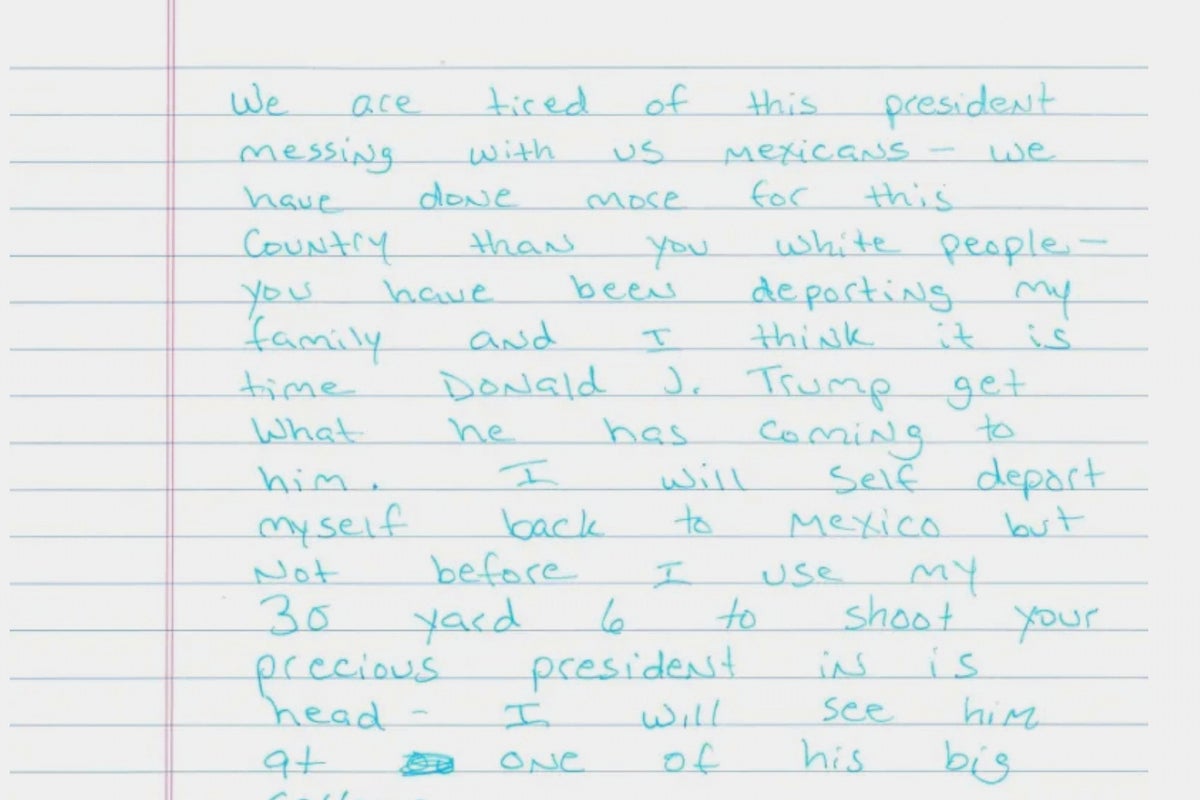
The sentencing of a Wisconsin man to 16.5 years in federal prison for orchestrating a deportation-avoidance scheme involving forged threats against a former president reveals a critical intersection of immigration desperation and the systemic hardening of federal judicial responses. This case is not a mere instance of localized fraud; it represents a calculated attempt to exploit the United States' asylum and protective status frameworks by weaponizing the security apparatus of the Secret Service. The severity of the sentence—nearly two decades—serves as a quantitative benchmark for how the Department of Justice (DOJ) weighs the subversion of federal investigative resources against the underlying intent of the defendant.
The Architecture of the Fraudulent Asylum Claim
To understand the 16.5-year sentence, one must deconstruct the operational logic the defendant, Senad Oseku, applied to his legal status. The scheme functioned through a feedback loop of manufactured crises designed to force a specific bureaucratic outcome: the suspension of deportation.
- The Trigger Phase: Oseku faced imminent removal from the United States. In the logic of a failing legal defense, he identified "victim status" as the only viable lever to remain in the country.
- The Fabrication Phase: He authored and mailed letters containing threats against Donald Trump, effectively framing himself or his family as targets of extremist groups or as individuals with "knowledge" of threats.
- The Intervention Phase: By sending these letters, Oseku forced the Secret Service and the FBI to open investigations. Under federal protocols, a person who is a witness or a victim in an active high-level criminal investigation can often secure a temporary stay of removal (such as a S-Visa or a U-Visa placeholder).
The failure of this strategy lies in the Inversion of Risk. While Oseku calculated that a criminal investigation would delay his departure, he underestimated the forensic capacity of federal handwriting and digital analysis. Once the threats were identified as self-generated, the "benefit" of the delay was instantly replaced by the "liability" of federal felonies.
Quantifying the Judicial Response: The Sentencing Calculus
The 198-month sentence deviates from standard identity theft or mail fraud cases because of the aggravation factors inherent in targeting a protected political figure. Federal sentencing guidelines (U.S.S.G.) utilize a point-based system that scales exponentially based on the nature of the victim and the intent to obstruct justice.
The Multiplier Effect of Political Targets
Threatening a current or former president triggers specific enhancements under §3A1.2 (Official Victim). This is not an emotional protection but a structural one. The court treats threats against high-ranking officials as "attacks on the function of government." When Oseku integrated these threats into a scheme to defraud the immigration system, he crossed from simple fraud into the territory of systemic sabotage.
The Resource Exhaustion Penalty
The DOJ and the presiding judge emphasized the "hundreds of hours" wasted by federal agents. In economic terms, this is a Sunk Cost Recovery Penalty. The court uses the sentence to recoup the perceived loss of national security focus. By diverting the Secret Service from legitimate threats to investigate a fraudulent "deportation shield," Oseku incurred a punitive debt that the court chose to collect in the form of time.
The Structural Flaws in the "Victimhood" Strategy
Oseku’s strategy relied on the assumption that the federal bureaucracy is too fragmented to correlate a threat investigation with a deportation proceeding. This assumption is increasingly obsolete. Post-9/11 information-sharing protocols (specifically the integration between DHS, DOJ, and the Secret Service) ensure that any individual involved in a high-profile threat investigation is immediately vetted against the National Crime Information Center (NCIC) and immigration databases.
- The Credibility Gap: Once a single element of an asylum or stay-of-removal request is proven fraudulent, the "Falsus in Uno, Falsus in Omnibus" (false in one thing, false in everything) principle applies. The court discarded any legitimate claims Oseku might have had regarding his original deportation case.
- The Deterrence Variable: Judges in the Seventh Circuit have increasingly signaled that "creative" immigration fraud will be met with maximum exposure. This is a strategic move to discourage the "asylum-by-litigation" trend, where defendants attempt to clog the court system to prevent physical removal.
Categorizing the Violations: A Hierarchy of Offenses
The case involved a cocktail of charges that, when stacked consecutively or concurrently under the "Grouped Counts" rule, lead to the 16.5-year figure.
- Identity Theft: Using the names and details of others to send the letters.
- Mailing Threatening Communications: A direct violation of 18 U.S.C. § 876.
- Obstruction of Justice: The underlying intent to derail a legal deportation process.
- False Statements to Federal Agents: The iterative lies told during the investigation phase.
The "Obstruction" component is the most significant. In the eyes of the court, the threats weren't the end goal—they were the tool. Using a threat against a former president as a "tool" is viewed by the federal judiciary as an extreme perversion of the legal system, necessitating a sentence that mirrors those given to violent offenders.
The Forensic Reality of Modern Threat Assessment
The technical failure of Oseku’s scheme highlights the sophistication of current federal forensic capabilities. The "anonymity" of a mailed letter is a 20th-century myth.
- DNA and Latent Print Recovery: Advanced vacuum-based collection methods can extract DNA from the adhesive of a stamp or the fibers of the paper even if the sender wore gloves.
- Linguistic Fingerprinting: The FBI’s Behavioral Analysis Unit (BAU) identifies patterns in syntax, spelling errors, and "threat style." Oseku’s letters likely contained specific linguistic markers that matched his previous legal filings or personal correspondence.
- Supply Chain Tracking: The specific paper, ink, and stamps used can often be traced back to point-of-sale locations or specific printer models via "yellow dot" tracking codes embedded in modern laser printers.
Oseku’s inability to account for these forensic realities suggests a "desperation-driven" intelligence gap. He treated a high-stakes federal security environment like a low-stakes administrative hurdle.
The Long-Term Impact on Immigration Policy Defense
This sentencing serves as a case study for defense attorneys and policy analysts. It defines the "Upper Bound" of risk for non-citizens attempting to manipulate the system.
The primary takeaway is the total collapse of the "delay at all costs" tactic. When the cost of the delay (a 16.5-year prison term) exceeds the "benefit" (avoiding a deportation that would have likely resulted in far less restricted movement, even in a home country), the strategy is proven mathematically and practically unsound.
Federal prosecutors are increasingly using these cases to send a message to the broader immigrant community and legal advocates: the threshold for "aggravated identity theft" and "systemic obstruction" will be applied at its most rigid level when political figures are used as props in personal legal battles.
The strategic recommendation for any entity monitoring federal judicial trends is to expect a continued rise in "stacked" sentencing for fraud that intersects with national security or high-profile political targets. The judiciary is no longer treating these as isolated "white-collar" crimes but as foundational threats to the integrity of the federal government’s protective and administrative duties.
The final strategic move for the Department of Justice in this matter is clear: the high-profile nature of the 16.5-year sentence is the "marketing" of the penalty. It is a deliberate effort to alter the risk-reward calculation for any individual currently considering the fabrication of threats to trigger federal protective protocols. The era of the "low-risk fraudulent stay" has ended; the new baseline is nearly two decades of federal incarceration.
To mitigate such risks in the future, the integration of biometric verification at every stage of the asylum and threat-reporting process will likely become the standard, closing the loophole Oseku attempted to exploit.