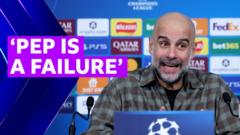
The modern football manager operates at the intersection of extreme performance volatility and constant public auditing. When Pep Guardiola asserts that "everybody wants to fire me," he is not making a literal emotional plea; he is deploying a calculated rhetorical defense designed to shift the burden of proof from his tactical record to the external expectations of the media. This phenomenon reflects a structural tension in elite sports where the shelf life of a manager is increasingly disconnected from long-term strategic output and tethered instead to immediate narrative cycles.
The friction between a manager and the press gallery is rarely about the specific events of a match. It is an ontological conflict regarding the definition of success. To understand why an elite practitioner like Guardiola adopts a defensive posture, one must deconstruct the variables of media scrutiny, the psychology of institutional pressure, and the diminishing marginal utility of transparency in a hyper-competitive environment.
The Asymmetry of Expectation and the Zero-Sum Narrative
The fundamental problem facing top-tier managers is the Law of Diminishing Narrative Returns. For a club like Manchester City, winning is the baseline expectation. This creates a structural imbalance: victories provide zero "narrative alpha," as they are merely the fulfillment of a predicted outcome. Conversely, every draw or loss generates exponential negative data points.
In this environment, the media operates on a Zero-Sum Narrative model. For the press to generate engagement, a story requires a protagonist in crisis. When results dip, journalists naturally gravitate toward "The Sack Race" because it is the most digestible high-stakes plot point for a general audience.
Guardiola’s "everyone wants to fire me" statement serves as a preemptive strike against this model. By vocalizing the perceived desire for his failure, he achieves three tactical objectives:
- The Martyrdom Effect: He aligns himself with his squad, positioning the team as an "us against the world" collective.
- Irony as a Shield: By hyper-extending the logic of his critics to the point of absurdity, he renders their actual criticisms less potent.
- Pressure Redistribution: He forces the interrogators to defend their own objectivity, temporarily halting the momentum of negative questioning.
The Three Pillars of Managerial Job Security
To quantify the risk of a "firing," we must move beyond the headlines and look at the actual levers that dictate a manager's tenure. Job security in elite football is a function of three distinct, yet overlapping, pillars.
1. The Performance Delta
This is the variance between the board’s projected points-per-game (PPG) and the actual PPG. If the Delta is positive, a manager can survive significant media hostility. If the Delta turns negative for more than six weeks, the media narrative begins to influence internal stakeholders (investors, board members, and sponsors). Guardiola's security is historically high because his Performance Delta has remained consistently positive across a decade-long sample size. However, the media operates in the "Now," ignoring historical data to focus on the current micro-cycle of results.
2. The Dressing Room Coefficient
A manager’s authority is directly proportional to the players' belief in the tactical system. When a manager lashes out at the press, it is often a signal to the locker room. By appearing "under fire," the manager tests player loyalty. If the squad responds with increased intensity, the Coefficient rises. If they remain passive, it indicates the "everyone wants to fire me" sentiment has permeated the internal structure.
3. Brand Equity and Commercial Stability
At the highest level, a manager is a corporate asset. Sacking a manager like Guardiola involves astronomical severance costs and, more importantly, the potential devaluation of the club’s global brand. The "Guardiola Brand" is synonymous with dominance and tactical innovation. The board recognizes that the cost of replacement often exceeds the cost of a temporary slump.
The Mechanism of Media Hostility
Journalistic scrutiny functions as a feedback loop. A single loss triggers a "Review Phase," where tactical decisions are picked apart. A second consecutive loss triggers the "Speculation Phase," where potential replacements are named. A third loss enters the "Ultimatum Phase."
Guardiola’s friction with the media usually occurs at the transition between the Review and Speculation phases. His hostility is a deliberate attempt to break the loop. By being difficult, sarcastic, or confrontational, he makes the cost of questioning him higher for the individual journalist. It is a form of "Media Deterrence."
The specific phraseology—"Everybody wants to fire me"—is a pivot. It moves the conversation from "Why did your team lose?" (a question about his competence) to "Why are you so cynical?" (a question about the journalist's intent). This shift is a masterclass in deflection.
The Biological and Psychological Tax of Long-Term Dominance
There is a physical reality to the pressure Guardiola describes. High-performance environments trigger a sustained cortisol response. Over an eight-year tenure at a single club, the cumulative effect of being the "face" of an organization leads to a state of hyper-vigilance.
When a manager feels "everyone" is against them, it is often a projection of this cumulative fatigue. The "us vs. them" mentality is a psychological survival mechanism. It simplifies a complex, multi-faceted job into a binary struggle. This simplification is necessary to maintain the focus required for elite tactical planning.
The Failure of Traditional Sports Journalism
The "fire him" narrative persists because traditional sports journalism lacks the tools to analyze systemic failure. Instead, it relies on individual blame. If a team's Expected Goals (xG) is high but their conversion rate is low, it is often a matter of statistical variance—bad luck. However, "bad luck" does not sell newspapers or generate clicks. "Guardiola under pressure" does.
This creates a permanent disconnect:
- The Manager's Reality: Systems-based, long-term, data-driven.
- The Media's Reality: Narrative-based, short-term, emotion-driven.
Guardiola’s outbursts are the sound of these two tectonic plates grinding against each other. He knows that his job is safe as long as the data (The Performance Delta) remains sound, but he also knows that the noise can eventually distract the players and influence the board.
Strategic Maneuvering in the Late-Cycle Tenure
As a manager enters the "Late-Cycle" of their tenure (typically year 5+), the media's hunger for a fresh narrative becomes insatiable. At this stage, the manager has two options:
- The Arsène Wenger Path: Attempting to remain dignified and professional while the narrative slowly erodes authority over a decade.
- The Jose Mourinho/Pep Guardiola Path: Using confrontation to create a vacuum between the team and the public, effectively burning bridges with the media to reinforce the internal culture.
Guardiola has opted for the latter. His "firing" comments are not a sign of weakness; they are a sign of total control. He is choosing the terms of the conflict. By labeling the media as "the enemy" who wants him gone, he ensures that any player who doesn't give 100% is seen as siding with the media, not just failing the coach.
Operational Conclusion for Executive Stakeholders
For owners and sporting directors, the "Guardiola Out" noise should be treated as a lagging indicator of media boredom rather than a leading indicator of performance decline. The strategic play is to ignore the rhetorical flourishes of the manager during press conferences and focus exclusively on the internal metrics: player physical output, tactical adherence, and the Performance Delta.
The manager’s public defiance is a functional tool of his trade. It protects the players from the blast radius of a loss and maintains the cult of personality required to lead million-dollar assets. To fire a manager based on the "everyone wants to fire me" narrative is to succumb to a feedback loop that the manager himself is intentionally manipulating.
The final strategic move for a club in this position is to issue a private vote of confidence that remains private. Public votes of confidence only validate the media's speculation. Silence from the board, combined with public defiance from the manager, creates the most stable environment for performance recovery. Focus on the internal "Dressing Room Coefficient" and allow the manager to continue his rhetorical war; it is the friction that keeps his competitive edge sharp.