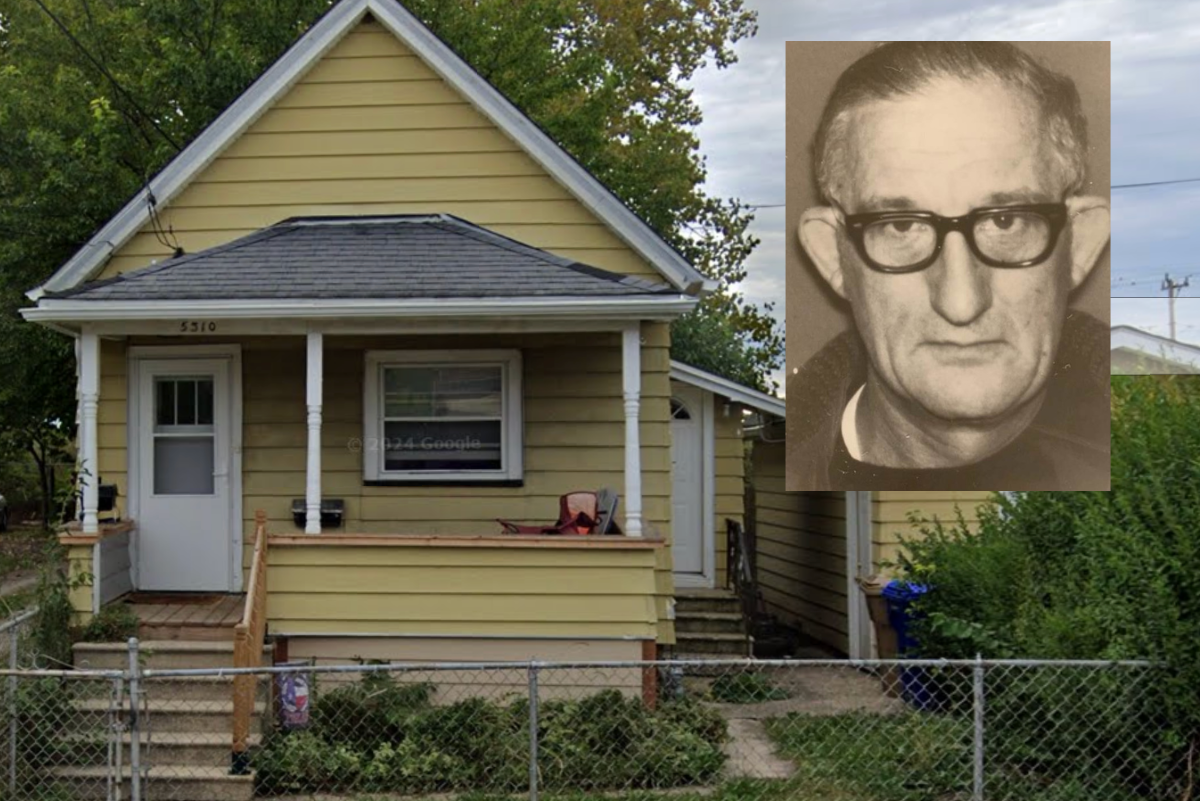
The arrest of a 68-year-old suspect in Minnesota for a 1974 Wisconsin homicide represents more than a localized law enforcement success; it serves as a data point in the total collapse of the "time-decay" strategy previously utilized by violent offenders. Historically, the probability of an arrest for a violent crime decreased exponentially as the interval from the event increased, a phenomenon driven by witness attrition, physical evidence degradation, and the limits of traditional serology. The resolution of the John Sikes murder case, nearly five decades post-incident, demonstrates that technological advancements in genomic sequencing have effectively neutralized the protective effect of time.
This shift is governed by the The Law of Genomic Persistence. Unlike digital footprints or eyewitness testimony, biological material—if stored with even minimal environmental shielding—retains its informational integrity for decades. When this persistence is paired with the logarithmic growth of consumer DNA databases, the result is a permanent, retroactive surveillance state for those whose biological markers were left at a crime scene.
The Triad of Investigative Friction
To understand why this case remained stagnant for 50 years before a rapid resolution, one must categorize the specific points of failure in the original 1970s investigation. Cold cases are rarely the result of lack of effort; they are products of high "investigative friction."
- Informational Isolation: In 1974, law enforcement operated in silos. If a suspect moved across state lines, as occurred in this instance with the transition from Wisconsin to Minnesota, the data linkage between the crime scene and the individual’s new identity was nonexistent.
- Biological Compression: Forensic science in the mid-70s relied on the ABO blood typing system. This provided "exclusionary power" but lacked "identificatory power." At best, investigators could narrow a suspect pool to 10% or 15% of the population, which is insufficient for a conviction in the absence of a confession or a direct witness.
- The Database Gap: Even with the advent of CODIS (Combined DNA Index System) in the 1990s, matches were only possible if the suspect was already in the system for a prior qualifying offense. For "one-off" offenders or those who ceased criminal activity after a single high-impact event, CODIS functioned as an empty library.
Forensic Genetic Genealogy as a Disruptive Framework
The catalyst for the recent arrest was Investigative Genetic Genealogy (IGG). This process bypasses the CODIS bottleneck by leveraging civilian data. The logic of IGG follows a specific mathematical progression that makes anonymity statistically impossible.
The Proximity Coefficient
IGG does not look for a 1:1 match. Instead, it identifies "Shared Centimorgans" ($cM$)—the unit of measurement for genetic linkage. By identifying third or fourth cousins of an unknown suspect in public databases like GEDmatch or FamilyTreeDNA, investigators can construct a "Reverse Tree."
The efficiency of this method is defined by the Network Effect of DNA. Research indicates that in a population where only 2% of the people have uploaded their DNA, over 90% of the population can be identified through at least a third-cousin match. In the Wisconsin case, the suspect’s decades of "clean living" in Minnesota provided no protection because his biological relatives, perhaps seeking a breakdown of their heritage or health risks, inadvertently acted as genetic informants.
The Refinement Protocol
Once a cluster of relatives is identified, the investigation shifts from biological science to traditional documentary analysis.
- Step 1: Common Ancestor Identification: Finding the specific set of great-great-grandparents shared by the DNA matches.
- Step 2: Descendancy Research: Tracking every descendant of that couple forward through time.
- Step 3: Geographic and Demographic Filtering: Eliminating descendants who do not fit the profile (e.g., were the wrong age in 1974, were deceased, or were in a different country).
- Step 4: Direct Comparison: Once the pool is narrowed to a single individual, undercover surveillance is typically used to recover "surreptitious DNA" (a discarded coffee cup or cigarette butt) to confirm the match against the original crime scene evidence.
The Economic and Moral Cost of Cold Case Stagnation
Leaving a homicide "open" creates a compounding social debt. The 1974 beating death of John Sikes represents a failure of the state to fulfill its basic social contract. When a case is cleared after 50 years, we must analyze the Opportunity Cost of Justice Delayed.
The suspect lived nearly two-thirds of a human lifespan with the benefit of liberty, while the victim’s family suffered five decades of informational vacuum. This delay is not merely a temporal inconvenience; it is a systemic failure of the "deterrence" function of the legal system. If an offender believes the "statute of limitations" is effectively dictated by the expiration of physical evidence, the psychological barrier to committing a crime is lowered.
The successful arrest in Wisconsin recalibrates this risk assessment. It signals to both current and past offenders that the "Risk of Discovery" ($\text{RoD}$) no longer trends toward zero over time. Instead, due to the falling costs of genomic sequencing—from $2.7 billion for the first human genome to under $600 today—the $\text{RoD}$ is actually increasing for crimes committed in the past.
The Integrity of Evidence and the Chain of Custody
The primary vulnerability in this new era of prosecution is not the science of DNA, but the Legacy Logistics of the evidence itself. For a 50-year-old case to reach trial, the prosecution must survive a "Chain of Custody Audit."
The biological sample recovered from the 1974 crime scene had to survive five decades of storage. Any lapse in the documented movement of that sample creates "Reasonable Doubt." Defense attorneys in these high-profile IGG cases focus on:
- Degradation Artifacts: Claims that environmental damage to the DNA created a "false positive" or misidentification.
- Cross-Contamination: Arguing that 1974 collection techniques (which predated DNA awareness) allowed DNA from an investigator or a bystander to mingle with the sample.
- Privacy Infringement: Challenging the legality of using a relative’s DNA to find a suspect without that relative's explicit consent for criminal investigation purposes.
The Wisconsin arrest suggests that the original investigators maintained a sufficiently rigorous evidence locker to satisfy modern legal standards. This highlights an often-overlooked variable: the competence of the 1974 "beat cops" is as vital to a 2026 conviction as the sophisticated algorithms used by the genealogists.
Structural Implications for Law Enforcement Strategy
Agencies must now treat "Evidence Preservation" as a high-yield investment. The John Sikes case proves that evidence deemed "unsolvable" today may be trivial to solve in a decade. Consequently, the strategic prioritization of cold case units should shift from "Active Re-investigation" to "Biological Asset Management."
The bottleneck is no longer the ability to find the suspect, but the funding required to perform the high-grade SNP (Single Nucleotide Polymorphism) testing required for IGG. Standard law enforcement labs are often unequipped for this, requiring the outsourcing of samples to private firms. This creates a "Pay-for-Justice" tier system where wealthier jurisdictions can clear their backlogs while underfunded rural counties remain stagnant.
To optimize the clearing of the estimated 250,000 unsolved homicides in the United States, a centralized, federalized "Genomic Clearinghouse" is the only logical path forward. This would move the process from a boutique, case-by-case effort to an industrial-scale operation.
The Wisconsin arrest is a definitive warning. For the 68-year-old suspect, the decades spent in Minnesota were not a period of safety, but a period of "borrowed time." The biological record left in 1974 functioned as a silent witness that simply waited for the math to catch up.
Municipalities should immediately audit their cold case inventories to prioritize cases with viable biological samples, as the window for arresting living suspects is closing due to the natural aging of the offender population. The objective is no longer to find a needle in a haystack; it is to use a magnet to pull the needle out. The magnet is now fully functional.