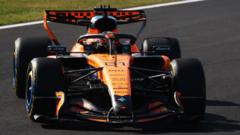
George Russell didn't expect to see the papaya cars that far ahead. After the opening practice sessions at the Japanese Grand Prix, the Mercedes driver admitted that McLaren’s raw speed looked "exceptionally" strong. It’s a wake-up call for the Brackley squad. While Red Bull usually occupies the thoughts of every driver on the grid, it’s the Woking-based team that’s currently stealing the spotlight as the primary threat behind Max Verstappen.
If you watched the Friday sessions at Suzuka, you saw a familiar story with a slight twist. Max was fast. Nothing new there. But the gap between the rest of the field and McLaren was enough to make Russell do a double-take at the timing screens. Mercedes brought updates. They had a plan. Yet, they ended up chasing shadows in the high-speed sectors where the MCL38 seems to thrive.
The High Speed Dominance of the MCL38
Suzuka is a driver's track. It's brutal. It rewards aerodynamic efficiency and high-speed stability more than almost any other circuit on the calendar. This is exactly where McLaren has found its sweet spot. Russell pointed out that the McLaren drivers were "mighty" through the first sector. That’s the "S" Curves—a sequence that requires a car to change direction like a fighter jet without losing its balance.
Mercedes struggled here. The W15 has been a bit of a Jekyll and Hyde car lately. One lap it feels planted; the next, the rear end wants to overtake the front. When you're looking at the telemetry, the difference isn't just about engine power. It’s about confidence in the high-speed turns. Lando Norris and Oscar Piastri looked like they were on rails. Russell and Lewis Hamilton, meanwhile, looked like they were wrestling a bear in some of those transitions.
The data suggests McLaren has managed to solve the "drag vs. downforce" riddle better than Mercedes for this specific type of track. Russell noted that while Mercedes felt "okay," okay doesn't win trophies in F1. You need to be "on it" every single millisecond at Suzuka.
Why Mercedes Updates Aren't Clicking Yet
Mercedes didn't show up empty-handed. They've been working on the floor and the wing edges to try and find that elusive "consistent" downforce. But Russell’s comments suggest the team is still searching for the right setup window. It’s frustrating. You spend millions on R&D, you bring the parts to the track, and then a rival team—one that was struggling at the back of the grid eighteen months ago—blows past you.
The problem seems to be thermal management and "bouncing." Even if the porpoising of 2022 is gone, the current cars are still sensitive to ride height. If Mercedes runs the car too low to get the downforce, they hit the bumps and lose grip. If they raise it, they lose the aero. McLaren seems to have found a wider "operating window." They can run the car aggressively without it snapping on the driver.
The Gap in Sector One
The time lost in the first sector is what really bothered Russell. You can’t make up that kind of time in the hairpin or the chicane. If you lose two-tenths in the S-Curves, your tires are already screaming by the time you get to Degner. It’s a snowball effect. Russell mentioned that they need to "dig deep" into the data overnight. That’s F1 speak for "we’re confused and need the simulators in Brackley to run 24/7."
Tire Degradation and Race Trim Realities
Friday practice isn't just about the fastest lap. It’s about how the tires hold up over twenty laps. Here’s the kicker. McLaren’s long-run pace looked just as scary as their qualifying simulations. Russell acknowledged that the McLarens were "very impressive" on the C3 compound.
In Japan, the asphalt is abrasive. It eats tires for breakfast. If your car is sliding even a little bit, your surface temperatures skyrocket. Because the McLaren is so stable in the high-speed corners, the tires don't scrub as much. They stay in the "Goldilocks" zone. Mercedes, on the other hand, was seeing more "thermal degradation." Basically, the tires were cooking themselves from the inside out.
What Russell Needs for Saturday
To even stand a chance at out-qualifying a McLaren, Russell needs a car that doesn't "roll" as much on entry. He’s been vocal about wanting a more "pointed" front end. If the engineers can tweak the mechanical balance to give him that bite without making the rear end nervous, he might bridge the gap. But it’s a tall order. Ferrari is also in the mix, making the battle for the "best of the rest" behind Red Bull a three-way scrap.
The Psychological Shift in the Paddock
There’s a shift happening. For years, the pecking order was Mercedes, then everyone else. Now, Russell is openly admitting that they're looking at McLaren's data to see what they're doing right. That’s a massive ego hit for a works team. McLaren is a customer team using Mercedes engines. Being beaten by your own engine in a chassis you designed is the ultimate "it's not the power, it's the aero" statement.
Russell is a realist. He doesn't sugarcoat things. When he says he's surprised, he means the gap was larger than their internal simulations predicted. Mercedes thought they'd be neck-and-neck with McLaren at Suzuka. Instead, they're looking at a gap that might require a "perfect lap" just to get on the second row.
What This Means for the Rest of the Season
If McLaren can maintain this edge at a track as demanding as Suzuka, it doesn't bode well for Mercedes at places like Silverstone or Spa. These "temples of speed" are where the MCL38 shines. Russell and Hamilton are basically in damage control mode. They're trying to extract every tenth, but you can't drive around a fundamental aero deficit.
The focus now shifts to "optimization." It’s a boring word, but it’s the only tool Mercedes has left this weekend. They won't find a magic aerodynamic part in the garage overnight. They have to play with dampers, toe-in, and wing levels. They might even consider a lower downforce setup to try and pass on the straights, even if it hurts them in the corners. It's a gamble.
George Russell knows the score. He’s gone from fighting for wins to fighting to be the fastest Mercedes-powered car on the grid. That’s a tough pill to swallow, but his honesty about McLaren’s pace shows he knows exactly where the bar is set.
Keep an eye on the tire pressures and track temperatures during the final practice. If the track gets hotter, Mercedes might suffer more. If it stays cool, they might find a bit more "stick." Either way, the papaya cars have a target on their backs, and right now, Russell’s aim is a little off.
Check the live timing during the next session. Pay attention specifically to the "Minimum Corner Speed" in Turn 7. If Russell can't get that within 3-4 km/h of Norris, Mercedes is looking at a long Sunday afternoon staring at a McLaren rear wing.