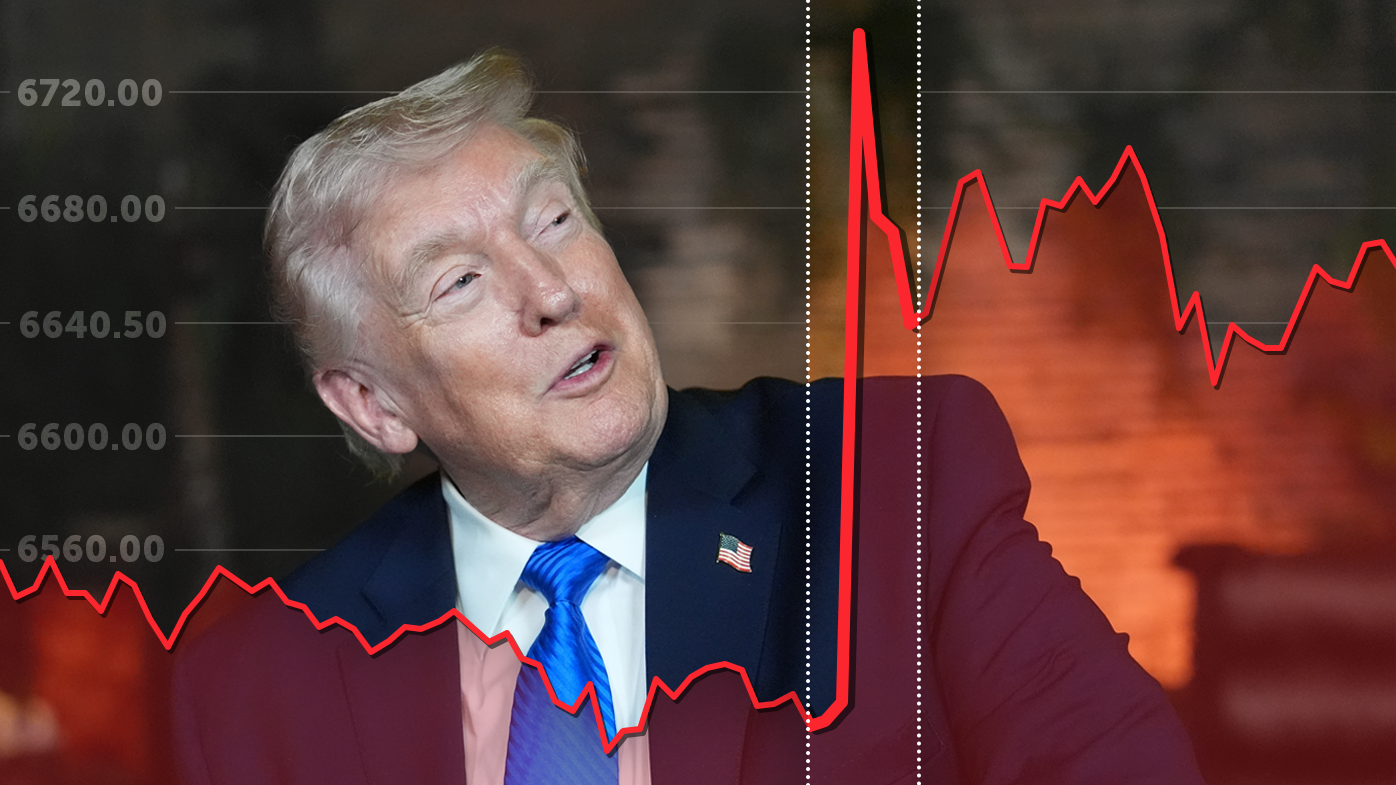
The execution of $800 million in crude oil futures contracts moments before a major geopolitical announcement is not an anomaly of "luck"; it is a case study in the mechanics of information leakage and the structural advantages of high-frequency positioning. When a massive capital shift occurs in the seconds preceding a market-moving statement by a U.S. President, the event provides a clinical look at how institutional actors capitalize on the delta between private information and public price discovery.
The Mechanics of Pre-Announcement Position Loading
To understand the scale of an $800 million trade in the West Texas Intermediate (WTI) or Brent markets, one must look at the liquidity environment of the futures exchange. In a standard trading window, a sudden influx of $800 million—equivalent to thousands of lots—would typically trigger "slippage," where the large order size itself moves the price unfavorably for the buyer.
The fact that these trades were executed successfully suggests a specific execution strategy designed to absorb available liquidity without alerting the broader market until the position was locked. This requires:
- Algorithmic Fragmentation: Breaking the $800 million total into "child orders" across multiple exchanges (CME, ICE) to avoid hitting "iceberg" order detection.
- Information Lead Time: A minimum of 5 to 10 minutes of lead time is necessary to deploy this much capital without causing a premature price spike that would ruin the entry point.
- Directional Conviction: The trade was not a hedge; it was a directional bet on the volatility or the specific outcome of the Trump announcement regarding energy policy or sanctions.
The Three Pillars of Information Asymmetry
Market efficiency assumes that all participants have equal access to data. This event proves the persistence of a three-tiered hierarchy of information that dictates modern commodities trading.
- Tier 1: Sovereign and Executive Data: Information held by government officials, speechwriters, and policy advisors. In the context of a presidential announcement, this is the "zero-point" of the information wave.
- Tier 2: The Proximity Layer: Highly connected institutional desks or "super-users" who receive early drafts, briefing notes, or signals from policy insiders. This is where the $800 million likely originated.
- Tier 3: The Public Feed: The retail and standard institutional market that reacts to the televised broadcast or the official White House Twitter/X notification.
The "alpha" (excess return) generated in this $800 million trade is found in the time gap between Tier 1 and Tier 3. If an announcement is expected to drive oil prices up by 2%, a trader entering at the Tier 2 stage captures the full move, while a Tier 3 trader often enters at the peak of the spike, essentially providing the liquidity for the Tier 2 trader to exit.
The Cost Function of Front-Running Geopolitics
While the media focuses on the "scandal" of potential insider trading, a structural analyst focuses on the risk-reward ratio. Entering a massive position before a televised address carries a high "binary risk."
- The Error Margin: If the President had changed the tone of the speech or delayed the announcement, the $800 million position would have been exposed to massive "mean reversion" risk.
- The Liquidity Trap: Selling $800 million worth of oil contracts is harder than buying them. If the market move was smaller than anticipated, the trader would face a "liquidity hole," where they cannot exit the position without driving the price back down against themselves.
This suggests the actors involved had a high degree of certainty not just in the timing of the announcement, but in the exact verbiage used. In commodities, specific words like "sanctions," "waivers," or "strategic reserve" have quantified dollar values.
Structural Failures in Market Surveillance
The Commodity Futures Trading Commission (CFTC) and exchange-level compliance systems are designed to flag "spoofing" (fake orders) and "wash trading" (trading with oneself). However, they are historically poorly equipped to handle "information-based positioning."
The difficulty lies in the "Noise-to-Signal" ratio. On a day with a scheduled presidential announcement, total market volume is already elevated. An $800 million move, while massive, can be disguised as "pre-event hedging" by global airlines or national oil companies.
The regulatory bottleneck occurs because:
- Futures markets are global. The trade could originate from a Singapore-based desk using a Cayman-domiciled fund, making the "know your customer" (KYC) trail cold for U.S. regulators.
- The legal definition of "insider trading" in commodities is narrower than in equities. In stocks, you cannot trade on non-public information about a company. In oil, trading on non-public information about government policy occupies a gray legal area that aggressive funds exploit.
Quantifying the Impact on the Retail Participant
When $800 million enters the market minutes before the public is informed, the "price discovery" process is corrupted. The price the public sees when the news breaks is already "stale"—it has already been adjusted by the hidden $800 million move.
This creates a "Predatory Spread." Retail traders see the news, attempt to buy, and find that the price has already jumped. They are effectively buying the contracts that the $800 million "insider" is now selling to realize their profit. This transfer of wealth from the uninformed to the informed is the fundamental tax of information asymmetry.
Strategic Requirement for Market Participation
The existence of these trades confirms that "trading the news" is a losing strategy for any participant without low-latency execution and direct-access feeds. To survive an environment where $800 million can be moved on a whisper, market participants must shift from reactive strategies to structural ones.
- Volatility Neutrality: Utilizing "straddles" or "strangles" in the options market to profit from the movement rather than the direction. This mitigates the risk of being on the wrong side of an insider move.
- Order Flow Analysis: Monitoring "Large Open Interest" (LOI) changes in the 30 minutes preceding scheduled government events. Unusual spikes in volume without price movement often signal "accumulation" by Tier 2 players.
- Latency Minimization: Recognizing that the "public" news arrives 500 milliseconds to 2 seconds later on web platforms than on professional terminals like Bloomberg or Refinitiv. In an $800 million event, 2 seconds is the difference between profit and total liquidation.
The incident underscores a permanent shift in the geopolitical-economic interface. Information is no longer a shared resource; it is a high-speed commodity that is harvested and sold before the general public is even aware a harvest is taking place. The only defense for the modern investor is to assume the market is always "pre-loaded" and to price that hidden risk into every entry.
The next strategic play is not to chase the "insider" trade, but to build a diagnostic tool that monitors the "Time-Weighted Average Price" (TWAP) deviations in the 15-minute window before all scheduled Executive Branch briefings. When the TWAP deviates by more than 1.5 standard deviations on high volume, the trade is already over, and the only remaining move is to wait for the inevitable post-announcement "volatility crush" to enter a mean-reversion position.