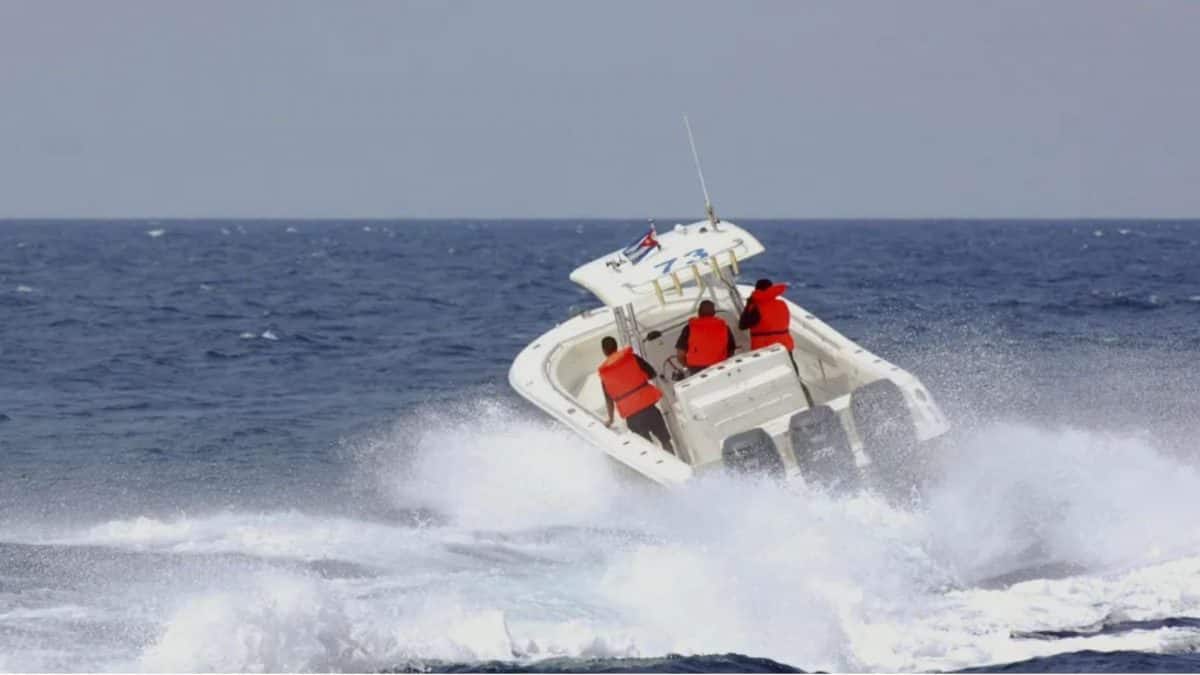
The seizure of a high-speed vessel carrying Cuban nationals, tactical weaponry, and explosive materials near the island’s northern coast represents more than a localized security breach. It serves as a case study in the logistical requirements of asymmetric maritime infiltration. Understanding this event requires a decomposition of the operation into three distinct variables: tactical transit capability, the kinetic payload profile, and the geopolitical friction points generated by non-state actor movement across territorial waters.
The Logistics of High-Speed Maritime Infiltration
The choice of a speedboat as the delivery mechanism is a calculated trade-off between stealth and velocity. In the context of the Florida Straits—a 90-mile corridor characterized by heavy commercial traffic and intense radar surveillance—the operational success of an unauthorized entry depends on "clutter management." Small, fiberglass-hulled vessels possess a low Radar Cross-Section (RCS). When combined with high-output outboard engines, these craft can execute a "sprint-and-drift" profile that evades standard coast guard patrol patterns.
The physics of this transit dictate the mission’s constraints. To maintain a speed of 40–50 knots while heavily laden with fuel, personnel, and ordnance, the vessel must sacrifice structural protection (armor) and electronic countermeasure suites. This creates a binary outcome: the mission either remains undetected or it faces total failure upon interception. There is no middle ground for sustained engagement with state-level naval assets.
Deconstructing the Kinetic Payload
The Cuban Ministry of the Interior’s report of "arms and explosives" points to a mission profile designed for sabotage or targeted disruption rather than territorial occupation. Analyzing the utility of such a payload requires a look at the Functional Utility of Tactical Infiltration:
- Explosive Yield vs. Psychological Impact: In high-tension political environments, the detonation of low-grade explosives at critical infrastructure points (power grids, communication hubs, or government offices) acts as a force multiplier. The goal is rarely the total destruction of the asset but the demonstration of the state's inability to secure its perimeter.
- Small Arms Saturation: The presence of rifles and sidearms suggests a requirement for "exfiltration security" or the intent to arm internal clandestine cells. This implies a pre-existing logistical chain within the target territory.
- The Personnel Variable: Infiltrators are typically divided into "operators" and "facilitators." Operators manage the kinetic aspects, while facilitators—often nationals with local knowledge—are essential for navigating the social and physical geography of the landing zone.
The Internal-External Feedback Loop
State security apparatuses use these incidents to validate internal restrictive measures. When a government identifies an external threat involving "terrorist" infiltration, it triggers an immediate shift in the domestic security posture. This creates a feedback loop where the threat of infiltration justifies the expansion of surveillance, which in turn necessitates more sophisticated—and riskier—infiltration methods from opposition groups.
This specific incident occurs against a backdrop of severe economic volatility in Cuba. From a structural perspective, when a state’s "Social Contract" weakens due to resource scarcity, the utility of a "Foreign Threat" narrative increases. It provides a unifying focal point for the population and a justification for the suppression of internal dissent under the guise of national defense.
Jurisdictional Friction and the Florida Straits
The transit from the United States to Cuba involves navigating three distinct legal zones: U.S. Territorial Waters, International Waters, and Cuban Territorial Waters. The ambiguity of "Stateless Vessels" or vessels carrying mixed-nationality crews creates a jurisdictional bottleneck.
Under the 1982 United Nations Convention on the Law of the Sea (UNCLOS), the "Right of Visit" allows warships to board vessels on the high seas if there are reasonable grounds for suspecting piracy or unauthorized broadcasting. However, the movement of armed nationals intending to commit acts of sabotage falls into a grey area of "Aggressive Intent" that often precedes a formal state of conflict.
The U.S. Coast Guard and the Cuban Border Guard (Tropas Guardafronteras) maintain a functional, albeit strained, communication channel to manage migration flows. When "terrorist" labels are applied to intercepted parties, this channel collapses. The political cost of cooperation becomes higher than the security cost of unilateral action.
The Intelligence Gap in Non-State Actor Analysis
A critical failure in analyzing these maritime incursions is the tendency to view them as isolated tactical events. In reality, they are the terminal phase of a much longer procurement and planning cycle.
- Procurement: Acquisition of high-speed craft in the private market without triggering financial red flags.
- Staging: Loading and fueling in "soft" marinas where security is secondary to commercial throughput.
- Intelligence: Identifying gaps in the target state’s coastal radar and patrol schedules.
The fact that the Cuban authorities were able to intercept this specific vessel suggests a breakdown in the operational security (OPSEC) of the planning cell or a successful penetration of the cell by state intelligence assets. In asymmetric warfare, the information domain is more decisive than the kinetic one. The intercept was likely decided days before the boat ever left the dock.
Strategic Implications of Persistent Infiltration Threats
The persistence of these missions indicates that the perceived "Return on Investment" (ROI) for the sponsoring groups remains high. Despite the risk of capture or death, the potential to trigger a disproportionate state response—leading to international condemnation or internal unrest—remains a viable strategy for disenfranchised actors.
For the Cuban state, the challenge is maintaining a defense posture that is robust enough to deter these incursions without being so restrictive that it further collapses the domestic economy through the total militarization of ports and coastal zones.
The strategic play for any state facing such threats is to move from a "Reactive Interdiction" model to a "Network Disruption" model. This involves targeting the financial and logistical nodes in the country of origin rather than attempting to catch every 30-foot boat in 40,000 square miles of ocean. Success is measured not by the number of intercepted speedboats, but by the increasing cost and complexity forced upon the infiltrating parties until the mission becomes logistically unsustainable.
The most effective counter-infiltration strategy involves the integration of satellite-based synthetic aperture radar (SAR) with localized human intelligence. By correlating heat signatures and wake patterns of high-speed vessels with known "safe house" locations on the coast, a state can transition from blind patrolling to "Pre-Emptive Intercept." For the entities organizing these missions, the next logical step is the adoption of semi-submersible technology, which further reduces the probability of visual and radar detection, shifting the conflict from the surface to the sub-surface domain.