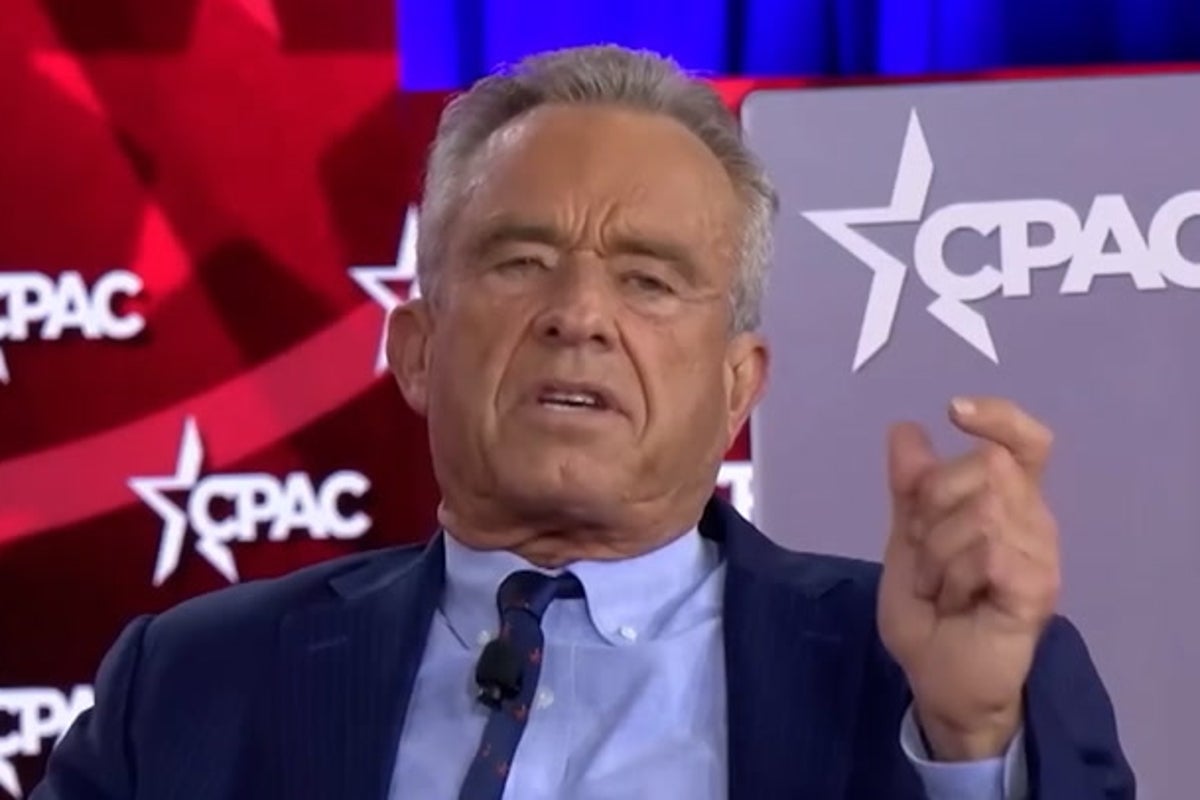
Robert F. Kennedy Jr. recently ignited a firestorm of skepticism and intrigue by claiming Donald Trump possesses the uncanny ability to draw a detailed, accurate map of the Middle East from memory. According to Kennedy, Trump isn’t just familiar with the region; he understands the intricate, jagged borders of every nation, the flow of its rivers, and the strategic positioning of its capital cities. This assertion attempts to paint the former president as a closeted geopolitical savant, a man whose public persona of "America First" isolationism masks a deep, granular obsession with the world’s most volatile geography. Whether the claim holds water or serves as a calculated piece of political theater, it forces a look at how visual intelligence and personal narrative are being used to redefine leadership credentials in a high-stakes election cycle.
The Middle East is a cartographer’s nightmare. It is a region defined by colonial lines drawn in the sand after World War I, borders that often ignore ethnic and religious realities, and territories that remain in a constant state of flux. To draw it from memory requires more than just a passing interest. It requires an intimate familiarity with the Sykes-Picot Agreement’s legacy and the modern shifts in power dynamics from the Levant to the Persian Gulf. Kennedy’s anecdote isn't just about a map. It is about authority. Discover more on a related subject: this related article.
The Psychology of the Mental Map
When a politician claims another leader can draw a map by hand, they are invoking a very specific type of intellectual dominance. Visual memory is often equated with mastery. If you can see the world in your mind's eye, the logic goes, you can manipulate it to your advantage.
In the world of intelligence and high-level diplomacy, "map exercises" are common. Briefers use them to test the spatial awareness of commanders. However, the transition from viewing a map to reproducing one involves a different cognitive process. It requires a grasp of scale, proximity, and the relational importance of neighbors. For Trump, a man who spent decades in real estate—a business entirely dependent on site plans, zoning, and geography—the idea of spatial memory isn't entirely far-fetched. Yet, the leap from a Manhattan city block to the border between Iraq and Iran is massive. Additional reporting by Al Jazeera explores related perspectives on the subject.
Kennedy’s narrative suggests that during their private meetings, Trump used this skill to demonstrate why certain military involvements were failures. The map becomes a prop in a larger argument for a specific kind of realism. By showing where the mountains are, or where a particular ethnic group is concentrated across a border, a leader can argue that a policy is doomed by the sheer facts of the earth itself.
Political Theatre or Hidden Depth
We have to ask why Kennedy is sharing this now. By validating Trump’s intellect in such a specific, almost academic way, Kennedy is attempting to bridge the gap between Trump’s base and the more skeptical independent voters who view the former president as impulsive or uninformed.
This isn't the first time a leader’s "hidden" skills have been used to soften their image. Historically, we’ve seen stories of presidents who were secret poets, master carpenters, or, in the case of Eisenhower, talented painters. But those were hobbies. Kennedy is describing a professional tool. He is framing Trump as a man who doesn't need a teleprompter or a briefing book because the world is already etched into his mind.
Critics, however, point to the "Sharpiegate" incident of 2019. During Hurricane Dorian, Trump famously displayed a weather map that had been altered with a black marker to include Alabama in the storm's path. To his detractors, this showed a man who doesn't respect the map, but rather tries to bend the map to his will. The contrast between that moment and Kennedy’s "perfect map" story creates a jarring disconnect that the American public is forced to navigate.
The Strategy of the Border
The Middle East is not just a collection of countries; it is a series of bottlenecks and chokepoints. The Strait of Hormuz, the Suez Canal, and the Bab el-Mandeb are the veins of global trade.
The Levant and the Mediterranean
Understanding the Levant requires a deep dive into the proximity of Lebanon to Israel and the Syrian corridor. A "perfect" map would have to account for the Golan Heights and the shifting lines of control in Northern Syria. If Trump truly has this committed to memory, it suggests a level of focus on the 2017–2021 regional shifts that many analysts previously underestimated.
The Gulf and the Iranian Border
To the east, the map becomes about energy and influence. The jagged line separating Iraq and Iran was the site of one of the 20th century's bloodiest wars. Mapping this area correctly means understanding the Shatt al-Arab waterway and the oil-rich Khuzestan province.
Kennedy’s claim implies that Trump’s decision-making—specifically the Abraham Accords—wasn't just a series of transactional deals handled by subordinates. It suggests the principal was the one driving the geography of the peace. By bringing Israel, the UAE, and Bahrain together, the administration essentially redrew the political map of the region without changing a single physical border.
The Investigative Skepticism
As journalists, we must look at the source and the setting. Kennedy is currently in a position where his endorsement and his alignment with the Trump campaign are his primary currency. Elevating Trump’s stature is in his best interest.
Does a "perfect map" actually exist in the mind of a billionaire? Probably not in the way a professional cartographer would define it. But the "perfect map" is a metaphor. It represents a claim to clarity in a world that is increasingly chaotic. It tells the voter: "This man knows where the bodies are buried and where the borders should be."
There is a long history of leaders using maps to project power. From the colonial empires of Europe to the Cold War war rooms, the map is the ultimate symbol of control. When Kennedy says Trump can draw it from memory, he is saying Trump is ready to take control of a region that has humiliated almost every American president for the last fifty years.
The Real World Implications of Spatial Literacy
If we take the claim at face value, it changes the conversation about how we vet leaders. Should we expect our presidents to be able to identify every nation on a blank map? In an era of GPS and instant digital access, the "mental map" feels like a throwback to a 19th-century style of statesmanship.
However, there is a practical benefit. A leader who understands geography understands why a landlocked country behaves differently than a maritime power. They understand why a neighbor’s civil war is an existential threat. They understand that you cannot simply "exit" a region without leaving a vacuum that will be filled by the nearest hungry power.
Trump’s foreign policy was often criticized for being erratic. Yet, if he truly possesses a mental blueprint of the Middle East, it suggests a method to what many saw as madness. It suggests that his moves—withdrawing from the Iran nuclear deal, moving the embassy to Jerusalem, or drawing down troops in Syria—were based on a personal internal logic derived from his view of the landscape.
The Cartography of Power
The danger of the "perfect map" is the same danger found in any simplified view of the world. A map shows you where things are, but it doesn't always show you how people feel. It doesn't show the religious fervor, the historical grievances, or the economic desperation that actually drives the Middle East. You can draw the borders of Iraq perfectly, but if you don't understand the tension between Baghdad and Erbil, the map is just a drawing.
Kennedy’s anecdote serves its purpose regardless of its literal truth. It has created a new talking point that counters the narrative of a leader who doesn't read his daily briefs. It positions Trump as a man of hidden depths and intense, private study.
In the coming months, we will likely see more of these stories. As the campaign intensifies, the battle won't just be over policies or personality, but over the fundamental competence of the candidates. The ability to draw a map is a tangible, testable claim. It is a challenge to the "expert" class that has long dismissed Trump’s intellectual curiosity.
Whether he can actually draw the map is almost beside the point. The story has been told, the image has been planted, and the map has been drawn in the minds of the electorate. In politics, the perception of mastery is often just as powerful as the mastery itself.
The map is the territory, until the territory decides to fight back. For any leader looking to navigate the Middle East, the hardest part isn't knowing where the lines are drawn; it's knowing what to do when someone tries to move them.
Look at the history of the region. Look at the failed interventions. The map hasn't changed much in a century, but the blood spilled over those lines has never stopped flowing. Any leader who thinks they have a "perfect" grasp of that reality is either a genius or dangerously overconfident. There is no middle ground when you are drawing with a permanent marker.