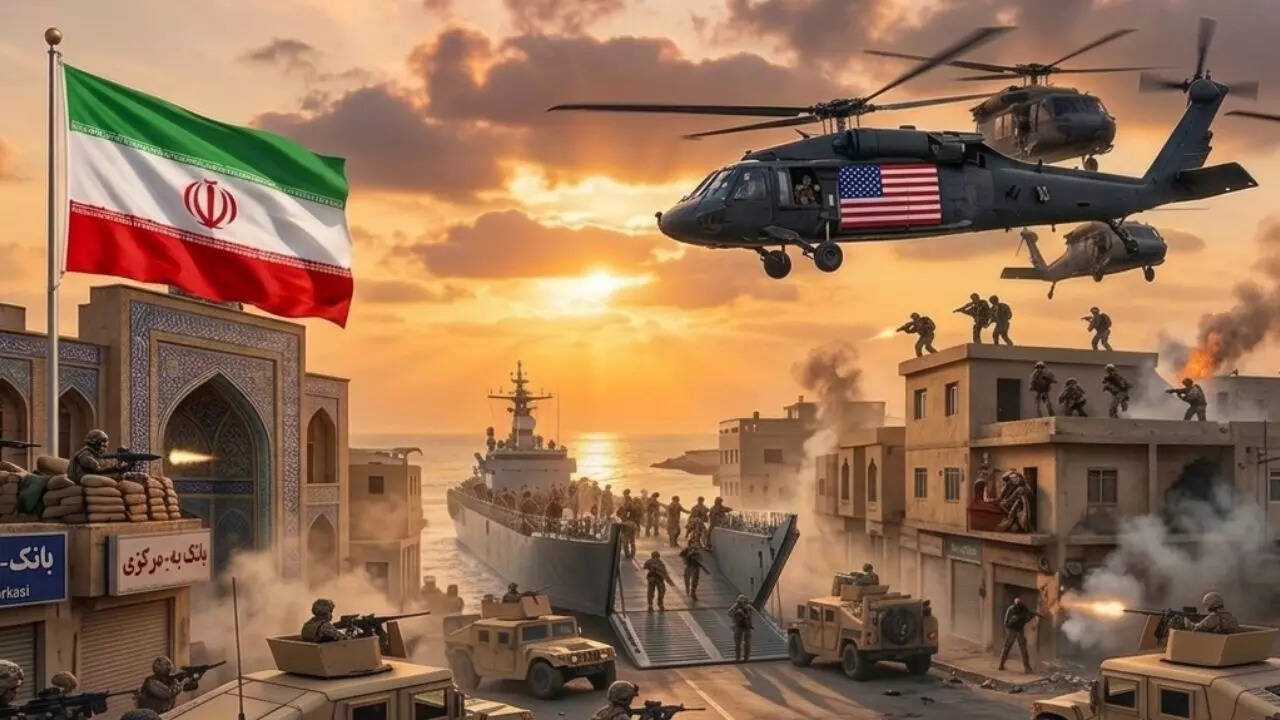
The air inside the Pentagon’s innermost rings doesn't circulate like the air in your living room. It feels heavy, processed, and perpetually chilled to protect the humming servers that calculate the cost of human life in real-time. On a Tuesday morning, a low-level analyst stares at a screen where a digital cursor blinks over a coastline he has never visited. The Persian Gulf.
The report on his desk isn't a declaration of war. Not yet. It is a logistics manual, a dry accounting of boots, fuel, and the terrifying physics of moving half a million young men and women across an ocean. But when the Pentagon starts talking about "boots on the ground," the world stops being a series of geopolitical chess moves and starts being about a kid from Ohio named Elias who is currently cleaning a rifle he hopes he never has to fire.
The Ghost of 2003
History doesn't repeat, but it certainly echoes with a haunting persistence. To understand why a potential invasion of Iran is the most whispered-about nightmare in Washington, you have to look back at the scars of the early 2000s. We were told that technology would make war clean. We were promised "surgical strikes" and "regime change" that would be over by Christmas.
It wasn't.
Instead, a generation of soldiers learned the specific, metallic smell of an IED explosion. They learned that holding territory is infinitely harder than taking it. Now, as reports surface of updated contingency plans for Iran, that same institutional memory is screaming. Iran is not Iraq. It is a fortress of geography. Imagine a country roughly the size of Alaska, but instead of tundra, it is a jagged maze of the Zagros Mountains—peaks that rise 14,000 feet into the clouds, creating a natural wall that makes traditional tank warfare nearly impossible.
When the Pentagon updates its "deployment of US troops" files, they aren't just looking at troop numbers. They are looking at the sheer impossibility of the terrain. To put Americans on the ground there is to commit to a vertical war, a struggle where every valley is a choke point and every mountain pass is a potential trap. It is a logistical Sisyphean task.
The Logistics of a Nightmare
War is often discussed in the abstract terms of "strategy" and "objectives," but for the people who actually have to execute it, war is about calories and diesel.
Consider a hypothetical sergeant named Miller. If the order comes, Miller isn't thinking about the Strait of Hormuz or global oil prices. He is thinking about whether his unit has enough clean water to survive 110-degree heat. He is thinking about the fact that Iran’s coastline is lined with hundreds of "swarm" boats—fast, nimble vessels designed to overwhelm a massive, slow-moving Navy carrier.
The current reports suggest that the U.S. is dusting off plans that involve massive troop surges. But where do they go? To land a force large enough to be effective, you need a port. To get to that port, you have to pass through the Strait of Hormuz, a waterway so narrow that it can be closed by a few well-placed underwater mines or a volley of shore-to-ship missiles.
It is a claustrophobic reality.
The "invisible stakes" here aren't just about who sits in a palace in Tehran. They are about the global economy’s jugular vein. If a ground invasion begins, the price of the gasoline you put in your car to drive to work doesn't just go up; it skywrites a message of global instability. We are talking about a scenario where the world’s energy supply is effectively held hostage by the physics of a narrow channel of water.
The Silicon Shield
One thing the dry reports often skip over is how much the nature of "the ground" has changed since the last time the U.S. fought a major land war. In 2026, the ground is no longer just dirt and asphalt. It is data.
Iran has spent the last decade perfecting the art of asymmetrical warfare. They know they cannot win a head-to-head dogfight against an F-35. So, they don't try to. Instead, they invest in cyber capabilities and drone swarms that can be manufactured in a basement for the cost of a used sedan.
When a report mentions "ground troops," it implies a front line. But in a modern conflict with Iran, there is no front line. A soldier sitting in a forward operating base in the Iranian desert could be targeted by a drone launched from a hundred miles away, or his home bank account back in the States could be wiped out by a hacker in a high-rise office building. The war follows you home. It bypasses the mountains. It enters your pocket through your smartphone.
The Human Geometry
Why now? Why are these reports surfacing in the middle of an already fractured global climate?
The answer lies in the terrifying logic of "deterrence." In the halls of power, the argument is often made that you must prepare for the war you most want to avoid. You show your teeth so you don't have to use them. The Pentagon updates these plans because failing to have a plan is seen as a sign of weakness.
But there is a tipping point where preparation begins to look like inevitability.
For the families of active-duty service members, these reports aren't "news." They are a sudden, cold weight in the pit of the stomach. They represent the possibility of another "forever war," one that would make the last two decades look like a rehearsal. Iran has a standing military of over half a million people, with millions more in reserve. This wouldn't be a "liberation." It would be a generational struggle.
Think about the math of a city like Tehran. It is a sprawling metropolis of nearly nine million people, nestled against the mountains. To "occupy" such a place would require a troop density that the U.S. hasn't seen since World War II. It would mean house-to-house fighting in a city that is larger and more complex than Los Angeles.
The Silence Between the Lines
What the competitor's report didn't tell you is what happens to the soul of a nation when it contemplates a move like this.
We live in an era of "disconnection." We see the maps on our screens, the little red icons representing troop movements, and the blue icons representing our own. It looks like a video game. It feels clean. But the people who write these reports—the colonels and the strategists—they know the truth. They know that "boots on the ground" is a euphemism for "blood in the soil."
They know that every time a transport plane takes off from Dover Air Force Base, it carries the weight of a thousand broken promises.
The real story isn't just that the Pentagon has a plan. Of course they have a plan; they have a plan for a zombie apocalypse and an alien invasion. The real story is the atmosphere in which this plan is being discussed. It is being discussed in a world where the guardrails of diplomacy have been weathered down to rusted wire. It is being discussed at a time when we are increasingly comfortable with the idea of the unthinkable.
The analyst in the Pentagon clicks his mouse. He saves the file. He goes to get a coffee. He walks past a wall of photos of young men who didn't come home from the last plan.
The map on his screen stays open. It is a beautiful map, filled with intricate lines and shaded reliefs of the Zagros peaks. From thirty thousand feet, the mountains look like wrinkles in a piece of tan velvet. They look peaceful. They look like they aren't waiting to swallow the next generation of American dreams.
But maps are liars. They don't show the heat. They don't show the fear. They don't show the way a mother’s voice cracks when she hears her son is being deployed to a place she can't find on a globe.
The report is just paper. The plan is just data. But the cost is always, and forever, human.
Somewhere in a barracks in North Carolina, a kid named Elias is looking at his phone, reading the same headlines you are, and wondering if he should start writing the letter he hoped he’d never have to send.