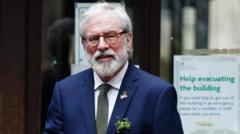
The air in a London courtroom carries a specific, heavy stillness. It is a vacuum where decades of history are compressed into the scratch of a court reporter’s pen and the rustle of legal robes. When Gerry Adams took the stand, he wasn't just a retired politician from West Belfast. He was a walking Rorschach test for an entire archipelago’s grief.
For some, he is the architect of a fragile peace, the man who coaxed the tiger of paramilitarism into the cage of democracy. For others, he remains the ghost in the machine of the Provisional IRA, a figure whose denials are as thick and impenetrable as the fog over the Black Mountain. This wasn't a trial about a single day or a single document. It was a forensic excavation of the 1970s, an era when the line between a freedom fighter and a terrorist was drawn in the blood of civilians.
The core of the case rests on a devastatingly simple question: What did Gerry Adams know, and when did he know it?
Three men, survivors of the 1973 Old Bailey and Scotland Yard bombings, are not looking for a simple apology. They are seeking a legal determination that Adams was part of the IRA’s leadership—the "Army Council"—that green-lit a campaign of terror on the British mainland. It is a civil claim, a desperate grab for accountability in a world where the official records of the Troubles are often redacted into oblivion.
The Weight of a Shadow
Imagine standing in a room where everyone knows your name, but no one can agree on your soul.
Gerry Adams has spent half a century perfecting a very specific kind of presence. He is soft-spoken. He is articulate. He bears the grandfatherly air of a man who enjoys poetry and mountain walks. Yet, the allegations leveled against him in this High Court action paint a picture of a commander overseeing a "human wave" of explosive violence.
Consider the reality of March 8, 1973. It wasn't an abstract political event. It was a day of shattered glass and screaming sirens in the heart of London. More than 200 people were injured. One man died of a heart attack in the chaos. For the claimants—Liam Young, Peter Gurney, and Anthony Spark—the trauma isn't a historical footnote. It is a physical companion they have carried for fifty-three years.
The legal battle hinges on a "vicarious liability" claim. The survivors argue that because Adams was a high-ranking member of the IRA, he bears responsibility for the actions of those who planted the bombs. Adams, as he has done since the first day he stepped into the public eye, maintains a steady, unwavering line: He was never in the IRA.
The Grammar of Denial
In court, the language of the Troubles undergoes a strange sterilization. "Operations" replace killings. "Units" replace neighbors with guns. When Adams speaks, he uses a lexicon designed to bridge the gap between his past as a republican firebrand and his present as a statesman.
But the claimants brought receipts. They pointed to historical accounts, intelligence reports, and the testimony of former comrades who have long since broken their silence. They spoke of the "Green Book," the IRA’s internal manual of rules and induction. They spoke of a command structure that was supposedly rigid, hierarchical, and absolute.
If the IRA was as organized as history suggests, how could a man at the very top of the republican movement in Belfast not be a member of the organization he was supposedly representing at secret humps and negotiations?
The absurdity of the situation is not lost on anyone in the room. It is the Great British and Irish Paradox. To secure the Good Friday Agreement, the world had to accept a certain level of constructive ambiguity. We had to pretend we didn't know exactly who was pulling the strings so that we could all agree to stop the puppets from dancing. Now, decades later, that ambiguity is being dragged into the harsh, artificial light of a courtroom.
The Invisible Stakes
This isn't just about Gerry Adams. It is about the soul of transitional justice.
When a conflict ends not with a total victory but with a weary handshake, the truth is often the first thing buried in the shallow grave of "moving on." For the victims of the 1973 bombings, "moving on" feels like a betrayal. They are asking for a judicial recognition of what they believe is an obvious truth.
There is a profound human cost to being told that your pain was an "incident" and your perpetrator was "unidentifiable."
Suppose you were a young man in 1973, just going about your day, when the world suddenly turned into a whirlwind of fire and shards. You spend the rest of your life jumping at loud noises, feeling the phantom itch of scars that won't fade. Then, you see the man you believe ordered that carnage being toasted in international capitals, shaking hands with presidents, and writing memoirs that skip over the parts that hurt the most.
The anger isn't just about the bomb. It’s about the erasure.
A Masterclass in Deflection
Watching Adams on the stand is like watching a grandmaster play a game of chess where the board is constantly shifting. He doesn't get angry. He doesn't stumble. He simply redirects.
When confronted with books written by respected journalists—or even his own former associates—claiming he held specific ranks like "Adjutant" or "Chief of Staff," he dismisses them as fiction or hearsay. He treats the evidence not as a mountain of proof, but as a collection of campfire stories.
"I was a prominent republican," he might concede, but the leap from "prominent republican" to "IRA commander" is a chasm he refuses to cross.
The lawyers for the claimants pushed him on the internal logic of the movement. How does a man spend years in internment, engage in secret talks with the British government on behalf of the IRA, and yet remain outside the organization?
His answer is a masterpiece of semantic gymnastics. He was a political bridge. He was a voice for a community. He was everything except a soldier.
The Ghost in the Gallery
As the proceedings continue, the room feels crowded by people who aren't there. The ghosts of the disappeared, the victims of Enniskillen, the families of the Birmingham Pub bombings—they all haunt the edges of this civil suit.
If the court finds that Adams was indeed a leader of the IRA, it opens a floodgate. It challenges the entire narrative of the peace process, which relied on the fiction that the political wing (Sinn Féin) and the military wing (the IRA) were two entirely separate entities that just happened to share the same goals, the same personnel, and the same funeral orations.
But the law is a blunt instrument for such a delicate operation. A civil court operates on the "balance of probabilities," a lower bar than the "beyond reasonable doubt" required in criminal trials. The claimants are betting that the sheer weight of historical consensus will finally tip the scales.
The Long Shadow of 1973
The tragedy of the Troubles is that the "truth" is often a matter of geography. In some parts of West Belfast, Adams is the man who saved them from state oppression. In the corridors of the High Court in London, he is the man who represents an era of unpunished slaughter.
The claimants are aging. Their memories are sharp, but their bodies are tired. This trial represents perhaps the last chance to get a definitive ruling on the record of history before the participants fade away.
There is a specific kind of exhaustion that comes from fighting a ghost. You throw a punch, and your hand passes right through the mist. Adams has spent his life being that mist. He is the man who wasn't there, even when he was standing right in front of you.
As he stepped down from the witness box, the silence returned to the courtroom. He smoothed his suit, adjusted his glasses, and walked out into the London afternoon, leaving behind a trail of unanswered questions and a trio of men still waiting for a version of the truth they can finally live with.
The trial will end. A judgment will be written. But the shrapnel from 1973 remains lodged in the psyche of a nation, a reminder that peace is not the same thing as silence, and a ceasefire is not the same thing as justice.
History isn't something that happened in the past; it's something that is currently happening to us, one courtroom testimony at a time.