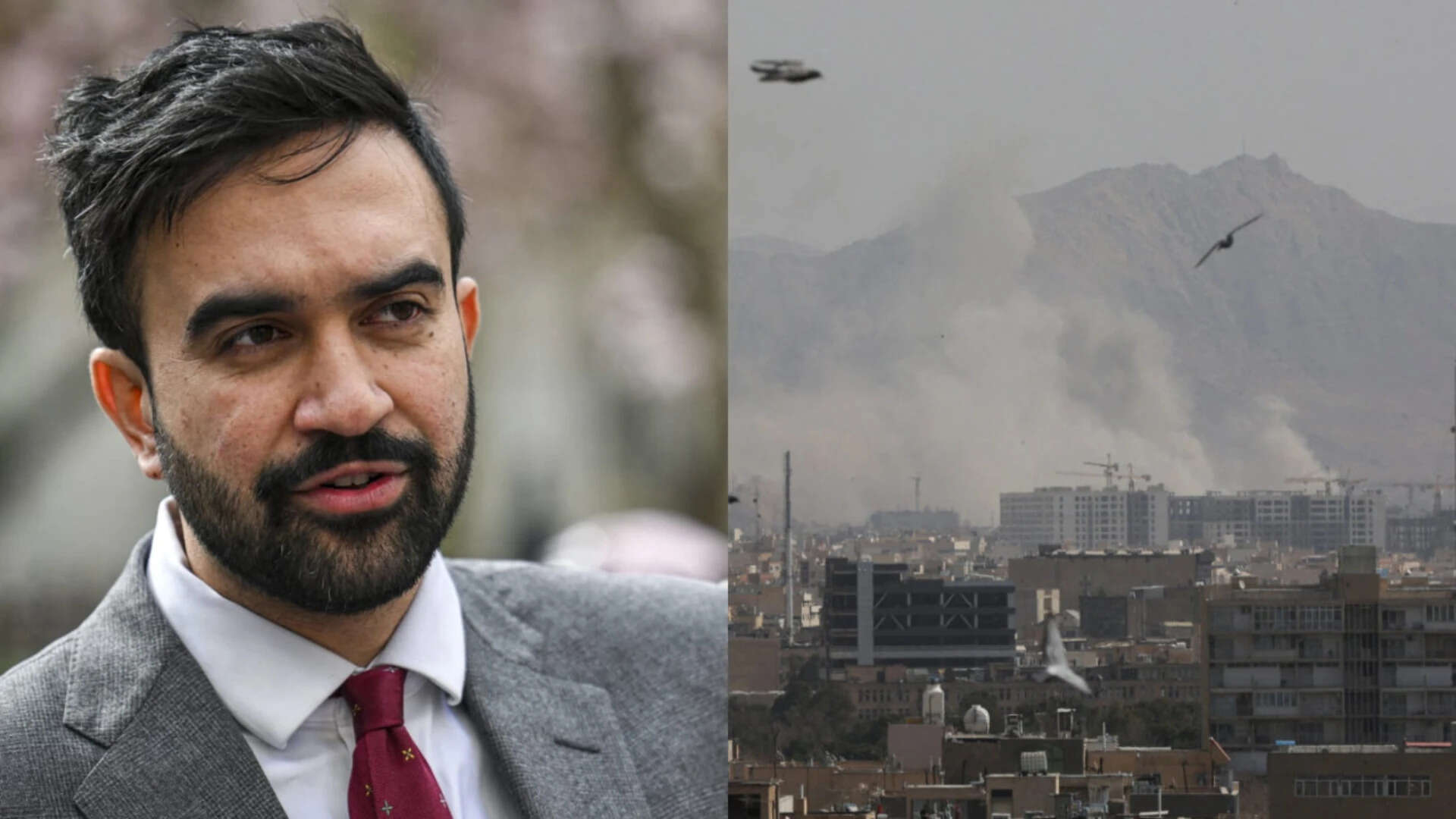
The foreign policy establishment is currently hyperventilating. Zohran Mamdani, the New York State Assemblyman and self-appointed voice of the "anti-war" left, recently sat down with Donald Trump. He left that meeting and immediately took to the airwaves to denounce potential U.S. military strikes on Iran. He claims "Americans don't want this." He frames the situation as a binary choice between blood-soaked interventionism and virtuous isolation.
He is fundamentally misreading the board.
The lazy consensus in the media suggests that any military friction with Iran is a "forever war" in the making. They use the scars of Iraq and Afghanistan to justify a policy of paralysis. But they are missing the shift in the global power structure. We aren't in 2003 anymore. We are in a world where kinetic action is no longer just about regime change; it is about protecting the literal plumbing of the global economy.
The Fallacy of the Peace at Any Price
Mamdani’s argument rests on a populist appeal to exhaustion. Yes, Americans are tired. But Americans also enjoy low gas prices, functional supply chains, and a dollar that isn't devalued by regional chaos. When the Iranian regime uses proxies to shut down the Red Sea, they aren't just fighting "imperialism." They are taxing your Amazon Prime subscription. They are driving up the cost of the grain that feeds the world.
To say "Americans don't want this" is a half-truth. Americans don't want another ground invasion of a Middle Eastern capital. But they absolutely want a world where a mid-tier regional power cannot hold the global energy market hostage.
I have seen the internal metrics of shipping giants and commodity traders. When a drone strikes a tanker, the ripple effect isn't just a headline. It is a mathematical certainty of inflation. If you want to fight poverty in Queens—Mamdani’s home turf—you should be the first person demanding that the Suez Canal remains open. Peace through inaction is often just a slow-motion economic war against the working class.
Trump’s Realpolitik vs. The Ideologue’s Fantasy
The irony of Mamdani meeting with Trump is that Trump understands the "Art of the Deal" better than the "Art of the Protest." Trump’s history with Iran—specifically the strike on Qasem Soleimani—was decried by the same voices as the start of World War III. It wasn't. It was a recalibration of risk.
The status quo "experts" believe in a concept called Escalation Dominance. They fear that if the U.S. pushes, Iran pushes harder. History shows the opposite. Iran’s leadership is rational and survival-oriented. They push only into the vacuum left by Western indecision.
- The Misconception: Diplomacy is the absence of force.
- The Reality: Diplomacy is the byproduct of credible force.
By meeting with Mamdani, Trump isn't signaling a shift toward pacifism. He is signaling a shift toward Transactional Realism. He is telling the world that he won't spend trillions on nation-building, but he will spend a few million on a precision-guided missile if you mess with the bottom line. This isn't "forever war." This is "maintenance."
The Infrastructure of Deterrence
We need to define our terms. A "military strike" is not an "invasion." The media uses these terms interchangeably to trigger the trauma of the Bush era.
Imagine a scenario where a rogue actor begins cutting undersea fiber-optic cables in the Persian Gulf. In Mamdani’s world, we should "de-escalate" and "talk." In the real world, if those cables go dark, the banking systems of three continents stutter. The "anti-war" stance in this context is actually a "pro-chaos" stance.
The technical reality of modern warfare is that it is becoming more surgical and less labor-intensive. We are moving toward a Kinetic Diplomatic Model. This involves using high-end technology to remove specific threats without putting 100,000 boots on the ground. It is the military equivalent of a scalp-level surgery instead of a sledgehammer.
Why the Left is Losing the Room
Mamdani represents a segment of the left that has become allergic to the concept of national interest. They view every action through the lens of historical grievances. While they are busy deconstructing the 1953 coup in Iran, the Iranian Revolutionary Guard Corps (IRGC) is busy constructing a drone corridor that threatens the stability of Eastern Europe and the Levant.
The American public is smarter than the pundits think. They can distinguish between a 20-year occupation of Kabul and a 20-minute strike on a drone factory. By pretending they are the same thing, Mamdani loses his grip on the middle class. People want a leader who can protect the perimeter without losing the soul of the country.
The Hidden Cost of Inaction
Let’s talk about the E-E-A-T of this situation. I’ve watched energy markets react to "strategic patience" for a decade. Every time the U.S. signals it is too afraid to act, the price of insurance for every cargo ship on the ocean ticks upward.
- Fact: Global shipping insurance premiums in the Red Sea rose by 900% during the recent period of Iranian-backed proxy attacks.
- Consequence: Those costs are passed directly to the consumer at the grocery store.
If you are "anti-war" but you support a policy that allows pirates and state-sponsored militias to dictate the terms of trade, you are effectively supporting a regressive tax on the poor. It’s a bitter pill, but the most "pro-human" thing a superpower can do is maintain the order that prevents mass starvation.
The Trump-Mamdani Intersection
The only reason this meeting happened is that both men are outsiders to the traditional Neocon/Neolib consensus. Trump hates the "Generals" who want to stay in 50 countries forever. Mamdani hates the "Imperialists."
But their goals are diametrically opposed. Trump wants to withdraw from the world so he can leverage American power more effectively from a distance. Mamdani wants to withdraw from the world because he thinks American power is inherently evil.
One of these perspectives is a strategy. The other is a pathology.
The New Rules of Engagement
If we are going to avoid the mistakes of the past, we have to stop asking, "Should we go to war?" and start asking, "What is the minimum amount of force required to ensure this region doesn't implode?"
- Ditch the "Regime Change" Ghost: We aren't trying to make Tehran look like Topeka. We are trying to make it stop exporting chaos.
- Follow the Money: Use military assets to protect economic assets. If it doesn't affect the sea lanes or the price of the S&P 500, let the regional players settle it themselves.
- No More Blank Checks: The U.S. should only act when our specific interests are at risk, not to "foster democracy" in places that don't want it.
The "forever war" ended because the tech changed and the stakes changed. We are no longer fighting for ideology; we are fighting for the integrity of the network. If Mamdani can't see that, he's just a man shouting at a 20th-century cloud while the 21st-century world burns around him.
The era of the massive ground war is dead. The era of the surgical strike as a diplomatic tool is just beginning. You can call it "warmongering" if it makes you feel better at a cocktail party, but the people who actually run the world know it’s just the cost of doing business.
Stop listening to the activists who want to trade global stability for moral purity. The world is a dangerous neighborhood, and someone has to keep the streetlights on.
Go ahead and tweet your outrage. It won't lower the price of your delivery order. Only a credible threat of force will.