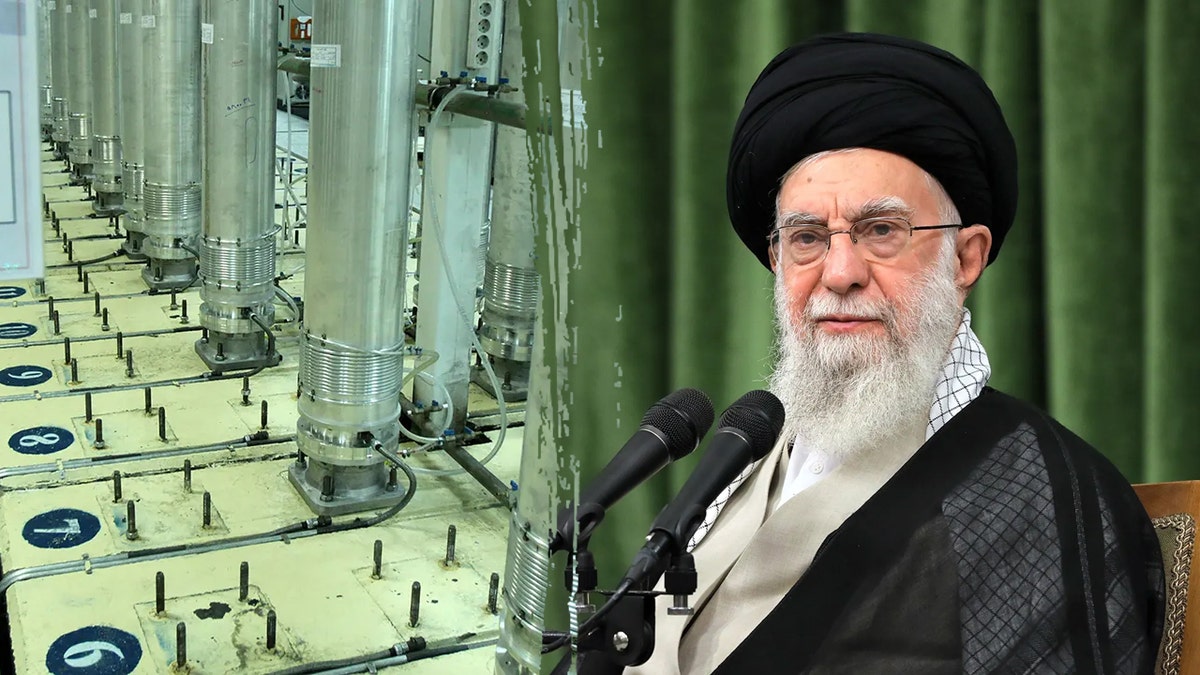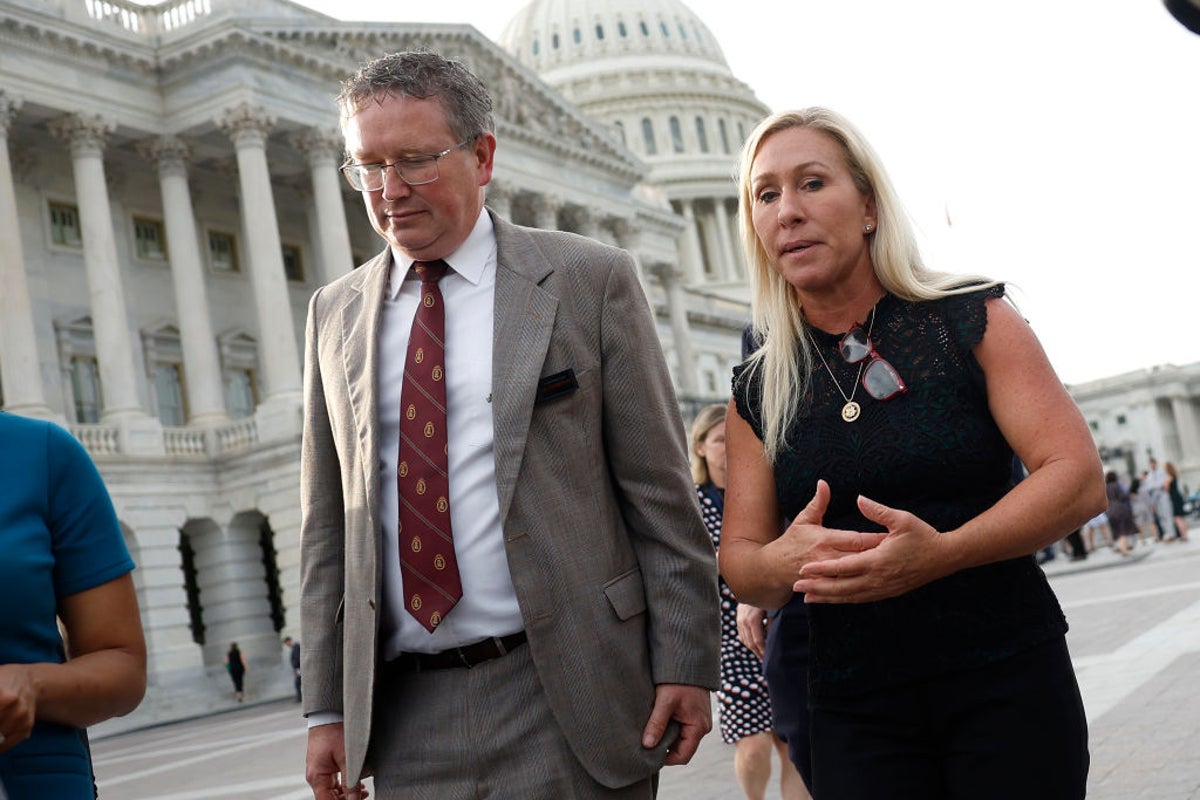
The Republican party is currently eating its own over the definition of "America First." While the headlines focus on the spectacle of floor votes and shouting matches, the real story is a fundamental breakdown in the alliance between Donald Trump and his most loyal legislative foot soldiers. Representatives Thomas Massie and Marjorie Taylor Greene are no longer just gadflies; they are now the primary architects of a populist resistance that views Trump’s recent posture toward Iran as a betrayal of the 2016 anti-interventionist mandate.
This isn't just a spat. It is a structural shift in how the populist right views executive power and foreign entanglements. For years, the MAGA movement was held together by the singular gravity of Trump’s personality. Now, that gravity is failing to pull in the hardline isolationists who believe the former President is being recycled by the very "neoconservative" establishment he once promised to dismantle. The looming congressional votes on Iran strikes have become the ultimate litmus test for a movement that is rapidly losing its cohesion.
The Ideological Fracture
For Massie and Greene, the objection to military action against Iran is not about defending a foreign regime. It is about the constitutional authority to wage war and the spiraling cost of global policing. They argue that any strike without a formal declaration of war from Congress is an illegal overreach. This puts them in direct opposition to a Republican leadership that has historically favored broad executive discretion in military matters.
The tension reached a breaking point when Trump began signaling support for a more aggressive stance. To the "Massie wing," this looked less like strategic deterrence and more like the "forever wars" of the Bush era. They aren't just arguing with Democrats anymore; they are accusing their own figurehead of adopting the "America Last" policies they were sent to Washington to kill.
This internal friction exposes a massive vulnerability in the GOP's 2024 and 2026 strategy. If the base is split between those who want to "bomb the hell out of them" and those who want to "bring every soldier home," the party has no unified foreign policy. It has a collection of grievances.
The Mechanics of the Congressional Blockade
Greene and Massie are using the narrow Republican majority as a lever. By threatening to tank procedural votes or even challenge the Speakership again, they are forcing a public debate that the GOP establishment would rather have behind closed doors. Their strategy is simple: make it politically expensive for any Republican to vote for intervention.
They are leveraging digital platforms to bypass traditional media, speaking directly to a base that is increasingly skeptical of the "military-industrial complex." When Massie tweets about the cost of a single missile versus the cost of securing the domestic border, he isn't just venting. He is framing a choice that resonates with voters who feel left behind by the global economy.
Money and Blood
The argument always returns to the ledger. The populist right has successfully linked foreign intervention to domestic inflation and debt. They argue that every dollar spent on a kinetic strike in the Middle East is a dollar stolen from infrastructure in Kentucky or Georgia. This "guns vs. butter" argument was once the domain of the far left, but it has been thoroughly co-opted and redesigned by the MAGA rebels.
They are also tapping into a deep-seated exhaustion within the military community. Many of the voters who propelled Trump to power in 2016 were veterans of Iraq and Afghanistan who were promised an end to aimless conflicts. By branding Trump’s current rhetoric as "America Last," Massie and Greene are attempting to reclaim the moral high ground of the original movement.
The Trump Response and the Risk of Irrelevance
Donald Trump finds himself in an unfamiliar position. Usually, he is the one purging the heretics. Now, he is being accused of heresy by his most devoted followers. His response has been a mix of trademark bravado and attempts to bridge the gap, but the "tough on Iran" stance is hard to square with "no more wars."
If Trump ignores this faction, he risks a suppressed turnout among the very people who provide his loudest support. If he caves to them, he risks looking weak to the traditional hawks who still control much of the party’s donor class. It is a zero-sum game.
The upcoming votes on Iran will force every member of the GOP to pick a side. There is no middle ground when it comes to launching Tomahawk missiles. You are either for the strike or against it. For Greene and Massie, a "No" vote is a vote for the survival of the republic. For the rest of the party, it is a matter of national security and maintaining the global order.
The New Alignment
We are witnessing the birth of a new political alignment that doesn't care about traditional party lines. Massie frequently finds himself in agreement with progressive anti-war voices, creating a "horseshoe" coalition that terrifies the Pentagon. This isn't a temporary alliance of convenience; it is a shared recognition that the post-WWII consensus on American hegemony is crumbling.
The "MAGA rebels" are betting that the American public is more tired of war than they are afraid of Iran. They are betting that the "America First" slogan actually means something specific, rather than just being a brand name for whatever Trump decides to do on a Tuesday.
The Constitutional Crisis in Waiting
The core of the dispute is the War Powers Act. Massie has long been a stickler for the letter of the law, insisting that the President cannot act without a specific authorization for use of military force (AUMF). The problem is that the 2001 and 2002 AUMFs have been stretched by successive administrations to cover almost any action in the region.
Greene and Massie are demanding a repeal of those "blank check" authorizations. They want a clean vote. They want the blood of American soldiers to be a decision made by the people’s representatives, not by a general in a windowless room at the Pentagon. By framing the Iran issue through this lens, they make it difficult for their colleagues to oppose them without appearing to surrender their own constitutional power.
The Power of the Purse
Beyond the legalities, there is the raw power of the budget. The rebels are prepared to use the appropriations process to defund any unauthorized military movement. This is the ultimate "hard-hitting" tactic. It stops the tanks by cutting off the gas money.
While the establishment scoffs at these tactics as performative, they have a tangible impact on the ground. Military planners cannot operate effectively when their funding is tied to a volatile political civil war. The uncertainty alone is a victory for the isolationist wing.
The Impact on the 2026 Midterms
This schism will define the next primary season. Expect to see "America First" candidates running against "MAGA" candidates. It sounds like a contradiction, but in the new reality of the Republican party, the labels have different meanings. One side represents the cult of personality; the other represents the rigid adherence to an isolationist ideology.
Voters will be forced to decide if they want a leader who dictates the terms or a movement that dictates the terms to the leader. Massie and Greene have made their choice. They have decided that the movement is bigger than the man.
The upcoming congressional showdown isn't just about Iran. It is a battle for the soul of the American right, fought with the ferocity of a blood feud. If the rebels succeed in blocking the strikes, they will have effectively neutered the executive's ability to lead the party's foreign policy. If they fail, they will likely become martyrs to a cause that is only growing more vocal as the national debt climbs toward 40 trillion dollars.
The era of bipartisan consensus on foreign intervention is dead. It wasn't killed by the Democrats; it was smothered by a group of Republicans who decided that the biggest threat to America wasn't across the ocean, but across the aisle—and sometimes, right at the top of their own ticket.
Demand a floor vote on the specific rules of engagement before a single dollar is authorized for Middle Eastern escalation.