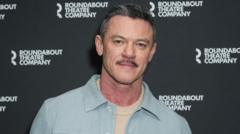
The idea that a Hollywood A-lister needs a "breakthrough" feels a bit ridiculous. We're talking about Gaston. We're talking about a guy who went toe-to-toe with Vin Diesel in the Fast & Furious franchise and led huge period epics like Dracula Untold. But for Luke Evans, the glitz of a film set was always a detour from the wooden boards of a theater stage. His move to Broadway isn't just another job on a resume. It's the closing of a circle that started decades ago in London's West End.
Most people don't realize that Evans spent nearly ten years in musical theater before a camera ever pointed at him. He was the guy in the ensemble. He was the understudy. When he finally lands on 45th Street, he isn't arriving as a movie star trying to prove he can sing. He’s a stage veteran coming home.
The long road from Pontypool to New York
The journey wasn't exactly a straight line. Evans grew up in a small Welsh town where the bright lights of Broadway felt like they were on another planet. He left school at 16 to work in a shoe shop to pay for singing lessons. That's the kind of grit you don't see much anymore. He eventually won a scholarship to the London Studio Centre, which launched a solid, if grueling, career in the West End.
He did the work. He was in Rent, Miss Saigon, and Piaf. But the jump to Broadway remained elusive even as his film career exploded. Hollywood usually keeps you busy once they find out you can carry a blockbuster. Between 2010 and 2024, Evans was essentially tethered to film sets in New Zealand, Europe, and Atlanta. Broadway became that one "bucket list" item that kept getting pushed to the next year.
The timing of this debut matters. It isn't happening during a career slump. It's happening because he finally said no to the green screens to prioritize the proscenium arch. That takes guts. Most actors wouldn't trade a massive paycheck for the eight-shows-a-week grind of a New York theater schedule.
Why theater critics are watching him closely
The transition from film back to live theater is notoriously tricky. On film, you can act with your eyebrows. A micro-expression tells a whole story. On Broadway, you have to project that same emotion to the guy sitting in the very last row of the mezzanine.
Evans has an advantage because his voice is built for this. If you've heard him sing "Gaston" or listened to his studio albums, you know he has a powerful, classically trained baritone. But Broadway demands more than just hitting the notes. It demands stamina. There are no "retakes" when your voice cracks on a Tuesday night performance.
Industry insiders are looking at this debut as a litmus test. Can a modern action star still hold the gravity of a Broadway house? Based on his West End track record, the answer is almost certainly yes. He understands the mechanics of the stage—the lighting cues, the spatial awareness, and the way a live audience breathes with the performer.
The reality of the Broadway bucket list
We hear actors talk about "bucket list" roles all the time. Usually, it's just PR fluff. With Evans, it feels different. He’s been vocal about his love for the theater since he first started doing press for Clash of the Titans back in 2010.
Broadway represents a specific kind of validation. You aren't a "theater actor" in the global sense until you've done a run in New York. The community there is tight-knit and famously skeptical of "Hollywood tourists." Evans isn't a tourist, though. He’s more like a long-lost cousin returning for a family reunion.
His presence on the marquee is also a massive win for the theater district. Broadway has struggled with attendance numbers in the post-pandemic era. Bringing in a name that carries both cinematic weight and genuine vocal talent is the "golden ticket" for producers. It fills seats while maintaining artistic integrity.
What this means for his future career
Don't expect Evans to disappear back into the Marvel or DC machines immediately. This Broadway run likely signals a shift in how he wants to spend his 40s and 50s. Actors who find success on Broadway often get the "theater bug" all over again.
It’s about the immediate feedback. There's nothing like the silence of a thousand people holding their breath during a solo. You don't get that on a film set where someone is yelling "moving on" every five minutes.
If you're planning to catch him on stage, keep a few things in mind. Broadway schedules are brutal. These performers are essentially high-level athletes. They don't go out after shows. They don't talk much during the day. They live on honey, ginger, and vocal rest. Seeing a performer like Evans in this environment gives you a much deeper appreciation for the craft than seeing him on a 60-foot IMAX screen.
Check the performance calendar specifically for his dates. Broadway stars often have "alternates" for certain shows, though a debut of this magnitude usually sees the lead performing all eight shows unless they're sick. Book your tickets at least three months out. The "Evans effect" is real, and the box office numbers usually spike the moment a Hollywood name is officially attached to a production.
Go see the show. Support live theater. Watch a man who spent twenty years dreaming of a specific stage finally stand on it. That kind of energy is infectious, and it's exactly what Broadway needs right now.


