The air inside a Terminal 3 waiting area doesn't circulate; it stagnates. It carries the scent of recycled oxygen, burnt coffee, and the metallic tang of adrenaline that has nowhere to go. For three hundred Australians huddled in the relative, fragile safety of a Middle Eastern transit hub, that air felt like lead. They weren't just passengers. They were survivors of a geopolitical tectonic shift, people who had spent the last seventy-two hours learning exactly how thin the veneer of modern stability really is.
They sat on suitcases because the chairs were full. They clutched passports like holy relics. When the flight status board finally flickered, changing a red "Delayed" to a green "Boarding," no one cheered. The silence was heavier than any shout. It was the sound of a collective exhale a week in the making. Don't forget to check out our recent coverage on this related article.
The Geography of Fear
Distance is a liar. We live in an age where a flight from Tel Aviv or Beirut to Sydney is just a series of movies and a couple of mediocre meals. We’ve been conditioned to believe that the world is small and accessible. But when the sky closes—when the sirens begin their rhythmic, chest-rattling wail and the iron dome of civilian life cracks—the distance between home and the horizon becomes infinite.
Consider the reality of a family we will call the Millers. They aren't a statistic in a government briefing. They are a mother, a father, and two toddlers who were visiting relatives when the first ripples of the conflict turned into a tidal wave. For them, the "traumatic waiting game" cited by news wires wasn't a game. It was a series of impossible calculations. To read more about the background here, NPR offers an in-depth summary.
Do we head to the airport now and risk being stuck in a glass building during an aerial bombardment? Or do we stay in the basement and risk missing the last government-chartered flight out of the zone?
This is the invisible tax of war on the civilian soul. It is the erosion of agency. One moment you are a tourist or a dual citizen visiting a childhood home; the next, you are a "case" to be managed by a distant department of foreign affairs. The Millers spent forty-eight hours in a hallway, the children sleeping on a pile of laundry, while the father refreshed a dead-end website on a phone with 4% battery.
The Logistics of Mercy
Bringing people home from a war zone isn't as simple as sending a plane. It is a violent ballet of diplomacy and physics. To land a heavy wide-body jet in a region where the GPS is being jammed and the flight paths are being contested requires a level of coordination that most of us will never have to contemplate.
The Australian government, working alongside international partners, had to negotiate windows of "deconflicted" airspace. This means convincing multiple warring factions to stop shooting just long enough for a metal tube filled with civilians to climb to thirty thousand feet.
The statistics look clean on a spreadsheet:
- 300 passengers per flight.
- 8,000 kilometers of transit.
- 14 hours of flight time.
But those numbers hide the friction. They hide the frantic calls to embassies, the gate agents working thirty-hour shifts, and the pilots who know that their flight path is being tracked by radar systems that don't always distinguish between a Boeing 787 and a strategic threat.
The trauma isn't just in the bombs. It’s in the uncertainty. It’s the three-a.m. email that says the flight is cancelled, followed by the four-a.m. text saying it’s back on. It’s the sight of soldiers in the terminal, their presence a reminder that the "safety" of the airport is a polite fiction sustained only by the hope that no one decides to break the rules today.
The Weight of the Suitcase
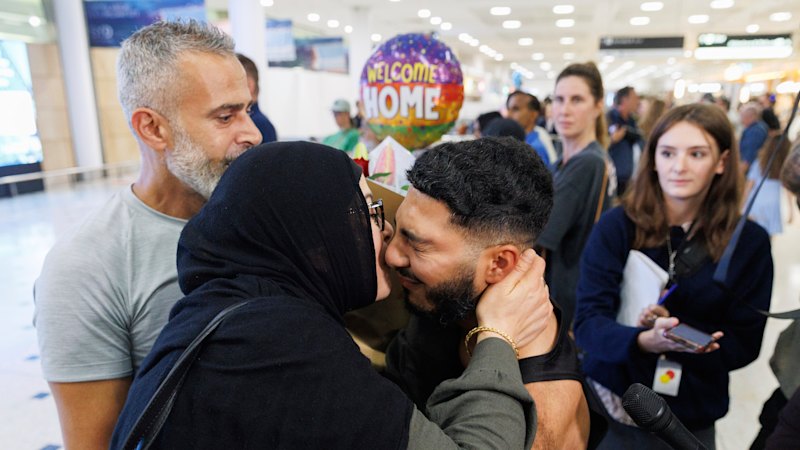
When the wheels finally touched down on the tarmac in Sydney, the sensation wasn't one of triumph. It was a collapse.
Watch the footage of those arrivals. They don't look like people who have won a prize. They look gray. They look like they have left a piece of themselves back in the dust and the sirens. Many of these Australians have families still there. They have homes that might not exist by the time the next news cycle begins.
This creates a brutal psychological schism. You are "home," which means you are safe, but your heart is still tuned to a different frequency. You find yourself flinching when a garage door slams too hard. You check the weather in a city you just fled before you check the weather in the suburb where you live.
The "waiting game" doesn't end when the passport is stamped. It just changes shape.
Why We Look Away
It is easy to read the headline, feel a brief prick of sympathy, and move on to the sports scores or the weather. We do this because the alternative—truly internalizing the fragility of our own safety—is terrifying. We want to believe that the Australian passport is a magic shield, a document that guarantees the world will remain orderly for us.
But these returning travelers are a living testament to the fact that order is a miracle.
They are people who had to choose which one suitcase of their lives to keep and which to abandon. They are parents who had to sing lullabies louder than the sound of distant explosions. They are the human cost of a world that has forgotten how to speak any language other than force.
As they walked through the arrivals gate, greeted by the blinding Australian sun and the mundane chatter of a Tuesday morning, the contrast was jarring. To the rest of the world, it was just another day. To those three hundred people, it was the first day of a second life.
The real story isn't that they arrived. The story is what they had to become to get there. They are the ones who now know that the distance between a quiet suburban street and a war zone is exactly the length of a single, cancelled flight.
The tarmac was hot. The hugs were desperate. And for the first time in weeks, the air didn't taste like lead. It just tasted like nothing. Which, in a world on fire, is the greatest luxury of all.