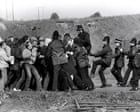
The air in Orgreave doesn't smell like coking plants anymore. It smells of damp grass and the non-descript neutrality of a housing estate built over a battlefield. If you stood on the hillside today, you would see families pushing strollers where, forty-two years ago, thousands of men in sweat-soaked shirts stood face-to-face with a wall of riot shields.
For decades, the men who were there—the ones who ran, the ones who bled, and the ones who watched their livelihoods vanish in a cloud of coal dust and baton strikes—have carried a heavy, private weight. It is the weight of being told that what they saw with their own eyes didn't happen. It is the suffocating pressure of a narrative written by the victors while the losers were still washing the grit out of their wounds.
Now, the silence is breaking.
The chair of a fresh inquiry into the events of 1984 has issued a simple, devastating invitation: tell the truth. For the survivors of the Battle of Orgreave, this isn't about a dry legal proceeding. It is about the fundamental human need to be believed.
The Ghost in the Kitchen
Consider a man we will call Arthur. He is seventy-eight now. His knuckles are thick, mapped with the blue-black scars of a lifetime underground—"coal tattoos" that never fade. For forty years, Arthur has sat at his kitchen table in a small terrace house, reading newspapers that labeled him a "thug" and an "enemy within."
When his grandchildren asked about the strike, he usually changed the subject. How do you explain to a ten-year-old that you watched a policeman on a horse chase your best friend through a field like they were hunting a fox? How do you describe the feeling of the law—the entity you were taught to respect—suddenly turning its teeth toward you?
The official version of Orgreave, cemented in the immediate aftermath, suggested a chaotic surge of miner violence that forced a defensive police reaction. But the cracks in that story have become canyons. Documentaries, whistleblowers, and tireless campaigners have pointed to altered police statements and a coordinated effort to frame the miners for riot—a charge that carried a potential life sentence.
When the inquiry chair speaks of "finally speaking the truth," they are speaking to Arthur. They are acknowledging that for nearly half a century, a segment of the British population has lived in a different reality than the one broadcast on the evening news.
The Anatomy of a Narrative
To understand why this inquiry matters, we have to look at how a story is built. In 1984, the government and the media held the bricks and the mortar. They constructed a tale of a necessary modernization clashing with an archaic, violent workforce.
But a story built on a foundation of suppressed evidence is a haunting. It lingers in the pubs of Barnsley and the social clubs of Rotherham. It creates a generational cynicism. When a community feels that the state has lied about them, that distrust doesn't stay confined to a single event. It leaks. It poisons the relationship between the citizen and the precinct, the worker and the parliament.
The stakes are invisible because they are psychological. We aren't just talking about a scuffle in a field; we are talking about the integrity of the social contract. If the police can manufacture a riot, if the courts can be used as a blunt instrument of political will, then the "rule of law" is just a phrase used to keep the powerless in line.
The Physics of the Truth
Truth has a specific gravity. You can submerge it, hold it down with the weight of official secrets acts and redacted files, but it always wants to rise.
The inquiry faces a monumental task. Witnesses are aging. Memories, once sharp as a pickaxe, are softening around the edges. Yet, there is something more reliable than memory at play here: the paper trail. We now know that the prosecution’s case against ninety-five miners collapsed in 1985 because the evidence was deemed unreliable. We know that many police statements were dictated by senior officers, with identical paragraphs appearing in the notebooks of different men.
Imagine the logistical effort required to coordinate hundreds of officers to tell the same lie. It is a feat of dark engineering.
The inquiry isn't just looking for "what happened." It is looking for "who ordered it." Was the brutality a spontaneous combustion of tension, or was it a cold, calculated strategy designed to break the back of the National Union of Mineworkers once and for all?
The Weight of an Apology
Critics often ask: why now? Why dig up the bones of a dead industry and a forgotten strike? They say it’s time to move on, that the world has changed, that coal is a fuel of the past.
But time is not a healer; it is a concealer. For the families of those blacklisted, those imprisoned, and those who died feeling like outcasts in their own country, the clock stopped in 1984.
Moving on requires a platform to step off from. You cannot move on from a lie. You can only run away from it, and eventually, you get tired. The "truth" in this context isn't just a list of facts—it is a form of restorative justice. It is the state looking a man like Arthur in the eye and saying, "You weren't crazy. You weren't a criminal. You were a witness."
Consider the impact of the Hillsborough inquiry. It took twenty-seven years for the families of the ninety-seven to hear the truth officially recognized. That recognition didn't bring the dead back, but it allowed the living to breathe. It removed the stain of "hooliganism" that had been falsely bleached into their names. Orgreave is the industrial sibling of Hillsborough. It is the same DNA of cover-up and systemic gaslighting.
The Field Today
If you visit the site of the Orgreave coking plant now, you’ll find a landscape transformed. There are ponds, saplings, and quiet cul-de-sacs with names like "Waverley." It is a deliberate erasing of the industrial past.
But the men are still there. They are the ones standing in the supermarket queue, the ones coaching the local football teams, the ones watching the inquiry news with a skeptical flicker in their eyes. They have been promised "truth" before. They have seen committees come and go, and they have seen the shutters of the Home Office slam shut every time the word "inquiry" was mentioned.
This time feels different because the chair has shifted the focus from the institution to the individual. By asking the miners to speak, the inquiry is acknowledging that the most valid record of history isn't found in a sanitized police log, but in the shaking hands of a man who remembers the exact sound of a horse's hooves on the pavement.
We often think of history as something that happens to us, a Great Wave that sweeps us up. But history is made of choices. Someone chose to order the charge. Someone chose to pick up a pen and write a false statement. Someone chose to look the other way.
The inquiry is a process of un-choosing those lies.
It is a slow, painful peeling back of the bandages. Beneath, the wound is still raw, even after four decades. There is no "seamless" way to do this. It will be messy. It will be angry. There will be old men crying in wood-paneled rooms, and there will be lawyers parsing the meaning of "reasonable force."
But when the last witness has spoken, and the last document has been unredacted, the ghosts of Orgreave might finally find some rest. The field might finally just be a field.
Arthur sits at his table. He switches on the kettle. He hears the newsreader mention the inquiry, and for the first time in a long time, he doesn't turn the radio off. He listens. He waits for the world to catch up to what he has known since a Tuesday morning in June, 1984.
Justice isn't always a gavel hitting a block. Sometimes, it's just the sound of a story finally being allowed to end.