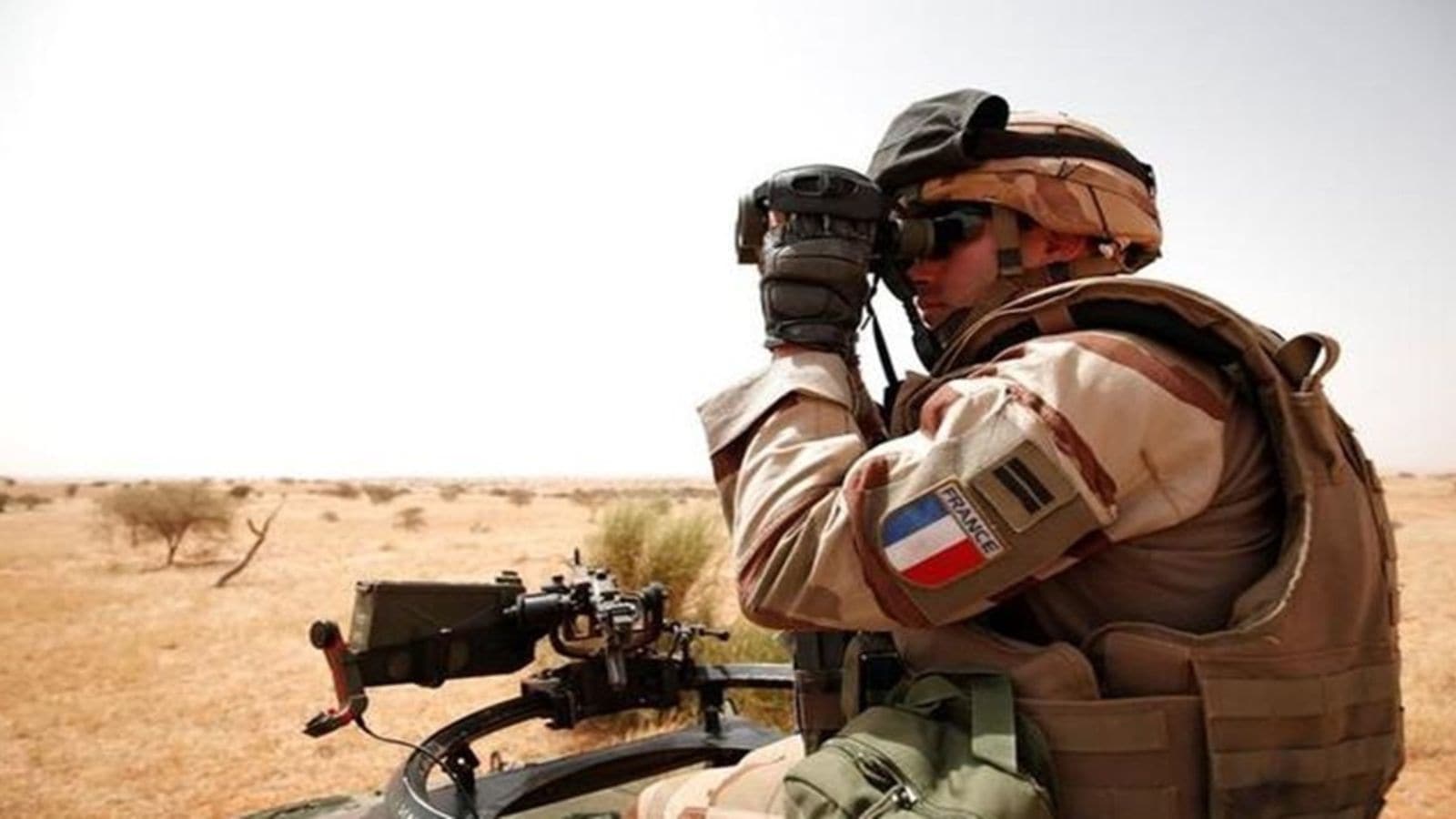
Rain slicked the tarmac at a military airbase in eastern Germany, reflecting the dull grey of a European winter that felt heavier than usual. For Colonel Marek—a name we will use to ground the abstract weight of command—the data scrolling across his encrypted tablet wasn't just a series of logistics reports. It was a ticking clock. Marek represents the generation of European officers who spent decades preparing for peacekeeping missions and "low-intensity" conflicts, only to wake up to a world where the old rules of engagement had been incinerated.
To his south, the Middle East was a CAU—a cauldron of intersecting missile trajectories and ancient grievances. To his east, the Ukrainian front remained a ravenous consumer of artillery shells. Marek’s problem was simple, devastating, and entirely representative of the continent’s current predicament. Europe’s military might is currently caught in a vice between the necessity of presence and the reality of depletion.
The Ghost of the Empty Magazine
For decades, the European defense strategy relied on a comfortable assumption: the Americans would provide the shield, and the Europeans would provide the specialized support. It was a division of labor that allowed for robust social safety nets and a general sense of security. That era ended with a series of concussions.
When the Red Sea became a shooting gallery for Houthi rebels using drones that cost less than a used hatchback, European navies rushed to the scene. On paper, the mission was a success. They intercepted the threats. They protected the shipping lanes. But look closer at the ledgers.
Consider the math of a single engagement. A European frigate fires a missile costing 2 million euros to down a "suicide drone" built for 20,000 euros in a garage. In the boardroom of a defense contractor, this is a victory. In the reality of a sustained conflict, it is a mathematical death spiral. We are trading gold for lead.
The Middle East is no longer just a regional flashpoint; it is a testing ground for the exhaustion of European stockpiles. Every interceptor fired in the Red Sea is an interceptor that cannot be sent to Kyiv or held in reserve for the defense of the Suwalki Gap. The "mixed" verdict on Europe’s military capability isn't about the bravery of the sailors or the quality of the tech. It is about the terrifyingly shallow depth of the magazines.
The Assembly Line Dilemma
Walk through the factory floor of a major European aerospace firm. You won't see the frantic, 24-hour motion of a wartime economy. Instead, you see something closer to a boutique watchmaker’s workshop. High-tech, precise, and agonizingly slow.
The irony of European military technology is that it is often too good. We build Ferraris when the moment demands a fleet of reliable pickup trucks. Each piece of equipment is a marvel of engineering, requiring specialized components sourced from global supply chains that are increasingly fragile. When a crisis in the Middle East demands an immediate surge in production, the system doesn't just speed up. It groans. It hitches. It waits for a specific microchip from a factory that might be under blockade or a raw mineral from a mine that has changed hands.
The invisible stake here isn't just "readiness." It is the loss of sovereign agency. If you cannot replenish what you use, you eventually lose the ability to choose your own path. You become a passenger in your own foreign policy.
The Human Cost of the Gap
Imagine a young technician named Sophie. She is twenty-four, brilliant with electronics, and stationed on a mission in the Mediterranean. Her job is to maintain the radar systems that track incoming threats. In the old manuals, Sophie’s role was technical. Today, it is psychological.
She knows that the sensors she monitors are some of the best in the world. She also knows that if a swarm of fifty drones appeared on her screen tomorrow, the ship doesn't have enough "bullets" to stop them all. This is the reality of the asymmetric age. The stress isn't just the fear of the enemy; it’s the awareness of the ceiling.
Europe’s military leaders are grappling with this "sophistication gap." We have the brains and the high-end steel, but we lack the mass. In the Middle East, mass is currently winning. The ability to fail, to lose a dozen cheap units and keep coming, is a luxury the European military structure currently cannot afford. Every loss is catastrophic because every asset is precious and nearly irreplaceable in the short term.
The Shift in the Wind
There is a growing, uncomfortable realization among the halls of power in Brussels, Paris, and Berlin. The "mixed" verdict on military might has triggered a frantic effort to reshore production and standardize equipment. For years, the European defense market was a fragmented mosaic of national champions—France had its jets, Germany its tanks, Sweden its submarines.
This lack of synergy meant that if a Spanish ship needed a part while docked in a Polish port, the logistics were a nightmare. The Middle East crisis has acted as a brutal catalyst. It has forced a level of cooperation that decades of diplomacy couldn't achieve. They are finally learning that in a world of giants, the small must act as one or be crushed individually.
Yet, there is a lingering doubt. Can a continent built on the foundations of peace and soft power truly pivot back to the "hard" realities of industrial warfare? The transition is not just about money. It is about the collective psyche. It is about convincing a population that has enjoyed the "peace dividend" for two generations that the world has become a much darker, much more expensive place.
The Silent Sea
The Mediterranean has always been Europe’s front porch. It is where trade, culture, and conflict have mingled for millennia. Today, it is where the limitations of a superpower-in-waiting are being laid bare.
The ships are there. The flags are flying. The sailors are ready. But beneath the surface, the anxiety is palpable. It is the anxiety of a boxer who knows he has a world-class right hook but only enough stamina for three rounds. If the fight goes to twelve, he is in trouble.
The Middle East has not just tested Europe’s hardware; it has interrogated its soul. It has asked: What are you willing to sacrifice to remain relevant? The answer is still being written in the smoke of distant intercepts and the quiet hum of factories trying to find their gear.
Marek sits back in his chair, the rain still drumming against the window of his office. He looks at the map, then at the inventory lists. He knows that the next time the phone rings, it might not be a test. It might be the moment the magazines run dry.
The sun sets over the Mediterranean, casting long, distorted shadows across the decks of the patrolling fleet. The water is calm, for now. But in the distance, the horizon is glowing with a heat that doesn't belong to the sun, a reminder that the cost of being a spectator in your own defense is a price that eventually becomes impossible to pay.