The air in a French courtroom doesn't circulate the way it does on the street. It is heavy, filtered through centuries of ritual, polished oak, and the crushing weight of words that can never be unsaid. When the verdict for the appeal in the Samuel Paty case was read recently, the silence wasn't just a lack of noise. It was a vacuum.
In 2020, a history teacher named Samuel Paty was murdered. He was beheaded in the street after showing caricatures of the Prophet Muhammad during a lesson on freedom of expression. It was an act of violence so visceral it felt like a tear in the fabric of the Republic. But the law, unlike the headlines, moves with a slow, agonizing precision. It doesn't look for catharsis; it looks for the exact measurement of a shadow.
The recent ruling by the Paris Court of Appeal saw the prison terms for three individuals reduced. These weren't the people who held the blade. They were the ones who built the bridge between a digital grievance and a physical tragedy. Their sentences were shortened from several years down to eighteen months or two years. To a bystander, this looks like a retreat. To the legal system, it is a calibration.
The Digital Spark and the Physical Fire
Consider the anatomy of a tragedy. It rarely begins with a scream. It begins with a notification.
Imagine a parent sitting in a kitchen, illuminated by the blue light of a smartphone. They see a post. They hear a rumor. They feel a surge of righteous indignation. This is a hypothetical scenario, but it mirrors the documented reality of how the campaign against Paty ignited. One person films a video. Another shares it. A third adds a name and a location.
In the digital age, we have outsourced our outrage to algorithms that don't understand context. The individuals in this appeal—Brahim Chnina, Abdelhakim Sefrioui, and a third associate—were the architects of the noise. Chnina was the father of a student who sparked the controversy with a lie about being present in the classroom. Sefrioui was an Islamist activist who helped amplify that lie into a call for action.
The court's decision to reduce their sentences rests on a razor-thin distinction: the difference between Provocation and Complicity.
In the original trial, the weight of the horror demanded the maximum possible reckoning. But on appeal, the judges had to strip away the emotion. They had to ask if these men knew a murder would happen. Did they provide the weapon? No. Did they drive the killer to the scene? No. They provided the atmosphere. They created the "climate of hatred." Under the cold eyes of French law, creating a climate is a different crime than pulling the trigger, even if the result is the same.
The Weight of Eighteen Months
Eighteen months.
It is a span of time that feels insultingly short to those who loved Samuel Paty. It is the length of two school years. It is less time than it takes to train a teacher to lead a classroom.
But for the justice system, those months represent a boundary. The court reduced the sentences because it found that while the defendants’ actions were "particularly grave," they did not technically constitute "complicity in a terrorist assassination" in the way the lower court had initially framed the severity of the punishment. Instead, the focus shifted toward "association with terrorists" and the specific harm of their public campaigns.
The reduction is a reminder that the law is not a tool for vengeance. It is a scale. If the scale tips too far toward emotion, it loses its authority. If it stays too light, it loses its purpose.
The Invisible Stakes in the Classroom
While the lawyers argue over months and years, there is a different trial happening in every staff room across France.
Every teacher now carries a ghost in their bag. When they open a textbook to a chapter on secularism, or laïcité, they aren't just teaching a concept. They are weighing a risk. The true "hidden cost" of the Paty tragedy isn't found in a courtroom transcript; it’s found in the split second of hesitation a teacher feels before they speak.
Freedom of speech is an abstract noun until it isn't. It is a muscle. If you are afraid to move it, it atrophies. The reduction of these sentences sends a complex message to the educators on the front lines. It says that the law will punish those who target you, but it will also be meticulously fair to them. It insists on a level of objectivity that feels almost inhuman in the face of such a human loss.
We often think of justice as a closing door. We want the trial to end, the sentence to be served, and the story to be over. But stories like this don't end. They ripple.
The Architecture of Accountability
The defendants argued that they were merely exercising their own right to protest, to criticize a teacher they believed had insulted their faith. This is the great paradox of the modern era: using the tools of democracy to dismantle its foundations.
The court had to navigate this labyrinth. If you punish a social media post too harshly, do you chill all dissent? If you punish it too lightly, do you give a green light to digital lynch mobs?
The ruling suggests a middle ground that satisfies almost no one. It acknowledges the "causal link" between the online campaign and the killer’s actions, yet it refuses to equate words with the act of murder itself. This is the "logical deduction" that feels like a betrayal to the heart but a necessity to the head.
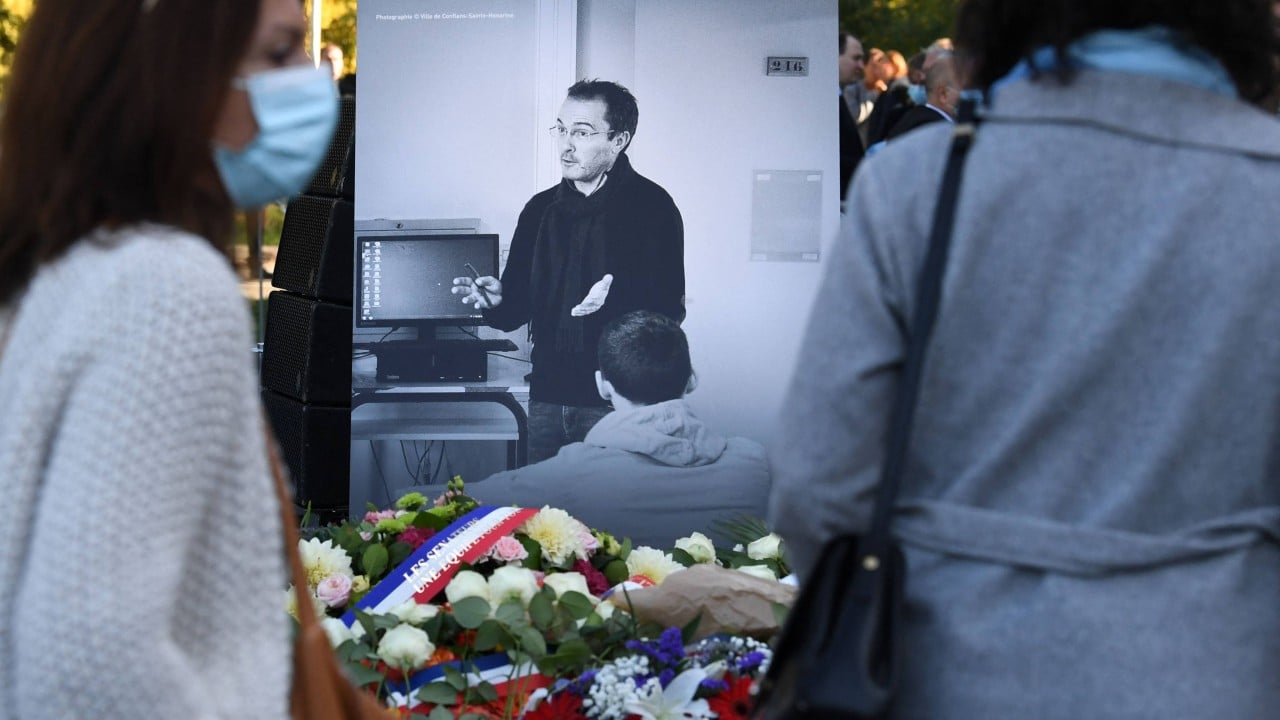
In the streets of Conflans-Sainte-Honorine, where the attack took place, the geography has changed. There are plaques. There are flowers. There are memories of a man who loved his job. But in the courtroom, Samuel Paty is no longer a man. He is a "civil party." He is a case file.
The law must be blind, they say. But in cases of such profound cultural trauma, we wish the law could see the tears. We wish it could feel the hollowness in the chest of a student who no longer feels safe asking a question.
The Final Measure
We are living in an era where the distance between a thought and a global broadcast is zero. We are all participants in a narrative we don't fully control. The individuals whose sentences were shortened are going back to their lives eventually. They will walk the streets. They will breathe the air.
The reduction of a sentence is a technicality of the legal machine, a adjustment of the gears to ensure the machine doesn't break under the pressure of its own precedents. It is a cold, hard fact of a democratic society.
But the lesson Samuel Paty died to teach remains unfinished. It is a lesson that isn't found in a courtroom, but in the courage to keep talking when the world wants you to be silent. It is found in the refusal to let a climate of hatred dictate the curriculum of the future.
The courtroom door closes. The lawyers pack their bags. The judges retreat to their chambers. Outside, the world is still loud, still messy, and still looking for a sign that the truth matters more than the noise.
Justice is not a feeling. It is a process. And sometimes, the process is the hardest thing of all to witness.
The ghost in the classroom doesn't care about eighteen months. It cares about whether the next teacher who stands up to speak will have the breath to finish the sentence.