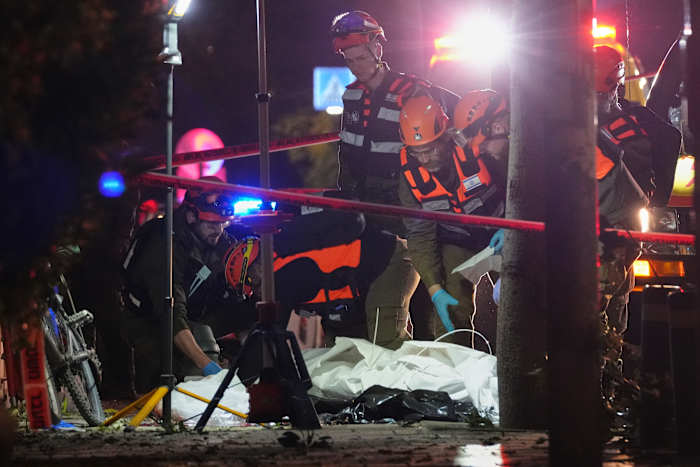
The sky over Eilat usually belongs to the sun and the salt air of the Gulf of Aqaba. It is a city of transit, where the desert meets the water, and the quiet is a commodity. But on a Tuesday in late October, that silence was fractured. It wasn't the familiar roar of a jet or the rumble of a distant truck. It was something else. A high-altitude intrusion that signaled a radical shift in the geography of modern fear.
Roughly a thousand miles to the south, in the rugged highlands of Yemen, a button had been pressed. If you found value in this article, you might want to read: this related article.
For years, the Houthi movement—officially known as Ansar Allah—has been a regional protagonist, a group defined by its slogans and its stubborn endurance in a brutal civil war. They were a local problem with regional sponsors. Or so the world liked to believe. That morning, when they launched a salvo of ballistic missiles and drones toward Israel’s southernmost tip, the distance between Sana’a and Jerusalem effectively evaporated.
The facts are cold. The Houthis claimed responsibility for the attack, marking their official entry into the escalating firestorm surrounding Gaza. They cited a sense of religious and moral duty. They spoke of "Axis of Resistance" solidarity. But beneath the geopolitical jargon lies a more visceral reality: the theater of war has no walls. For another angle on this story, check out the recent update from The Guardian.
The Architecture of the Arrow
Imagine standing on a coastline and trying to hit a target the size of a postage stamp from three states away. To do this, you need more than just intent. You need a specific kind of engineering.
The missiles used in these strikes aren't the makeshift "garage" rockets of decades past. They are sophisticated, liquid-fueled machines of flight. We are talking about the Zulfiqar or the Quds series—weapons that borrow heavily from Iranian blueprints, capable of traveling vast distances across the Arabian Peninsula. These are not just projectiles; they are messages wrapped in steel.
When one of these missiles climbs into the atmosphere, it isn't just navigating by stars or GPS. It is navigating a political minefield. To reach Israel from Yemen, a missile must overfly the territorial waters or the sovereign soil of Saudi Arabia and Jordan. It forces every nation in its path to make a split-second choice: intercept and take a side, or ignore and risk the fallout.
In this specific instance, the American destroyer USS Carney, patrolling the Red Sea, stepped into the fray. It spent nine hours picking threats out of the sky. It was a mechanical ballet of interceptors and sensors, a billion-dollar shield against a swarm of drones and missiles.
But shields are never perfect.
The Ghost in the Machine
We often talk about "Iranian-backed" groups as if they are mere puppets, unthinking extensions of a central brain in Tehran. This is a comforting simplification. It suggests that if you just cut the strings, the puppet falls.
The reality is far more haunting.
The Houthis have spent a decade becoming an autonomous military power. While they receive the technology and the training, the agency is theirs. They aren't just fighting for Iran; they are fighting for their own relevance on the global stage. By launching missiles at Israel, they transformed themselves from a domestic insurgent group into a pan-Islamic vanguard. They didn't just join a war; they hijacked the attention of the world.
Consider the person sitting in a command center in Yemen. They are operating in one of the most impoverished, war-torn places on Earth. Outside the door, there is a lack of clean water and a crumbling infrastructure. Inside, there is a terminal connected to a weapon that can reach across an entire sea to strike at a nuclear-armed state.
That disconnect is the defining feature of 21st-century conflict. You don't need a massive GDP to exert massive pressure. You only need the right hardware and a complete lack of hesitation.
The Invisible Stakes of the Red Sea
While the headlines focus on the explosions, the real casualty is the concept of distance.
The Red Sea is the jugular vein of global trade. Approximately 12% of everything the world buys or sells passes through the Bab el-Mandeb strait. When the Houthis start lobbing missiles over these waters, insurance premiums for shipping containers don't just go up—they skyrocket. This isn't just a military escalation. It is a slow-motion economic chokehold.
Every drone launched is a reminder that the world’s most vital trade routes are vulnerable to anyone with a launchpad and a grudge. The "human element" here isn't just the civilians in Eilat or the fighters in Yemen. It’s the sailor on a commercial tanker wondering if their ship is about to become a pawn in a holy war. It’s the family in a distant country whose cost of living rises because a shipping lane became a combat zone.
The Houthis have realized that they don't need to win a traditional war. They only need to create enough chaos to make the status quo unbearable.
The Sound of the Siren
There is a specific sound that defines life in the Middle East right now. It is the rising and falling wail of the air-raid siren. It is a sound that levels hierarchies. It doesn't matter if you are a tech CEO in Tel Aviv or a tourist in Eilat; when that sound begins, your world shrinks to the size of a reinforced room.
For the people in southern Israel, the Houthi involvement added a new, terrifying variable. They were already looking toward Gaza in the west and Lebanon in the north. Now, they have to look south.
The psychological toll of being surrounded is impossible to quantify. It creates a state of perpetual vigilance that erodes the soul. You start to look at the horizon differently. Every smudge of smoke, every glint of light in the distance is no longer just the weather. It is a potential threat.
The Houthis called this their "first" strike. That word—first—is a heavy one. It carries the weight of an unfinished sentence. It promises a sequel.
The Convergence
What we are witnessing is the death of the "contained" conflict.
The war in Gaza was never going to stay in Gaza. The borders drawn on maps are increasingly irrelevant in an age of ballistic reach. The Houthis' decision to fire wasn't just a tactical move; it was a demonstration of the new geometry of power. They have proven that they can reach out and touch a conflict that, geographically, they have no business being in.
This isn't a story about a single missile launch. It’s a story about the end of the "far away."
In the highlands of Yemen, the launchers are likely being reloaded. In the Red Sea, the destroyers are keeping their radars hot. And in Eilat, people are looking at the sky, waiting to see if the sun is the only thing that will be coming up over the water tomorrow.
The distance between a mountain in Yemen and a beach in Israel is 1,600 kilometers. In the time it took you to read this, a missile could have traveled a third of that way.
The world is getting smaller. The fire is getting closer.
There are no more spectators. There are only those who have been hit and those who are waiting for the siren to start.