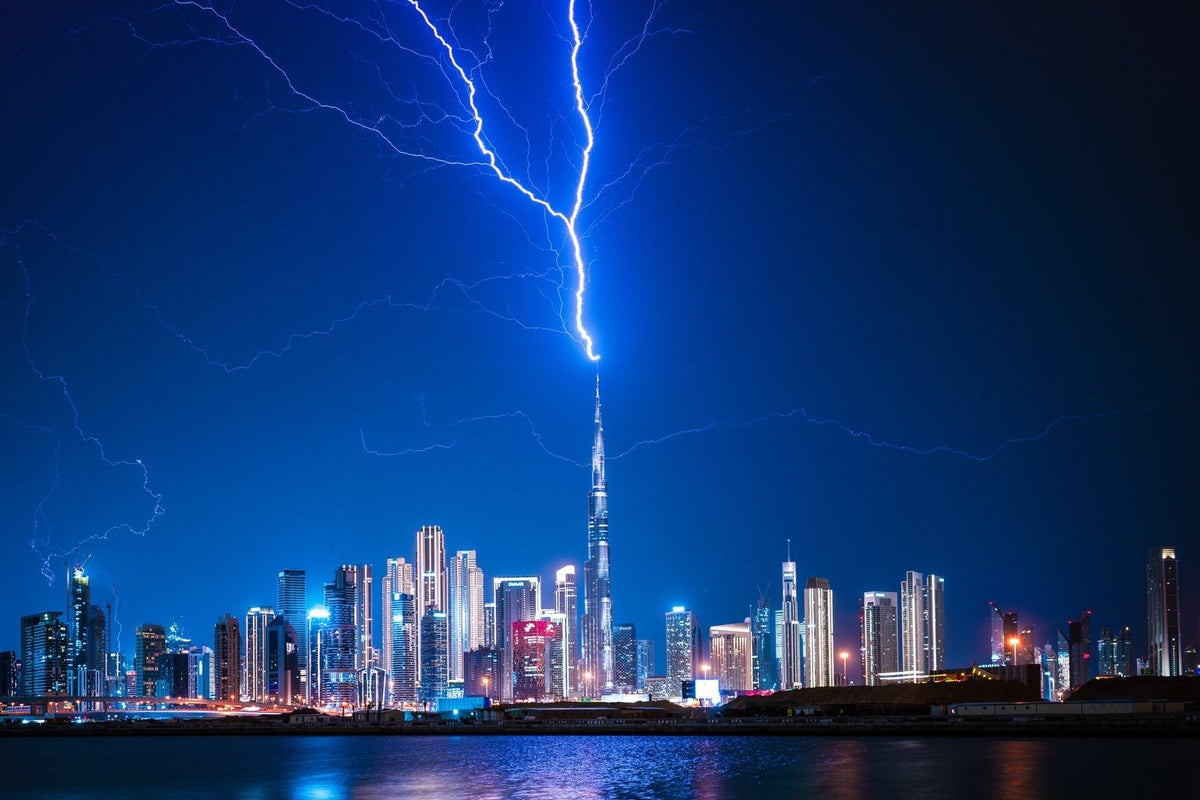
The Burj Khalifa’s interaction with atmospheric electrical discharges during Dubai’s recent cyclonic activity is not a decorative spectacle but a high-stakes stress test of electromagnetic shielding and grounding engineering. When a 160-story kinetic conductor is situated in a high-dust, high-salinity environment, the physics of the strike change from a simple grounding event into a complex management of peak current and thermal dissipation. Understanding how the world’s tallest building survives recurrent direct hits requires an analysis of the structural "Faraday Cage" effect, the chemistry of the UAE’s cloud-seeding-impacted atmosphere, and the specific failure points of urban infrastructure during "unprecedented" storm surges.
The Triad of Lightning Mitigation in Megatall Design
The survival of the Burj Khalifa during severe weather is dictated by three distinct engineering layers that transform the building from a target into a controlled conduit.
1. The Meshed Grounding System
The primary defense is not a single rod at the summit but a continuous, integrated mesh of structural steel and specialized copper conductors. This system operates on the principle of the Faraday Cage. By ensuring the exterior "skin" of the building is more conductive than its internal systems, the electrical charge is forced to travel along the outer perimeter.
- Total Equipotential Bonding: Every metallic component—from window frames to crane rails—is bonded to the main grounding network. This prevents "side-flashing," where electricity jumps from the external structure to internal electrical wiring or plumbing.
- The Foundation Pile Dissipation: The charge does not just "hit the ground." It is distributed through the building's massive pile foundation, which extends over 50 meters into the earth. The sheer volume of concrete and steel in the foundation acts as a massive heat sink, dissipating the energy into the subterranean water table.
2. High-Altitude Ionization and Point Discharge
The tip of the Burj Khalifa functions as a lightning attractor by design. In the minutes leading up to a strike, the intense electric field at the top of the spire causes the air to ionize. This creates a "upward leader"—a path of plasma that reaches up to meet the "downward leader" from the clouds.
By initiating the strike at a specific, reinforced point (the telescopic spire), the building controls the entry point of the current. This prevents the lightning from seeking out weaker points of the facade, such as communication dish arrays or mechanical floor vents, which lack the same level of thermal reinforcement.
3. Surge Suppression and Transient Protection
While the structural frame handles the raw current, the internal electronics are protected by a multi-staged Cascaded Surge Protection Device (SPD) architecture.
- Stage 1: Heavy-duty diverters at the main power entry points.
- Stage 2: Secondary suppressors at each of the seven mechanical "sky-lobbies."
- Stage 3: Localized protection for critical aviation lighting and telecommunications.
Atmospheric Variables and the Dubai Storm Profile
The recent storms in Dubai are characterized by a specific meteorological profile that differs from tropical or temperate thunderstorms. The presence of high particulate matter (desert sand) and the potential influence of silver iodide from cloud-seeding operations alter the dielectric strength of the air.
Particulate Interference in Plasma Formation
Dust particles in the atmosphere can act as secondary nucleation points for electrical charge. During a Dubai sandstorm-turned-thunderstorm, the density of the air increases. This requires a higher voltage potential to trigger a strike, but results in a more violent discharge when the insulation of the air finally breaks down. The Burj Khalifa’s exterior cladding, made of reflective glazing and aluminum, must withstand not just the electrical heat but the physical scouring of sand-laden winds reaching speeds over 100 km/h.
The Cloud Seeding Variable
The UAE’s National Center of Meteorology (NCM) utilizes cloud seeding to enhance precipitation. While seeding does not "create" lightning, it increases the moisture density and vertical development of convective clouds (Cumulonimbus). Larger, denser clouds lead to greater charge separation between the ice crystals at the top and the water droplets at the base. This increases the frequency of Cloud-to-Ground (CG) lightning, placing a higher repetitive-stress load on the Burj Khalifa’s grounding system than the building might face in a dryer climate.
The Cost Function of Urban Resilience
The Burj Khalifa serves as the lightning rod for the Downtown Dubai district. By intercepting strikes that would otherwise hit smaller, less protected buildings or public infrastructure, the tower provides a "shielding cone" for the surrounding area. However, this protection comes with an operational cost.
Maintenance Cycles and Metallic Fatigue
Each strike subjects the spire to temperatures exceeding 20,000°C for a fraction of a second. Although the duration is short, the thermal shock causes microscopic expansion and contraction in the metallic alloys.
- Inspection Protocols: After a major storm, specialized teams must conduct visual and ultrasonic testing of the spire’s structural integrity.
- Conductivity Decay: Salt spray from the Persian Gulf can lead to corrosion at the bonding points of the grounding mesh. If a single bond fails, the resistance of that path increases, potentially leading to localized fires or "arc-over" during the next strike.
The Failure of "Last-Mile" Infrastructure
While the Burj Khalifa remains operational, the surrounding city often faces systemic failures. The mismatch between "Megatall" resilience and "Ground-Level" infrastructure is the primary bottleneck in Dubai’s disaster management.
- Drainage Lag: The desert soil has low permeability. When heavy rain accompanies lightning, the lack of a comprehensive subterranean storm-water network leads to immediate surface flooding.
- Electrical Grid Sensitivity: While the Burj is shielded, the local distribution transformers in older districts often lack the same level of surge coordination. A strike on a nearby utility pole can cause a cascading blackout that the Burj's backup generators can bypass, but the city's economy cannot.
- Communication Blackouts: Lightning creates significant Electromagnetic Interference (EMI). During the peak of the storm, wireless data transmission and satellite links suffer from "noise," hindering emergency response coordination.
Structural Evolution and Future Load Requirements
As the intensity of storms in the Arabian Peninsula increases—likely due to shifting Indian Ocean Dipole patterns—the design requirements for future megastructures must evolve. We are moving past the era where lightning protection is an "add-on" feature.
The next generation of towers must move toward active lightning interception systems. These systems use lasers to create pre-ionized paths in the air, "guiding" lightning to ground points located away from the building itself. This would eliminate the thermal stress on the building's crown and reduce the EMI impact on internal data centers.
Architects must also reconsider the use of composite materials in facades. While carbon fiber and high-strength polymers offer weight advantages, they lack the natural conductivity of steel and aluminum. In a high-strike environment like a storm-prone Dubai, every square meter of the building's surface must be treated as a potential electrical terminal.
The strategic priority for Dubai's urban planners is now the "Hardening of the Intermediate Scale." The Burj Khalifa has proven its invulnerability; the focus must shift to ensuring that the power, transport, and data networks connecting to these giants possess the same level of electromagnetic and hydraulic resilience. This involves retrofitting existing substations with higher-rated gas-insulated switchgear (GIS) and implementing "sponge city" drainage tactics to manage the massive runoff generated by the very storms that the Burj Khalifa so effortlessly weathers.