The air inside a Boeing 787 at thirty thousand feet is scrubbed, pressurized, and meticulously climate-controlled, yet it carries a weight that has nothing to do with physics. It is the weight of trust. When a passenger settles into a seat, they are not just buying a carbon-fiber tube and a bag of pretzels; they are entering into a silent contract. They trust that the person behind the reinforced cockpit door speaks the language of the machine, the language of the weather, and—crucially—the language of the people they serve.
In Canada, that last part isn't just a courtesy. It is a fundamental thread in the national fabric.
But recently, a single speech in a wood-paneled room in Montreal pulled at that thread until it began to unravel. Michael Rousseau, the CEO of Air Canada, stood before a business audience and delivered a presentation entirely in English. In a city where the streets hum with the melody of French, where the history of the province is written in the struggle to preserve a tongue, the silence of the French language from the country’s flagship carrier felt less like an oversight and more like a bridge collapsing.
The fallout was immediate. It wasn't just a PR hiccup. It was a cultural tremor that reached the highest echelons of global finance and national identity.
The Accountant and the Ghost in the Room
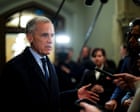
Mark Carney is a man who deals in the cold, hard logic of numbers and the grand, sweeping movements of global markets. He has run the Bank of Canada. He has run the Bank of England. He is, by almost any definition, a creature of the board room. Yet, when Carney stepped into the fray, he didn't lead with a balance sheet. He led with the soul of a country.
Carney’s rebuke of Rousseau wasn’t a lecture on linguistics. It was a reminder of what leadership actually looks like in a fractured world. Imagine, for a moment, a hypothetical small-town mayor in rural Quebec. Let’s call her Sylvie. For Sylvie, Air Canada isn't just a corporation; it is the "Maple Leaf." It is the symbol painted on the tail of the plane that connects her community to the world. When she hears that the man at the helm of that symbol couldn't—or wouldn't—speak to her in her mother tongue after living in Montreal for years, the distance between the boardroom and the sidewalk becomes an abyss.
Carney understood something that Rousseau seemingly missed: symbols matter.
A CEO is more than a chief administrator. They are the chief storyteller. If the story you are telling is that one of the two founding languages of your nation is a secondary concern, an "inconvenience" to be managed rather than a culture to be embraced, you aren't just failing a French test. You are failing a leadership test.
The Invisible Stakes of a Monoglot Mindset
Business school textbooks often talk about "frictionless" commerce. They suggest that the world is shrinking, that English is the undisputed lingua franca of the sky, and that as long as the planes land on time and the dividends are paid, the rest is just "optics."
This is a lie.
The stakes are invisible until they are absolute. Language is the primary technology of empathy. It is how we signal to another human being that we see them, that we respect their history, and that we are part of the same tribe. When Air Canada’s chief executive admitted he hadn't found the time to learn French despite decades of opportunity, he didn't just insult a demographic. He signaled a lack of curiosity. He signaled that his world was smaller than the country he was tasked with representing.
Consider the mechanics of a crisis.
In the cockpit, "Standard Phraseology" is a safety requirement. Pilots use specific, coded English to ensure there is no room for ambiguity. This is functional. It keeps the plane in the air. But a corporation does not live in the sky alone. It lives on the ground, in the hearts of the people who buy the tickets. On the ground, communication isn't about "standard phraseology." It’s about resonance.
When Mark Carney pointed out that a leader of a national institution must embody the values of that institution, he was calling out a growing trend of "technocratic insulation." This is the idea that if you are good enough at the "hard skills"—the finance, the logistics, the strategy—you can ignore the "soft skills" like culture and heritage.
But culture isn't soft. It’s the floor. And Rousseau had just fallen through it.
The Anatomy of an Apology
Rousseau eventually apologized, but the words felt like they had been passed through a filter of lawyers and consultants. The damage was done. The "English-only" message wasn't just a speech; it was a mirror held up to the corporate elite, showing a reflection that many Canadians found unrecognizable.
It raises a haunting question for any professional: What are you willing to learn to show that you care?
We live in an era where "global" is often used as a synonym for "homogenized." We are told that local quirks and regional identities are hurdles to be cleared in the race for efficiency. But the backlash against Air Canada proves the opposite. The more global we become, the more the local matters. The more we fly over borders, the more important it is to respect what happens on the ground beneath us.
Mark Carney’s intervention was a rare moment of a "money man" defending something that cannot be monetized. You cannot put a price on the feeling of being respected in your own home. You cannot calculate the ROI of a CEO who takes the time to struggle through a verb conjugation because it’s the right thing to do.
The Maple Leaf in the Wind
The incident has since become a case study in what not to do. But beyond the PR lessons, there is a human truth. We are all, in some way, the CEOs of our own lives and our own small circles. We all choose which languages we speak—metaphorically and literally—and which ones we ignore.
When we choose to remain in our silos, when we decide that the "other" way of speaking or being isn't worth the effort of learning, we aren't just saving time. We are shrinking our souls.
Air Canada is still flying. The planes still take off from Trudeau International and land at Pearson. The schedules haven't changed. But the "Maple Leaf" looks a little different now. It looks a little more fragile. It serves as a reminder that a brand is only as strong as the respect it shows to the people who built it.
In the end, the most important message wasn't the one Rousseau gave in English. It was the one he gave through his silence. It was a message that said: I am here, but I am not with you. Leadership is the art of saying I am with you, even when the words are hard to find, even when the grammar is broken, and even when the path to understanding is the longest flight of all.
The cockpit door remains closed, but the conversation on the ground is just beginning, and it is being spoken in every language but the one of indifference.
Would you like me to research the specific legal requirements for bilingualism in Canadian federal institutions to see how they apply to private-sector entities like Air Canada?