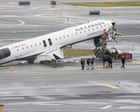
The headlines are bleeding with relief. "Miracle at LGA." "Disaster Averted." "Emergency Response Proves Effective."
It’s the same tired script every time a piece of multi-million dollar machinery clips another on the tarmac. We congratulate the pilots for not panicking and the fire crews for being fast, while completely ignoring the fundamental rot in the system that allowed two massive objects to occupy the same coordinate at the same time. For a deeper dive into this area, we suggest: this related article.
The consensus view is that this was a "freak accident" or a "lapse in communication." That is a lie designed to protect the status quo of archaic airport ground management. If you think a plane hitting a fire truck is just a bad day at the office, you aren't paying attention to the math.
The Myth of the Unforeseeable Collision
The narrative surrounding the LaGuardia incident suggests that because the plane was moving at taxi speeds and the fire truck was on an emergency roll, the collision was an unavoidable byproduct of a high-pressure environment. For additional background on this development, comprehensive coverage can be read on The Washington Post.
Nonsense.
In any other high-stakes industry—autonomous warehousing, high-frequency trading, or automated manufacturing—this kind of "interference" is a catastrophic systems failure. Aviation remains the only sector where we shrug off ground incursions as "human error" while refusing to implement the digital fences that would make human error impossible.
Ground controllers are still playing a 1950s game of "Eye Spy" with 150,000-pound aircraft. We rely on line-of-sight and verbal radio confirmations in an era where your $1,000 smartphone can track a delivery driver to within three feet.
The "lazy consensus" says the fire truck was doing its job. I argue that the system failed the driver and the pilot simultaneously. When an Aircraft Rescue and Firefighting (ARFF) vehicle is dispatched, it should trigger an immediate, automated hard-stop for all taxiing traffic in its projected path. We don't do this because the industry prizes "throughput" and "on-time performance" over the granular control required to actually prevent these clips.
Your Safety Is Being Managed by Post-it Notes
Let’s look at the actual mechanics of ground movement.
At LaGuardia—a cramped, logistical nightmare that shouldn't exist in its current footprint—space is the ultimate premium. The FAA uses ASDE-X (Airport Surface Detection Equipment, Model X) to track movements. It’s a sophisticated system, but it’s reactive. It tells a controller after a collision risk has manifested.
I have spent years looking at operational datasets for major carriers. The "battle scars" of ground ops aren't found in the crashes that make the news; they are found in the thousands of "near-misses" that occur because we refuse to move to a fully digitized, automated ground-control logic.
We are told that "human oversight" is the gold standard.
- Fact: Human reaction time is roughly 250 milliseconds.
- Fact: A narrow-body jet taxiing at 15 knots moves 25 feet per second.
- Fact: The verbal loop (Controller > Pilot > Brake Application) takes 3 to 5 seconds.
In those five seconds, the plane has traveled 125 feet. That is the distance between a "close call" and a fuselage breach. Relying on a human to see a truck, hit a radio PTT button, and a pilot to process that command is an invitation to physics to do its worst.
The Arrogance of "Emergency Priority"
The competitor articles love to highlight that the fire truck was responding to a separate emergency. This is used as a shield to deflect criticism.
"They were in a rush to save lives!"
This is the most dangerous logic in aviation. An emergency response that creates a second, potentially larger emergency is a failure of command, not a heroic effort. The fire truck’s "right of way" is a legal fiction that doesn't matter to a CFM56 engine.
The industry treats ARFF movements as wildcards. They shouldn't be. In a modern airport, an emergency vehicle’s GPS should be integrated into the transponder map of every aircraft on the field. If a truck enters a "hot zone," the cockpit should be screaming.
Instead, we rely on the ARFF driver to navigate a maze of taxiways while potentially looking at a thermal camera or a map, and we expect a pilot—whose visibility is restricted to a narrow forward cone—to spot a red truck coming from their 4 o’clock position. It’s a setup.
Stop Asking if the Passengers are Safe
The "People Also Ask" section of your brain is likely wondering: "Is LaGuardia safe to fly out of?" or "Are fire trucks common on runways?"
You are asking the wrong questions.
The question is: "Why are we still using verbal taxi clearances in 2026?"
The answer is cost and inertia. It is cheaper to pay the insurance premiums on the occasional wing-clip than it is to overhaul the Ground Management System (GMS) to a zero-trust, automated architecture.
If you want to fix this, you don't "retrain" the drivers. You don't "review" the radio transcripts. You remove the possibility of the encounter.
The Three Pillars of a Competent Airport
- Digital Twin Integration: Every vehicle, from the catering truck to the A320, must exist on a single, synchronized digital map with predictive pathing.
- Autonomous Braking Buffers: If an aircraft’s projected path intersects with a high-speed vehicle, the aircraft’s brakes should engage automatically, bypassing the pilot’s reaction time.
- Physical Decoupling: Fire stations should have dedicated "emergency lanes" that never intersect with active taxiways. If your airport is too small for this (looking at you, LGA), you shouldn't be running the volume you are.
The Brutal Reality of the LGA Layout
LaGuardia is a boutique airport trying to handle the volume of a global hub. It is a logistical miracle that these accidents don't happen daily.
When you hear people talk about the "upgraded" LGA, they are talking about the shiny terminals and the better food. They aren't talking about the taxiways, which remain a congested, convoluted mess. The "status quo" is to put a fresh coat of paint on a crumbling foundation and tell the public it's "world-class."
I’ve seen airlines lose millions in "hidden" costs—not from crashes, but from the sheer inefficiency of ground movements that prioritize "visual separation" over data-driven spacing. The fire truck crash is just the visible tip of an iceberg of operational incompetence.
Why "No Injuries" is a Dangerous Metric
The media will walk away from this story because nobody died. This is a mistake.
Using "lack of fatalities" as a metric for success is how you develop a "Normalization of Deviance." This is the term NASA used to describe why the Challenger exploded. If you ignore the small failures because they didn't result in a catastrophe, you are simply waiting for the variables to align for a massacre.
A plane hitting a fire truck is a "Small Failure" only by luck. If that truck hits the fuel tank in the wing instead of the landing gear or a cowling, we aren't reading a "What We Know" article. We are watching a 24-hour news cycle of a funeral.
Admitting that the system is broken is the only way to fix it. But admitting that would require the FAA and the Port Authority to acknowledge that their "modernization" efforts have been superficial at best.
The Actionable Truth
If you are a traveler, stop looking for "safety ratings." Look for airports that have implemented Surface Awareness Initiative (SAI) technology. Look for carriers that are pushing for ADS-B Out on all ground vehicles.
If you are an industry stakeholder, stop defending the "heroic" response of the crews and start demanding the removal of the human element from ground separation.
The "consensus" wants you to feel safe because the fire trucks are fast. I want you to feel outraged that the fire truck was there in the first place.
Stop praising the miracle. Start investigating the management.