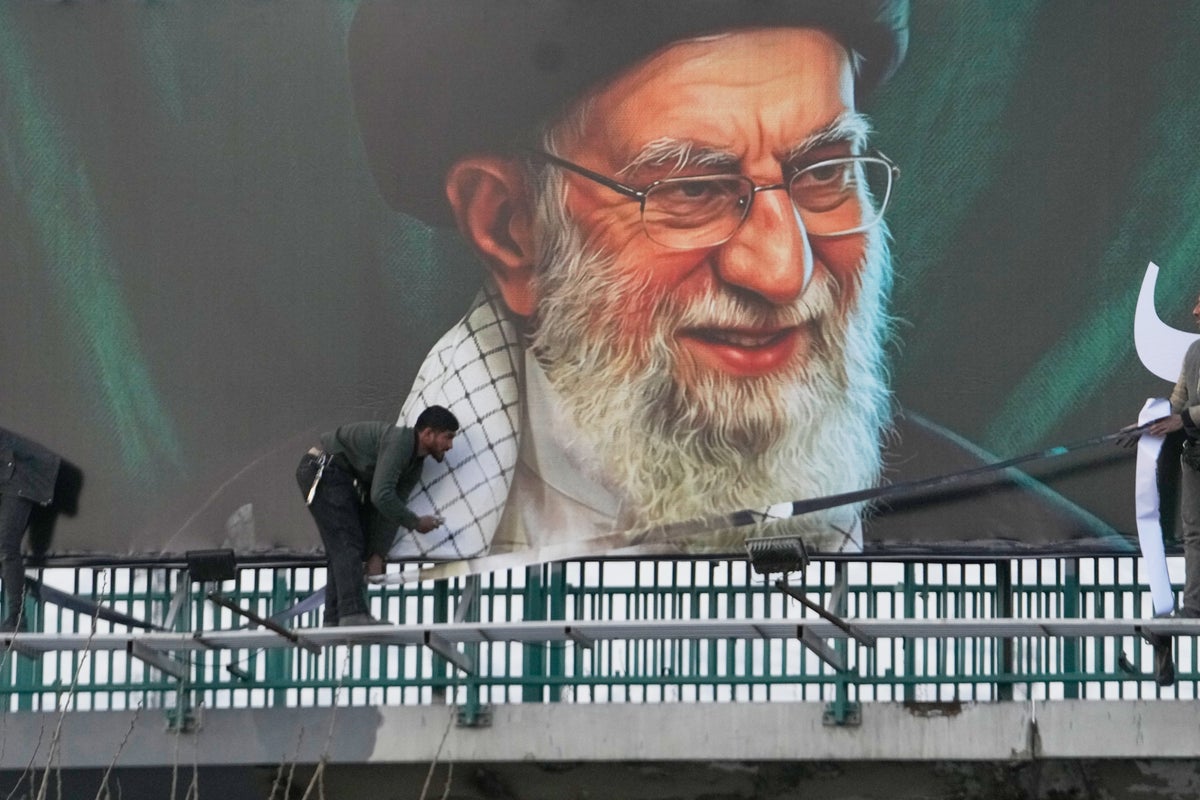
The recent elimination of Ali Khamenei in a precision strike has sent a shockwave through the global authoritarian axis, stripping away the illusion of state-level sanctuary. For Vladimir Putin, this isn't just a geopolitical shift in the Middle East. It is a terrifying proof of concept. The strike demonstrates that the traditional shields of power—deep bunkers, sophisticated jamming, and human layers of security—are failing against a new generation of kinetic and intelligence-driven warfare. The Russian leader is now recalibrating his survival strategy around a singular, haunting realization: the gap between "untouchable" and "target" has vanished.
The core of the Kremlin's current anxiety rests on the total failure of integrated defense systems to protect a high-value target in a hardened environment. If the supreme leader of a regional power can be neutralized in the heart of his own territory, the logistical math for every other autocrat changes instantly. This is not about a fear of a random assassination attempt. It is the cold, calculated fear of a technological overmatch that renders current Russian defensive doctrine obsolete. Also making headlines recently: The Kinetic Deficit Dynamics of Pakistan Afghanistan Cross Border Conflict.
The Myth of the Unreachable Leader
For decades, the security of the Russian presidency has relied on a philosophy of "total isolation." This involves a physical and digital blackout designed to make the leader a ghost in the machine. Putin’s reliance on physical couriers, the avoidance of smartphones, and the use of identical offices in different cities to mask his actual location are all tactics from a 20th-century playbook. They are designed to thwart human intelligence and basic electronic signals.
However, the strike on Khamenei signals that the intelligence gathering has moved beyond intercepting a phone call. It now involves a fusion of persistent satellite surveillance, thermal signatures that can track heat through concrete, and AI-driven pattern recognition that identifies a target’s "life pattern" even when they are trying to hide. Further insights on this are covered by Al Jazeera.
The Russian security apparatus, the FSO, is currently scrambling to address the fact that Putin’s habitual movements—his path from the Novo-Ogaryovo residence to the Kremlin—are now data points in a predictive algorithm. You cannot hide a motorcade from a drone that doesn't need to see the car to know it’s there. You cannot hide a person who needs to eat, breathe, and communicate with subordinates.
Signals Intelligence and the Invisible Snitch
One of the most overlooked factors in the recent decapitation strike is the role of the "digital exhaust" emitted by a leader's inner circle. While the principal target might stay off the grid, the hundred people required to keep him alive, fed, and informed do not. Every aide, cook, and bodyguard carries a potential beacon.
In Moscow, the paranoia has shifted toward the "inner circle" in a way we haven't seen since the Stalin era. But it’s more technical now. The concern is that Western intelligence isn't flipping generals with money; they are compromising the hardware those generals carry. If a single encrypted device in a bunker is compromised, the entire facility becomes a mapped coordinate.
The Kremlin has responded by intensifying the "cleansing" of the Ministry of Defense. While these arrests are publicly framed as anti-corruption measures, they serve a dual purpose: removing anyone with even the slightest hint of external vulnerability. A general with an offshore bank account is a general who can be tracked via his financial transactions. In the eyes of a paranoid leader, a corrupt subordinate is a GPS tag.
The Air Defense Paradox
Russia has long boasted that its S-400 and the newer S-500 systems create an "impenetrable dome" over Moscow and its strategic bunkers. The reality on the ground in Ukraine, where high-end Russian systems have been repeatedly picked apart by older Western tech, has already bruised this reputation. The Khamenei strike likely applied the killing blow to that confidence.
Precision strikes now utilize a combination of low-observable (stealth) cruise missiles and swarming electronic warfare that overwhelms radar. The math is simple and brutal. If you fire fifty decoys and one real penetrator, the defense system has to be 100% right, while the attacker only has to be right once.
Putin’s recent public appearances have become increasingly rare and tightly controlled, not just because of health rumors, but because the "dome" is no longer trusted. The move toward using deep-bore subway tunnels and Soviet-era "Metro-2" systems reflects a return to the earth. If the sky is no longer safe, the only option is to go deeper into the granite. But even there, "bunker-buster" technology like the GBU-57 Massive Ordnance Penetrator exists specifically to turn those sanctuaries into tombs.
The Psychological Siege
Living under the constant threat of a decapitation strike changes how a leader governs. It forces a retreat from the public eye, which in turn weakens the image of the "strongman" that the Russian state is built upon. When the leader becomes a hermit, the vacuum is filled by the ambitions of subordinates.
This is the "decapitation effect" even without a single shot being fired. By forcing Putin into deeper isolation, the West effectively limits his ability to manage the complex web of oligarchs and hardliners that keep him in power. A leader who cannot meet his people or his generals without a heavy veil of secrecy is a leader who is losing his grip on the narrative.
The paranoia is also fueled by the speed of the strike. There was no long build-up, no diplomatic warning. It was a clinical execution of power. For someone who views the world as a chessboard of slow, grinding maneuvers, the suddenness of modern kinetic warfare is a nightmare. It removes the time needed to negotiate or escalate. It is an "end-game" move delivered in the opening minutes of a conflict.
Hardened Silos and Soft Targets
The Russian state has spent trillions of rubles on hardening its nuclear command and control. These are the "hard targets." But the strike in the Middle East reminds Moscow that the leader himself is often a "soft target" in a hard shell.
We are seeing a massive shift in how the FSO manages Putin’s logistics. There is a reported increase in the use of decoy trains—armored, nondescript railcars that look like standard Russian Railways stock. The logic is that rail is harder to track than air travel and offers more physical protection than a limousine. Yet, even this assumes the adversary is looking for a train. In the age of cyber-physical attacks, the threat could just as easily come from a compromised piece of infrastructure software that causes a high-speed derailment.
The vulnerability is total. The Russian military-industrial complex is struggling to produce a countermeasure for a threat that moves at the speed of light and strikes with the weight of a mountain.
Redefining Red Lines
For years, the "red line" was a concept used by the Kremlin to deter Western intervention. The threat was always: "If you touch the leadership, we go nuclear."
The Khamenei strike challenged this bluff. It showed that the West is willing to call the hand of a nuclear-adjacent power. While Russia’s nuclear arsenal is vastly larger than Iran’s capabilities, the psychological barrier has been breached. The precedent is set. The untouchables are now reachable.
The current atmosphere in Moscow is one of frantic adaptation. They are trying to build a 21st-century fortress using 20th-century bricks, while the enemy is using 22nd-century tools. The bunkers are getting deeper, the walls are getting thicker, and the isolation is getting more profound. But in the quiet moments inside those reinforced rooms, the question remains: if the strike comes, will the walls even matter?
The era of the protected autocrat is over. Power now comes with a permanent, high-definition target painted on its back. The shift from offensive posturing to frantic survivalism is not just a change in policy; it is the death of the old guard’s sense of safety. Every shadow in the Kremlin now looks like a drone, and every hum in the air sounds like an incoming missile. The bunker isn't just a physical space anymore; it's a state of mind that eventually suffocates the person inside it.
Scrutinize the logistics of the Russian "Ghost Train" network and you will find the blueprint of a man who knows the sky is no longer his friend.