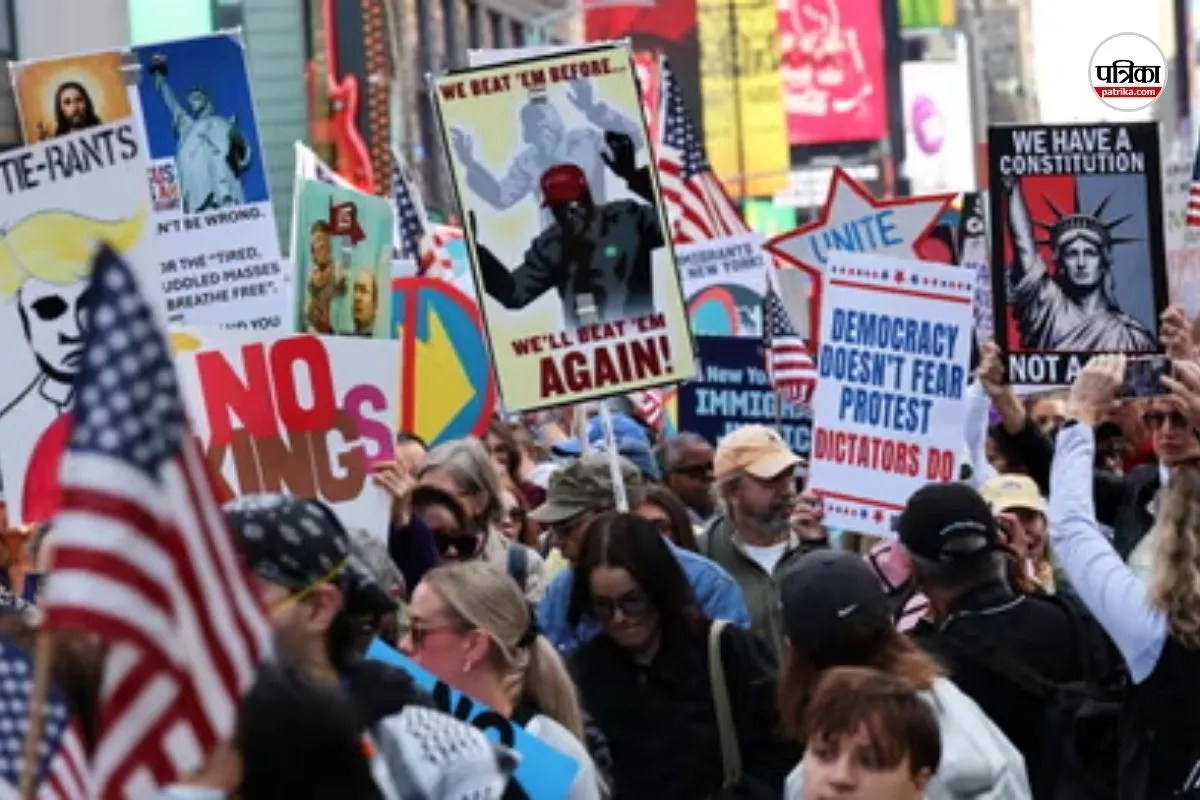
The streets of Washington D.C. and Los Angeles are currently choked not by the fog of war, but by the smoke of domestic dissent. While the Trump administration coordinates precision strikes against Iranian infrastructure following the collapse of regional stability, a domestic movement branded as "No Kings" has paralyzed major urban centers. This is not a standard anti-war protest. It is a fundamental rejection of executive overreach during a period of undeclared hostilites. The core of the anger stems from the White House's decision to bypass Congressional approval for a sustained bombing campaign, citing the 2001 Authorization for Use of Military Force (AUMF) as a legal blank check.
The "No Kings" moniker is a direct jab at the expanded powers of the modern presidency. Protesters argue that the current administration is treating the U.S. Constitution as a series of suggestions rather than a framework of law. As the conflict with Tehran escalates from maritime skirmishes to full-scale kinetic engagement, the domestic response has shifted from policy debate to civil disobedience. This movement is the physical manifestation of a nation that has reached its breaking point with perpetual executive warfare. If you found value in this article, you should read: this related article.
The Legal Fiction of the Perpetual War
For decades, the American public has watched as the executive branch slowly cannibalized the legislative branch’s power to declare war. The 2001 AUMF, originally intended to hunt the architects of 9/11, has been stretched so thin it is now being used to justify strikes against a sovereign nation in 2026. The "No Kings" movement has seized on this legal loophole. They are demanding an immediate sunset on all emergency war powers that have allowed the Trump administration to move troops and assets toward the Strait of Hormuz without a formal vote on the House floor.
This is where the investigative trail gets murky. While the administration claims these strikes are preemptive and necessary to prevent a nuclear-capable Iran, internal memos leaked from within the State Department suggest a different motive. There are indications that the "maximum pressure" campaign was designed specifically to trigger a response that would justify a broad military presence in the region, effectively securing energy corridors that have been under threat since the 2024 supply chain crisis. For another angle on this event, refer to the recent coverage from Reuters.
The protesters see this as a betrayal of the "America First" doctrine. They argue that billions of dollars are being funneled into a Middle Eastern quagmire while domestic infrastructure remains in a state of decay. The irony is sharp. A movement largely composed of the very demographic that felt abandoned by the previous political establishment is now turning its back on the man they once saw as their champion.
Financial Engineering Behind the Front Lines
War is expensive, but it is also a massive redistribution of wealth. As the No Kings protests grow, so does the scrutiny on the defense contracts signed in the last six months. Large-scale military operations require a surge in logistics, fuel, and munitions. Data from the Department of Defense shows a 40% increase in sole-source contracts awarded to firms with deep ties to the current administration's inner circle.
These are not coincidences. The protests are fueled by the perception that the Iranian conflict serves as a convenient distraction from a cooling domestic economy and a way to stimulate the industrial sector through government spending. When a cruise missile costs more than a public school’s annual budget, the optics of a 2026 bombing campaign become impossible to defend to a struggling middle class.
The No Kings organizers have cleverly linked the cost of the war to the rising cost of living at home. By highlighting the direct correlation between military spending and the inflation of basic goods, they have managed to bridge the gap between radical activists and disgruntled suburbanites. It is no longer just about "peace." It is about the price of eggs and gasoline.
The Geopolitical Gamble and the Tehran Response
Tehran is not a passive observer in this domestic American drama. Iranian state media has been broadcasting footage of the No Kings protests around the clock, using the images of American police clashing with their own citizens to undermine the U.S. moral high ground. This is a classic asymmetric warfare tactic. If you cannot defeat the U.S. military on the battlefield, you defeat the U.S. government in the court of public opinion.
The Trump administration’s strategy relies on the belief that a short, sharp series of strikes will force Iran to the negotiating table. History suggests otherwise. Every time an outside power intervenes in Iranian affairs, the various factions within the country—normally at each other's throats—unify against the common enemy. By striking now, the U.S. has likely inadvertently saved the Iranian regime from its own internal dissent.
The Collapse of the Centrist Consensus
For the last thirty years, there was a quiet agreement in Washington. Regardless of which party held the White House, the basic tenets of American hegemony were never questioned. That consensus has vaporized. The No Kings movement includes a strange-bedfellows coalition of far-left progressives and paleoconservative nationalists. They share a singular, burning desire to see the United States withdraw from its role as the world’s policeman.
The police response to these protests has been notably aggressive. In cities like Chicago and New York, the use of facial recognition technology and "non-lethal" crowd control measures has only validated the protesters' claims of an emerging autocracy. When a government uses the tools of war on its own citizens to protect its right to wage war abroad, it has lost the moral authority to govern.
Intelligence Gaps and the Fog of Disinformation
One of the most concerning aspects of the current conflict is the quality of intelligence being used to justify the escalation. Veteran analysts within the CIA have anonymously voiced concerns that the data regarding Iranian "imminent threats" is being massaged to fit a predetermined policy outcome. This is a haunting echo of the 2003 lead-up to Iraq.
The No Kings movement has been particularly effective at debunking administration talking points in real-time. Using decentralized verification networks, protesters are cross-referencing satellite imagery and local reports from Iran to challenge the official narrative. We are living in an era where a 20-year-old with a high-speed internet connection can sometimes provide more accurate battlefield assessment than a legacy news outlet.
This democratization of intelligence has made it impossible for the administration to maintain a monopoly on the "truth." Every time a spokesperson stands behind a podium and makes a claim, there are a thousand people online ready to pull it apart. This friction is what fuels the fire on the streets.
The Infrastructure of Dissent
The No Kings movement is not just a group of people with signs. It is a highly organized network with its own secure communication channels and legal defense funds. They have studied the failures of previous protest movements and have opted for a leaderless, decentralized structure that makes it nearly impossible for the government to "decapitate" the organization.
They are targeting specific nodes of the American economy. By blocking access to major ports and distribution centers, they are putting direct pressure on the corporate interests that benefit from a wartime economy. This is "economic sabotage" in the eyes of the law, but to the protesters, it is the only language the government understands.
The Militarization of the Homeland
As the strikes in Iran continue, the presence of National Guard units in American cities has become a permanent fixture. The visual of humvees on Main Street while B-21 Raiders fly missions over the Persian Gulf creates a surreal, fractured reality. The "No Kings" slogan has moved from a protest chant to a genuine cultural sentiment. It reflects a growing belief that the American experiment is being sacrificed on the altar of geopolitical relevance.
The administration’s refusal to engage with the protesters' core demands—a formal declaration of war or a total withdrawal—has created a stalemate. Neither side can afford to blink. For Trump, backing down means a loss of face on the global stage. For the protesters, giving up means accepting a presidency that operates without check or balance.
The Real Objective of the Maximum Pressure Campaign
If we look past the rhetoric of "defending democracy" and "stopping terror," the actual goals of the administration become clearer. This is a play for long-term regional dominance in a post-petroleum world. Iran holds the keys to several critical mineral deposits and trade routes that will define the next century of commerce.
The "No Kings" movement is essentially the first major anti-imperialist movement of the mid-21st century. It is not just about this war; it is about the entire philosophy of American power. The protesters are asking a question that the Washington establishment is terrified to answer: What happens if we just stop?
The answer, of course, is a vacuum. Other powers like China and Russia are waiting in the wings to fill the space left by an American retreat. The administration uses this "great power competition" as its ultimate justification. They argue that if the U.S. doesn't act as a king on the world stage, someone else will—and they will be much less benevolent.
A Republic in Name Only
The tension has reached a point where the legal system is starting to buckle. Several federal judges have issued stays against the use of certain executive orders, only to be ignored by the Department of Justice. This is the "No Kings" nightmare realized—a government that no longer recognizes the authority of the courts.
When the executive branch operates in a vacuum of accountability, the citizenry has two choices: submission or resistance. The streets are currently choosing resistance. The Iranian front may be thousands of miles away, but the real battle for the future of the American government is happening in the plazas and parks of the homeland.
Every night the protests continue, the legitimacy of the administration erodes a little more. The "No Kings" movement has successfully shifted the conversation from the tactical success of military strikes to the systemic failure of the American democratic process. They have made the war domestic.
The strategy of the White House now seems to be one of attrition. They hope that the protesters will eventually grow tired, that the media will lose interest, and that the "silent majority" will eventually demand order at any cost. But this isn't 1968 or 2003. This is 2026, and the digital and physical networks of dissent are more resilient than they have ever been.
The administration’s insistence on using the 2001 AUMF is the ultimate symbol of this disconnect. Using a law passed twenty-five years ago to fight a war today is not governance; it is an admission that the current system is incapable of generating a new consensus. The "No Kings" movement is simply holding a mirror up to that failure.
As long as the bombs keep falling in the Middle East, the barricades will remain in the West. The fracture is deep, and it may be permanent. The United States is no longer a country debating a war; it is a country debating its own identity. If the executive branch continues to act with the impunity of a monarchy, it should not be surprised when the people respond as revolutionaries.
Would you like me to analyze the specific legislative proposals being drafted by the "No Kings" legal team to replace the 2001 AUMF?