The air in the diner was thick with the scent of burnt coffee and diesel exhaust. In a small booth in rural Pennsylvania, a man named Jim—let’s call him Jim, though he represents a million faces in the American heartland—sat with his grease-stained cap resting on the table. For years, Jim has tuned into the same frequency. He watches the silver-tongued pundits and the firebrand commentators. He laughs at their jokes. He nods at their outrage.
But when it comes time to choose a captain for the ship, Jim doesn’t look for the man who makes him laugh. He looks for the man who built the dock.
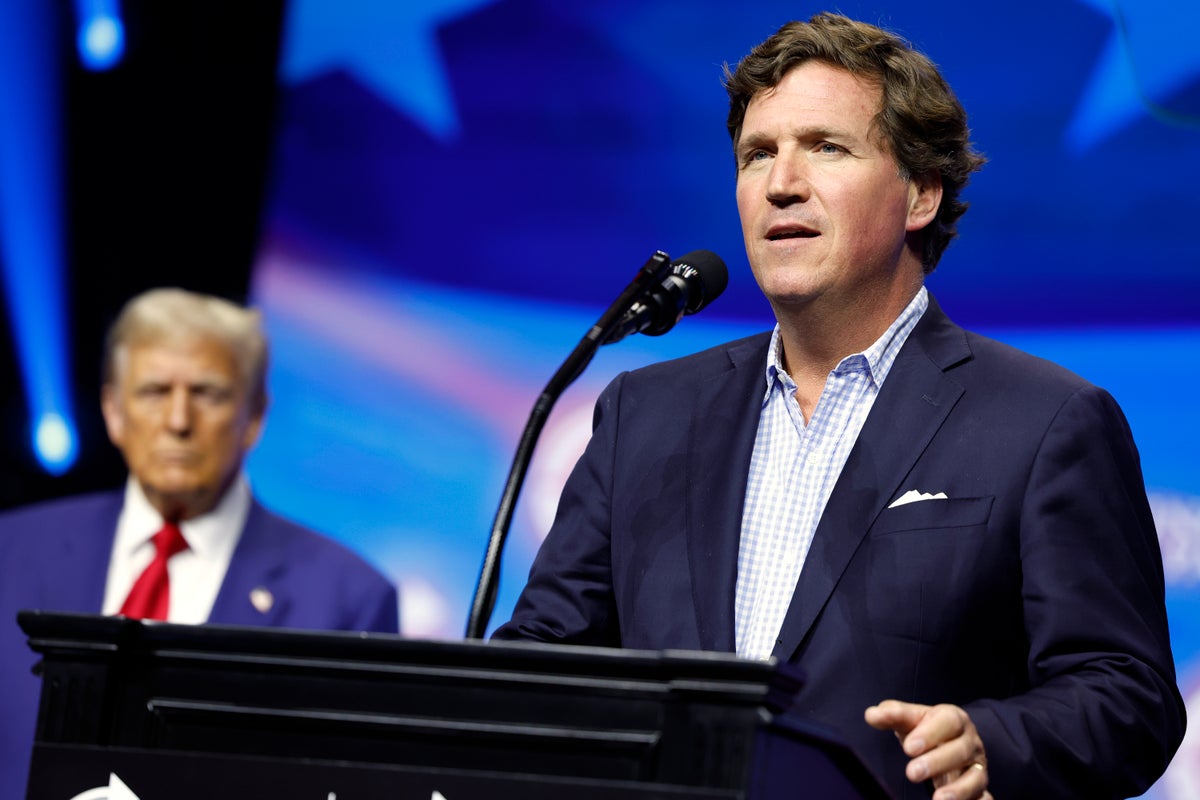
A recent wave of data has pulled back the curtain on a persistent myth in American politics: the idea that a media personality, no matter how beloved, can unseat the foundational architect of a movement. The numbers are staggering. Among the MAGA faithful, the preference for Donald Trump over Tucker Carlson isn't just a lead; it is a chasm. It is the difference between a spectator sport and a life's mission.
We often mistake volume for authority. Because Carlson’s monologues echoed through living rooms for years, the chattering classes assumed he was the natural heir to the throne. They saw the ratings. They saw the viral clips. They assumed that the audience belonged to the storyteller.
They were wrong.
The audience belongs to the protagonist.
The Weight of the Red Hat
To understand why Trump remains the immovable object in the path of every would-be successor, you have to look past the television screen. For the average voter in this movement, Trump isn't a "candidate" in the traditional sense. He is a historical event.
Consider the psychological investment. Since 2015, the MAGA base has weathered social ostracization, family arguments, and a relentless media barrage to stand by their choice. That kind of loyalty isn't built on witty commentary or clever segments about the ruling class. It’s built on the perception of shared scars. When Trump stands on a stage, his supporters don't see a politician; they see a man who took the arrows they feel aimed at themselves.
Tucker Carlson, by contrast, is a world-class observer. He is the man in the high tower, looking down and describing the battle with a smirk and a sharp tongue. He is brilliant. He is entertaining. He is, for many, essential viewing.
But he hasn't bled.
In the eyes of the voter, Carlson is the court jester—the smartest man in the room who can mock the king’s enemies. Trump is the king. You don’t replace the general with the man who chronicles the war.
The Polling of the Soul
The data points to a reality that many analysts find uncomfortable. When polled on a hypothetical matchup, the "outsider" appeal of a media figure evaporates the moment it touches the "builder" appeal of the former president. The margin isn't just a few points; it’s a total eclipse.
Why? Because politics, at its most primal level, is about the exercise of power, not the discussion of it.
Carlson’s rhetoric is often more ideologically "pure" or intellectually adventurous than Trump’s. He dives into the nuances of class struggle and the decay of the American empire. But the voter isn't looking for a thesis. They are looking for a battering ram. Trump, with his skyscrapers and his brash, unpolished execution, represents a physical reality. Carlson represents a digital one.
The invisible stakes here aren't about policy papers or tax brackets. They are about the human need for a champion who has actually occupied the arena.
The Illusion of Influence
We live in an era where we confuse followers for voters. We see a million likes on a post and assume it translates to a million ballots. This is the great deception of the digital age.
Influence is a soft currency. You can spend it on book deals, speaking tours, and podcast sponsors. But it rarely converts into the hard currency of political mandate. To govern is to carry the weight of the collective will. The MAGA voter recognizes that Carlson’s power is contingent on his platform. Trump’s power, in their eyes, is inherent to his person.
Think of it like this: If the power goes out, the storyteller falls silent. But the man with the hammer keeps working.
This preference reveals a sophisticated discernment among voters that the elite often miss. The base understands the difference between the "message" and the "messenger." They can love the show while knowing exactly who should be running the theater. They aren't being "tricked" by a media personality; they are using the media personality as a tool to sharpen their own resolve, all while keeping their eyes fixed on the man they believe actually changed the trajectory of their lives.
The Fortress of Identity
There is a specific kind of loneliness in being a voter who feels ignored by the mainstream. When you find a leader who finally speaks your language, that leader becomes a part of your identity.
To choose Tucker over Trump would be, for many, a form of soft betrayal. It would be an admission that the struggle of the last decade was about "content" rather than "conviction." By choosing Trump by such an overwhelming margin, the base is signaling that their movement is not a fad or a media phenomenon. It is a blood-and-iron commitment to a specific individual who they believe sacrificed a gilded life to fight in the mud.
Carlson’s "termination" from mainstream cable only heightened his status as a martyr of the truth, but it didn't elevate him to the status of a commander. If anything, it solidified his role as the ultimate outsider—a role that is fundamentally incompatible with the executive branch.
The voter knows that the man who describes the fire is not the man who puts it out.
The Long Shadow
As the political cycle churns, names will come and go. Pundits will speculate about "the next Trump" or "the smarter Trump." They will point to governors, senators, and TV hosts. They will analyze the "lanes" and the "demographics."
But they are missing the ghost in the machine.
The bond between the MAGA base and its founder is not a transaction. It’s a marriage. And in a marriage, you don't trade your spouse for someone who gives a better speech at dinner.
Jim, back in that Pennsylvania diner, finishes his coffee. He doesn't need a poll to tell him how he feels. He knows that when the world feels like it's spinning out of control, he doesn't want a narrator. He wants a driver. He wants the man who has already been behind the wheel, crashed the car, and walked away from the wreck with a scowl.
The storyteller can describe the horizon, but only the builder can take you there.
In the quiet of the voting booth, the laughter fades, the viral clips go dark, and the only thing left is the heavy, undeniable weight of a name that has become a symbol. For the millions who wear the hat, there is no substitute. There is only the original.
The king remains on the throne, not because of what he says, but because of who they believe he is. And the man in the booth? He isn't looking for a new story. He’s waiting for the next chapter of the only one that ever mattered to him.