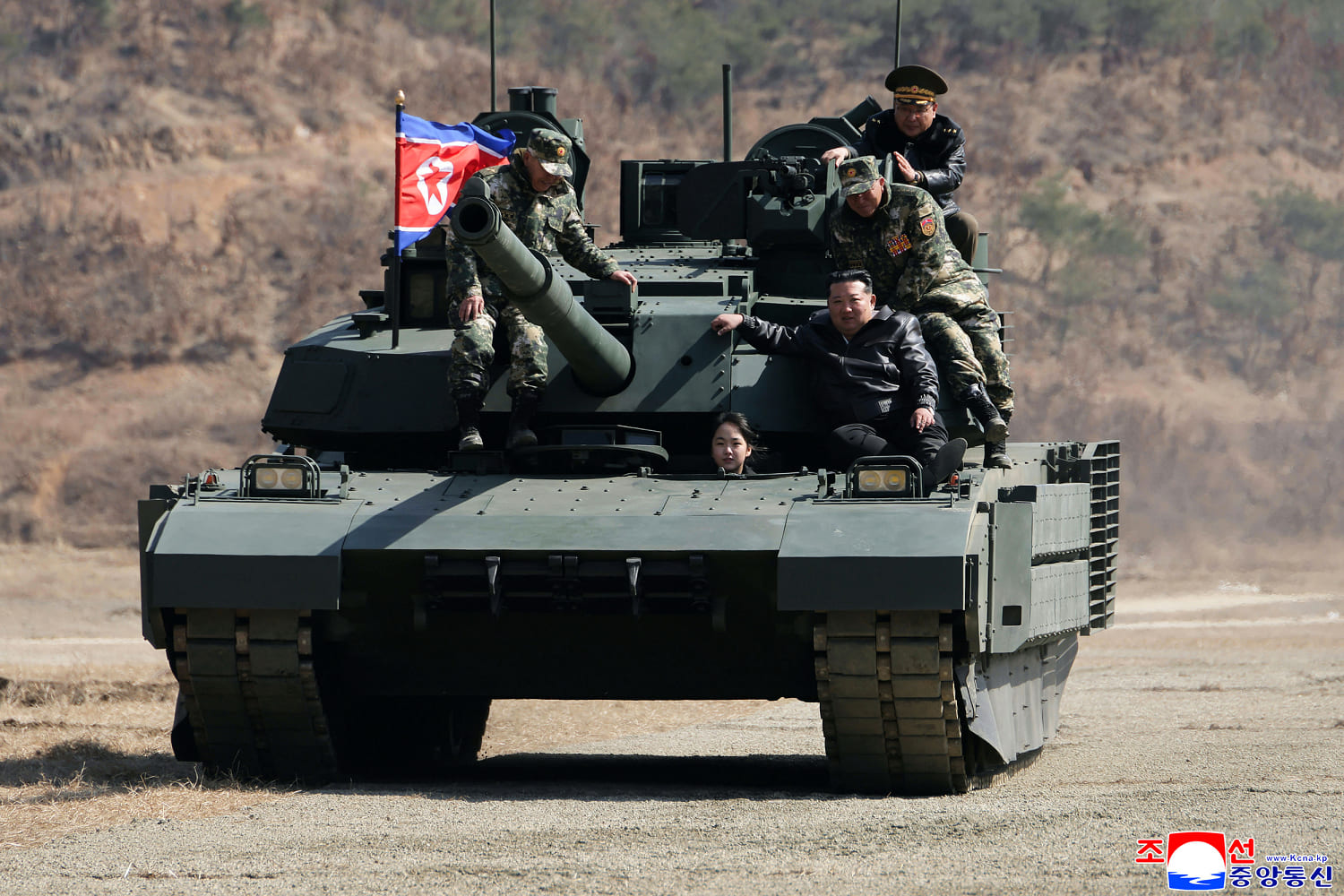
The appearance of Kim Jong Un and his daughter, Kim Ju Ae, operating a main battle tank during large-scale military exercises is not a human-interest story but a calculated deployment of "Kinetic Theatre." This operational doctrine uses high-visibility military hardware to validate three distinct strategic objectives: the normalization of the hereditary succession line, the demonstration of domestic industrial indigenousness, and the tactical pivoting toward offensive maneuver warfare. By transitioning from the static imagery of missile launches to the dynamic, physical occupation of a tank—a platform requiring manual operation and frontline presence—the North Korean leadership is signaling a shift from a posture of "deterrence by punishment" to "deterrence by denial" and potential regional overmatch.
The Succession Matrix: Integrating Ju Ae into the Command Structure
The presence of the "respected daughter" in the cockpit of a tank moves her profile beyond the ceremonial. In previous appearances, her role was observational, often framed within the context of strategic missile forces. The transition to conventional ground force exercises serves a specific demographic and institutional function.
- Institutional Anchoring: By placing the successor-apparent within the Army's tank divisions, the regime is attempting to secure the loyalty of the ground force officer corps, the most numerically significant branch of the Korean People's Army (KPA).
- Generational Continuity: The imagery creates a visual link between the "Precious Child" and the physical defense of the state, suggesting that the Kim dynasty’s survival is inextricably linked to the KPA’s operational readiness.
- Gender Neutralization in Command: North Korean propaganda is systematically eroding the traditional patriarchal barriers of the military hierarchy by presenting the daughter as a direct participant in high-intensity training, rather than a mere spectator.
The Technical Pivot: Analyzing the New Main Battle Tank (MBT)
The vehicle showcased in the exercise, often referred to by Western analysts as the "M2020," represents a significant departure from the Soviet-legacy T-62 and T-72 derivatives that have long defined the KPA’s armored units. The logic of this development suggests a focus on survivability and digitized fire control.
The Survival Function
The M2020 features a silhouette that mimics the US M1 Abrams and the Russian T-14 Armata. This is not merely aesthetic. The angular turret design suggests the integration of composite armor and potentially explosive reactive armor (ERA) panels designed to defeat tandem-charge anti-tank guided missiles (ATGMs). The inclusion of hard-kill active protection systems (APS)—visible as launch tubes around the turret perimeter—indicates an attempt to counter the precision-guided munitions that have dominated recent Eurasian conflicts.
The Firepower Variable
The primary armament, likely a 125mm smoothbore gun, is supplemented by externally mounted ATGM launchers. This configuration compensates for potential deficiencies in long-range kinetic energy penetrators by providing a high-explosive anti-tank (HEAT) capability at ranges exceeding 4 kilometers. This allows the KPA to engage South Korean K2 Black Panther tanks before entering the "kill zone" of superior Western-style optics.
Operational Doctrine: From Defensive Depth to Maneuver Supremacy
The specific exercise involving Kim Jong Un "driving" the tank signifies a shift in KPA doctrine. Historically, North Korean armor was viewed as a secondary exploitation force or a static defensive tool. The recent emphasis on high-speed maneuver training indicates a refined focus on three operational pillars:
- Shock Action: Using the M2020’s improved power-to-weight ratio to achieve rapid breakthroughs in the Demilitarized Zone (DMZ), aiming to encircle forward-deployed units before reinforcements can arrive.
- Urban Penetration: The upgraded sensor suites and remote weapon stations (RWS) suggest the tanks are being optimized for the complex terrain of the Seoul metropolitan area, where situational awareness is the primary bottleneck for armored survivability.
- Command Presence: The leader’s personal involvement in "tank driving" serves as a psychological operation (PSYOPS) to project an image of a "Warrior King," contrasting with the perceived technocratic and distant leadership of his adversaries.
The Industrial Constraint: Procurement vs. Propaganda
While the visual evidence suggests a leap in capability, a rigorous analysis must account for the "Sanctioned Industrial Gap." North Korea’s ability to mass-produce advanced electronics, thermal imagers, and high-output diesel engines remains unverified.
- The Component Bottleneck: Modern MBTs require high-end semiconductors for ballistic computers and localized network-centric warfare. North Korea likely relies on illicit procurement networks or "dual-use" civilian technology to fill these gaps.
- The Fleet Dilution Effect: Even if the M2020 is as capable as advertised, the KPA cannot replace its 4,000+ legacy tanks overnight. This creates a tiered force structure where a small "Praetorian Guard" of modern armor is expected to lead, while the bulk of the force remains vulnerable to modern anti-tank systems.
The Geopolitical Cost Function
This exercise is timed to coincide with US-South Korea joint military drills (Freedom Shield). The cost function for North Korea involves a trade-off: every liter of fuel and every hour of maintenance spent on these high-profile maneuvers is a diversion of scarce resources from the civilian economy. However, the regime views the "deterrence ROI" (Return on Investment) as high. By demonstrating that their leader is literally "in the driver's seat" of a modern tank, they signal that any conflict will be met with immediate, decisive, and personally directed maneuver warfare.
The tactical reality is that these tanks, while impressive in a vacuum, operate in an environment increasingly dominated by Unmanned Aerial Vehicles (UAVs) and man-portable air-defense systems. The KPA's next logical evolution will be the integration of electronic warfare (EW) suites directly onto these armored platforms to jam the signals of the drones that currently threaten the relevance of the main battle tank on the modern battlefield.
Monitor the deployment patterns of these M2020 units. If they are permanently stationed near the DMZ rather than kept in Pyongyang for parades, it signals a definitive shift from political posturing to genuine offensive preparation. Military planners should prioritize the saturation of anti-tank assets and drone-swarm capabilities in the frontline sectors to negate the shock-action advantage North Korea is currently attempting to build.