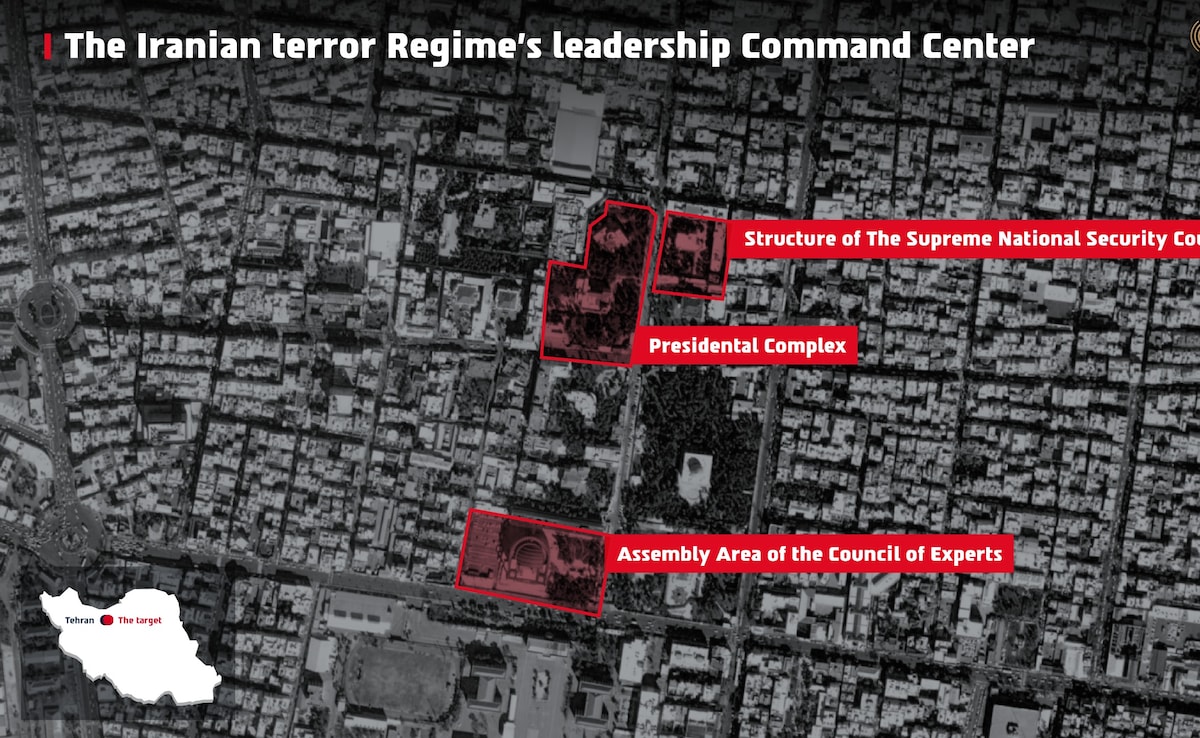
The overnight strikes on the presidential office and key administrative complexes in Tehran represent a fundamental shift from attrition-based warfare to the systematic deconstruction of state symbolism and command-and-control (C2) integrity. This operation functions as a high-stakes proof of concept for "Sovereignty Erasure"—a military doctrine where the objective is not the destruction of the standing army, but the public demonstration of a state's inability to protect its most sacred political geography.
The Geography of Vulnerability
Targeting the presidential office involves a sophisticated calculation of risk and psychological impact. Military planners categorize urban targets based on their functional and symbolic utility. In this instance, the strike profile bypassed traditional industrial or military outskirts to penetrate the "Green Zone" equivalents of Tehran. This necessitates three distinct technological successes:
- Electronic Warfare Neutralization: Penetrating Tehran’s integrated air defense system (IADS) requires more than stealth; it requires the active suppression of S-300 and indigenous Bavar-373 radar arrays. The failure of these systems to intercept incoming munitions suggests a catastrophic gap in Iran's mid-to-high altitude detection capabilities.
- Precision Geofencing: Striking a specific administrative building within a dense urban grid without flattening the surrounding civilian infrastructure minimizes international legal blowback while maximizing the internal political shock.
- Signal Intelligence (SIGINT) Correlation: The timing of the strikes—hitting the presidential office specifically—implies real-time intelligence on the movement of personnel or the lack thereof, signaling to the Iranian leadership that their physical locations are monitored with sub-meter accuracy.
The Three Pillars of Strategic Parallels
The Israeli strategy relies on a triad of pressure points designed to force a collapse of the Iranian deterrent model.
I. The Credibility Gap
For decades, Iran has relied on "Strategic Patience" and the threat of proxy escalation. By striking the heart of the capital, Israel effectively "called the bluff" of the Iranian defensive umbrella. When a state cannot protect the office of its executive, the social contract regarding national security begins to fracture. The deterrent value of the Islamic Revolutionary Guard Corps (IRGC) is predicated on the perceived invulnerability of the core; that perception is now a defunct asset.
II. Command Decentralization Force-Majeure
When central command hubs are targeted, the leadership is forced to decentralize. While decentralization can sometimes aid resilience, in a highly vertical autocracy like Iran’s, it creates a bottleneck. Subordinate commanders, fearing for their own safety and lacking clear directives from a compromised center, often succumb to "Paralysis of Choice." This strike effectively turned the Iranian bureaucracy into a series of isolated nodes with no secure way to synchronize a counter-response.
III. The Economic of Precision vs. Mass
The cost function of this engagement favors the attacker. Israel utilized high-cost, high-precision munitions to destroy targets of infinite political value. Conversely, Iran is forced to invest billions into repairing air defenses and hardening underground facilities—investments that yield zero offensive return. This creates an asymmetric drain on the Iranian treasury, which is already strained by sanctions and internal economic stagnation.
Functional Breakdown of the "Presidential Office" Target
In military terminology, the presidential office is a "Soft Target with Hard Value." Unlike a hardened nuclear facility like Fordow, which is buried under mountains of rock, an administrative complex is relatively easy to damage physically. However, its value is high because it serves as the central nervous system for civil governance.
- Communication Interruption: The destruction of server rooms and secure line terminators within the complex severs the direct link between the Presidency and provincial governors.
- Intelligence Exposure: In the chaos of a physical strike, classified documents and digital assets are often moved or exposed. This creates a secondary "harvesting" window for intelligence agencies to track where sensitive materials are being relocated.
- Psychological Displacement: The forced relocation of the executive branch creates a visual of "leadership in hiding," which is a powerful tool for domestic opposition movements.
Tactical Vector Analysis
The technical execution of the strikes suggests a multi-vector approach. Rather than a standard squadron of F-35s dropping gravity bombs, the signature of the damage points to a combination of stand-off cruise missiles and loitering munitions (suicide drones).
The use of loitering munitions in the heart of Tehran indicates a significant security breach. These smaller assets are often launched from within or near the borders, suggesting that "cells" or autonomous units were able to operate inside Iranian territory. This internal-external pincer movement is more damaging than a traditional cross-border air raid because it proves that the IRGC’s internal security apparatus (the Basij and Intelligence Ministry) is porous.
The Risk of Escalation Miscalculation
Every strategic action carries a "counter-move cost." The limitation of this strike is the potential to trigger the "Samson Option" or a dash for nuclear breakout. If the Iranian leadership perceives that their conventional survival is no longer possible, the incentive to remain within the bounds of the Non-Proliferation Treaty (NPT) vanishes.
However, the counter-argument—and the one seemingly adopted by Israeli planners—is that a regime that cannot protect its central offices lacks the operational stability to manage a complex nuclear assembly and deployment sequence under active bombardment. The strike was likely intended to demonstrate that the window for a nuclear "breakout" is being physically narrowed by kinetic intervention.
Structural Deficiencies in the Iranian Response
The subsequent "all-clear" signals and downplaying of the damage by Iranian state media (IRNA) follow a predictable pattern of information control. By minimizing the event, the state hopes to prevent panic. However, this creates a secondary risk: Information Divergence.
When the citizenry sees smoke over the presidential complex but hears "minor technical incident" on the radio, the credibility of the state as a source of truth evaporates. This gap is where psychological warfare (PSYOPs) finds its greatest leverage. The strike was as much an attack on the Iranian "Information Dome" as it was on its physical structures.
The Shifting Equilibrium of Middle Eastern Power
This operation signals the end of the "Shadow War" era. Previously, both nations engaged in deniable sabotage, cyber-attacks, and maritime harassment. The transition to overt, daytime-level precision strikes on government buildings in the capital indicates that the "Rules of Engagement" have been rewritten.
The new equilibrium is defined by Dominance Through Transparency. Israel is no longer hiding its hand; it is showing its hand to prove that the opponent cannot block the move. This is a classic application of the "OODA Loop" (Observe, Orient, Decide, Act). By acting faster and more decisively than the Iranian decision-making cycle can process, Israel has seized the initiative, forcing Iran into a permanent state of reactive defense.
The immediate requirement for the Iranian regime is a visible, kinetic response to satisfy its hardline base and proxy network. However, the structural reality is that any significant retaliation risks an even more intrusive second wave from Israel, which has now proven it can hit any coordinate in Tehran with impunity. The "Cost-Benefit" of a major Iranian counter-strike is currently negative, leaving Tehran in a strategic "Check" position.
The strategic play for regional actors is no longer centered on preventing a conflict, but on managing the specific terms of Iranian capitulation or reform. Security architectures in the Gulf must now pivot from defending against mass-missile barrages to securing high-value leadership nodes against surgical, low-signature penetrations.
The next logical phase involves the "Decapitation of Proxy Logistics." Having demonstrated the ability to hit the head of the snake, the focus will likely shift to the neural pathways—the specific Iranian military advisors and shipment hubs in Syria and Lebanon that bridge the gap between Tehran's intent and Hezbollah’s capability. The "Green Zone" strike was the signal; the systematic dismantling of the "Land Bridge" to the Mediterranean is the inevitable sequence.