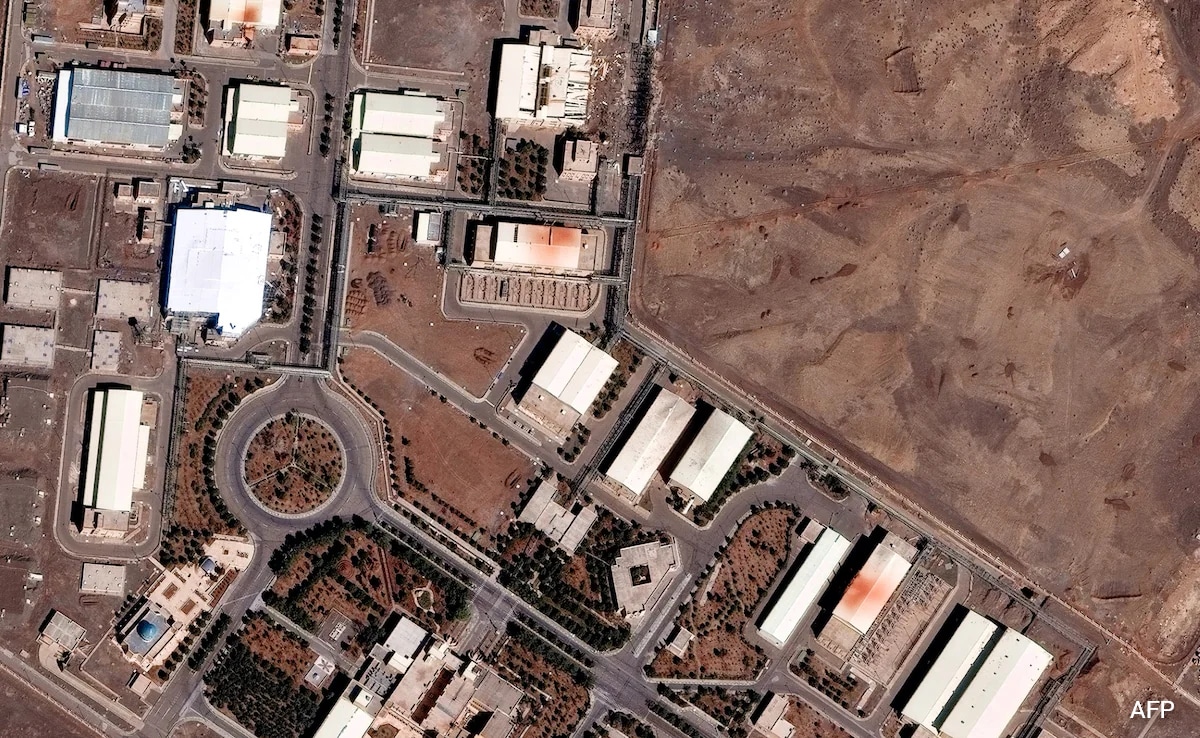
The vulnerability of hardened nuclear facilities to kinetic or cyber-electronic interference is not merely a matter of structural integrity, but of cascading systemic failure. In the context of the Natanz Fuel Enrichment Plant (FEP), the primary risk vector during an attack is not a traditional reactor meltdown, but the breach of containment during the enrichment of uranium hexafluoride ($UF_6$). Unlike a power reactor, which relies on a dense core of fissile material and high-pressure water cooling, an enrichment facility is an industrial-scale gas processing plant. Its danger profile is defined by the chemical toxicity of its feedstock and the mechanical energy stored in thousands of high-speed centrifuges.
The Physics of Centrifuge Failure
The Natanz facility relies primarily on IR-1, IR-4, and IR-6 centrifuges to isolate the $U^{235}$ isotope. These machines operate at rotational frequencies exceeding 1,000 Hz, where the outer wall of the rotor moves at supersonic speeds. This creates a high-energy environment where any physical disruption—be it an explosive charge or a frequency-altering cyber-attack—triggers a "crash."
When a centrifuge rotor fails at these speeds, it does not simply stop. The stored kinetic energy causes the rotor to disintegrate into shrapnel, which then impacts adjacent machines in a "domino effect" within the cascade. The primary radiological threat here is the immediate release of $UF_6$ gas.
- Sublimation and Chemical Reaction: $UF_6$ is a solid at room temperature but is processed as a gas under low pressure. Upon a breach of the vacuum system, the gas reacts instantaneously with moisture in the atmosphere.
- Hydrofluoric Acid Formation: The chemical reaction $UF_6 + 2H_2O \rightarrow UO_2F_2 + 4HF$ produces uranyl fluoride and hydrofluoric acid.
- Inhalation Risks: While uranyl fluoride is a radioactive particulate, the hydrofluoric acid ($HF$) represents a more immediate lethal threat to personnel due to its corrosive nature and its ability to cause systemic calcium depletion in the human body.
Structural Containment vs. Environmental Release
Natanz is architecturally divided into the surface-level pilot plant and the underground Fuel Enrichment Plant. The FEP is buried under approximately 7.5 meters of reinforced concrete and soil, a design intended to mitigate the impact of aerial bombardment. However, this hardening creates a secondary risk profile: the "Chimney Effect."
If an internal explosion or mechanical failure occurs within the hardened halls, the containment structure may prevent the immediate wide-scale dispersal of radioactive isotopes into the atmosphere. However, the facility’s ventilation and filtration systems become the weakest link. If the filtration units are compromised or bypassed by the pressure wave of an explosion, the pressurized $HF$ and $UO_2F_2$ are forced through service conduits and elevator shafts.
The environmental impact is largely governed by the mass of $UF_6$ present in the "feed" and "product" lines at the moment of the breach. Because enrichment is a continuous process rather than a batch process, the inventory of gaseous material is relatively low compared to the bulk storage of solid $UF_6$ in cooling stations. Therefore, a localized attack on a centrifuge hall is more likely to result in an industrial hazmat crisis than a regional radiological disaster.
The Strategic Redundancy of Power Systems
A critical vulnerability identified in the April 2021 incident at Natanz was the destruction of the internal power distribution grid. Centrifuges require a highly stable, uninterrupted power supply to maintain the precise frequency of rotation.
The failure of the power system triggers a catastrophic deceleration. Without active magnetic bearings or dampers powered by the grid, the rotors hit their "critical speeds"—the resonant frequencies where the machine naturally vibrates. Passing through these frequencies without active control causes the rotors to touch the casing, leading to the aforementioned mechanical disintegration.
Strategic analysis of this vulnerability reveals three distinct layers of impact:
- Immediate Loss of Material: The $UF_6$ currently in the machines is lost and contaminates the vacuum headers.
- Long-term Infrastructure Degradation: The "crash" often damages the carbon-fiber or high-strength aluminum casings, requiring a total teardown of the cascade.
- Decontamination Latency: Before engineers can re-enter the hall to replace the machines, the uranyl fluoride dust—which settles as a fine, radioactive film—must be manually scrubbed from every surface. This extends the operational downtime from weeks to months.
Quantifying the Radiological Footprint
To assess the true risk of an attack on Natanz, one must differentiate between "Low-Enriched Uranium" (LEU) and "Highly Enriched Uranium" (HEU). Natanz has historically produced LEU (3.5% to 5%) and has more recently moved to 20% and 60% enrichment levels.
The radiological hazard scales with the level of enrichment, but not linearly in terms of external dose. The primary danger of $U^{235}$ and $U^{238}$ is alpha radiation. Alpha particles are easily blocked by the skin or a sheet of paper; however, they are devastating if internalized.
In a breach scenario involving 60% enriched $UF_6$:
- Internal Exposure: The specific activity of the material is higher, meaning a smaller mass of inhaled dust can cause significant lung tissue damage and long-term kidney toxicity.
- Plume Dynamics: Because the facility is underground, the heavy $UO_2F_2$ particulates tend to settle near the source of the breach. Unless there is a high-energy thermal event (a fire involving the storage of bulk cylinders), the "footprint" of contamination is typically restricted to the facility perimeter and the immediate downwind area (within 1-3 kilometers).
The Bottleneck of Specialized Components
The recovery of an attacked enrichment site is not a construction problem; it is a precision manufacturing problem. The IR-6 centrifuges involve high-strength maraging steel or carbon fiber rotors and specialized frequency inverters.
The destruction of these components creates a strategic bottleneck. Even if the structural concrete of Natanz remains intact, the "functional destruction" achieved by a kinetic or cyber strike on the electrical sub-station is equivalent to a total loss of the facility's output for the duration of the procurement cycle for new rotors.
Operational Constraints and Mitigation Failure
The effectiveness of any emergency response at Natanz is hampered by the facility’s secretive and hardened nature. Access for international inspectors or specialized civilian hazmat teams is restricted. This lack of transparency increases the probability of "Mitigation Failure," where the initial chemical leak is handled improperly by military personnel who may lack the specialized equipment to neutralize hydrofluoric acid gas in a confined, underground space.
The strategic play for any actor aiming to neutralize the facility without causing a civilian catastrophe involves targeting the "Balance of Plant" (BOP). This includes the cooling water systems, the frequency inverters, and the backup diesel generators. By inducing a controlled failure of these systems, the facility is rendered inoperable through mechanical self-destruction of the centrifuges, while the bulk of the radioactive inventory remains safely contained within their transport cylinders.
For observers and analysts, the metric of success in a Natanz-style engagement is not the depth of the crater on the surface, but the duration of the "flatline" in the facility's power consumption data. A zero-power state in an enrichment plant is the definitive indicator of a successful mechanical crash and subsequent chemical contamination of the vacuum halls.
The operational focus must remain on the volatility of the $UF_6$ gas-to-solid transition. Any future incident at Natanz will be defined by the speed at which the facility can be decontaminated of uranyl fluoride, a process that is significantly more complex than the simple replacement of hardware. The tactical reality is that the contamination itself becomes a "passive defense" or an "active delay" mechanism, preventing the rapid re-installation of enrichment capacity.