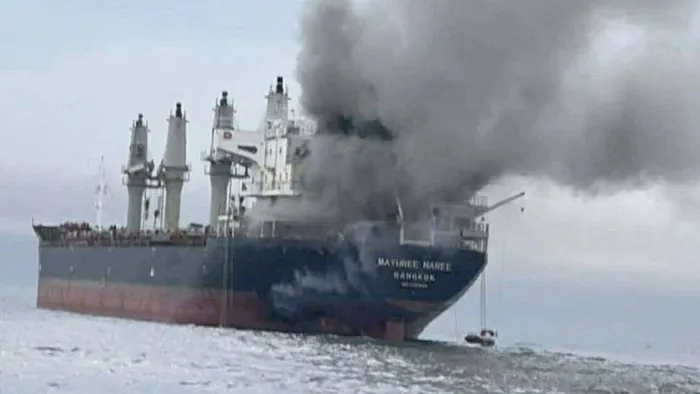
The recent physical strikes against three merchant vessels in the Strait of Hormuz represent more than a localized security breach; they signal a deliberate shift in Iranian maritime strategy from "shadow warfare" to "kinetic signaling." By deploying projectiles against commercial hulls, Tehran is testing the elasticity of global supply chains and the resolve of international maritime protection frameworks. This escalation is not a series of random tactical events but a calculated exercise in asymmetric leverage, designed to achieve specific geopolitical outcomes by manipulating the risk premiums of global energy transit.
Understanding the mechanics of these attacks requires a move beyond surface-level reporting. The Strait of Hormuz functions as a high-density choke point where 21% of the world's daily petroleum consumption passes through a transit lane only two miles wide in each direction. When a projectile strikes a vessel in this corridor, the primary damage is not found in the steel of the hull, but in the institutional architecture of global trade: insurance underwritings, freight rates, and the perceived reliability of the "Just-in-Time" delivery model.
The Triad of Maritime Vulnerability
The vulnerability of a vessel in the Strait of Hormuz is defined by three intersecting variables: Vessel Profile, Cargo Criticality, and Flag State Geopolitics.
- Vessel Profile: Large Crude Carriers (VLCCs) and Suezmax tankers offer the largest radar and visual cross-sections, making them primary targets for land-based anti-ship missiles or drone-launched munitions. Their limited maneuverability within the narrow Traffic Separation Scheme (TSS) prevents effective evasive action.
- Cargo Criticality: Attacks on ballast-state vessels (empty) send a different signal than attacks on fully laden tankers. Striking a laden vessel introduces the variable of environmental catastrophe, raising the stakes for coastal states like Oman and the UAE, effectively weaponizing the threat of an oil spill to force diplomatic concessions.
- Flag State Geopolitics: Selecting a vessel flagged to a specific nation allows the aggressor to "ping" the defense commitments of that nation’s allies. If a vessel under a "Flag of Convenience" (like Panama or Liberia) is hit, the response is often fragmented. If a vessel with direct ties to a major power is hit, the risk of a regional conflagration increases exponentially.
The Mechanics of Projectile Engagement
The shift toward "projectiles"—a category including loitering munitions (suicide drones), anti-ship cruise missiles (ASCMs), and rocket-propelled grenades—indicates an evolution in deniability and cost-efficiency.
Loitering Munition Dynamics
The Iranian-made Shahed-series drones represent a low-cost, high-precision solution for interdicting maritime traffic. These assets can be launched from mobile platforms on the Iranian coastline, making pre-emptive strikes by international coalitions difficult. The kinetic energy of a Shahed is insufficient to sink a double-hulled tanker, but the psychological impact is total. By targeting the bridge or the engine room, these munitions can effectively "mission-kill" a vessel without causing it to founder, leaving it adrift in one of the world's busiest waterways.
The Proximity Logic
Projectiles launched from the islands of Abu Musa or the Greater and Lesser Tunbs minimize the "detect-to-engage" window for shipboard defense systems. A subsonic cruise missile launched from these locations may have a flight time of less than 60 seconds. This creates a structural deficit in the defense capabilities of commercial vessels, which lack the Aegis-level integrated air defense systems found on naval destroyers.
The Cost Function of Maritime Instability
The immediate consequence of these three strikes is the recalibration of the War Risk Surcharge (WRS). Insurance markets, particularly the Lloyd’s Joint War Committee, react to kinetic events by expanding the "Listed Areas" where additional premiums are mandatory.
- Direct Costs: A single strike can increase the insurance premium for a VLCC transit by hundreds of thousands of dollars per voyage. These costs are rarely absorbed by the shipowner; they are passed through to the charterer and, eventually, the end-consumer.
- Operational Friction: To mitigate risk, vessels may opt for "high-speed transits" through the Strait, which significantly increases fuel consumption (bunker costs) and disrupts scheduled arrivals at refining hubs.
- Security Overhead: The demand for Privately Contracted Armed Security Teams (PCAST) increases. However, small arms carried by these teams are ineffective against incoming aerial projectiles, highlighting a mismatch between current maritime security protocols and the evolving threat profile.
The Strategic Intent of Kinetic Signaling
Iran's use of force in the Strait is rarely about the destruction of the target itself. Instead, it serves as a functional veto over international policy. By demonstrating the ability to strike three ships simultaneously or in quick succession, Tehran communicates that it can close the Strait at will, regardless of the presence of the U.S. Fifth Fleet or the European-led EMASOH mission.
This creates a "Security Dilemma" for Western powers. A heavy-handed military response—such as escorting every tanker (Operation Sentinel style)—is resource-intensive and potentially escalatory. A muted response, conversely, signals to the insurance and shipping markets that the Strait is a "contested space," leading to a slow-motion economic blockade as shipowners refuse to risk their assets in the region.
Defensive Limitations and the "Grey Zone" Gap
Current maritime law and naval doctrine struggle to address these "Grey Zone" activities. The Law of the Sea (UNCLOS) provides for "Innocent Passage," but it offers little in the way of proactive defense against non-state or state-sponsored proxy attacks that fall short of a formal declaration of war.
The primary limitation in the current defensive posture is the Sensor-to-Shooter Gap. While naval assets in the region have high-end detection capabilities, the sheer volume of traffic in the Strait—hundreds of vessels at any given time—makes it impossible to provide a defensive bubble for every potential target. The aggressor holds the "First Mover Advantage," choosing the time and place of the strike to maximize visibility and minimize the chance of interception.
Strategic Recommendation for Maritime Stakeholders
The escalation in the Strait of Hormuz necessitates a shift from passive monitoring to Active Resilience Modeling.
First, shipping conglomerates must move beyond standard insurance hedges and invest in Point-Defense Hardening. While full-scale anti-missile systems are cost-prohibitive, electronic warfare (EW) suites capable of jamming GPS and RF signals used by loitering munitions are becoming a commercial necessity.
Second, the international community must formalize a Proportional Response Framework. The current ambiguity regarding what constitutes a "red line" in maritime interdiction allows for continued escalation. A pre-agreed set of economic and cyber sanctions, triggered automatically by kinetic strikes on merchant shipping, would remove the "negotiation value" that Iran currently derives from these attacks.
Third, the energy market must accelerate the "bypass logic." The reliance on the Strait of Hormuz is a structural weakness in the global economy. Expanding the capacity of the East-West Pipeline in Saudi Arabia and the Habshan–Fujairah pipeline in the UAE is the only long-term method to degrade the strategic value of Iranian kinetic signaling. Until the "Hormuz Risk" is decoupled from the global oil price, the Strait will remain a theater where projectiles serve as the ultimate tool of diplomatic leverage.
The tactical reality is clear: as long as the cost of launching a $20,000 drone is significantly lower than the cost of the $200 million vessel it damages and the $100 million cargo it carries, the incentive for escalation remains. The defense must transition from protecting hulls to devaluing the attack itself through diversified transit and automated retaliation.