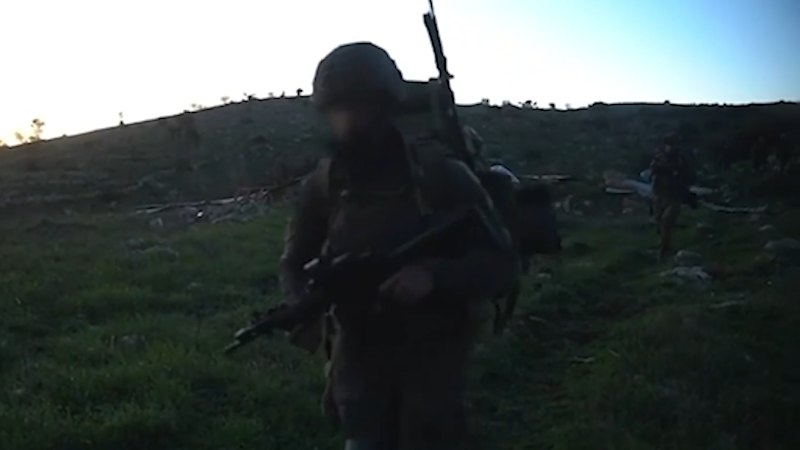
The shift from standoff precision strikes to close-quarters tactical engagement along the Blue Line signifies a transition from managed escalation to a high-density war of attrition. While media narratives often focus on the emotional weight of individual skirmishes, a structural analysis reveals that the current fighting is a function of two competing defensive architectures: Israel's "Active Defense and Rapid Maneuver" versus Hezbollah's "Subterranean Fortress and Asymmetric Saturation." The efficacy of these models is currently being tested not through grand territorial conquest, but through the systematic degradation of logistical nodes and personnel reserves.
The Geography of Asymmetric Friction
The conflict is defined by the topography of Southern Lebanon, which dictates the tactical possibilities for both state and non-state actors. This region acts as a natural force multiplier for defensive operations, characterized by limestone ridges and deep wadis that restrict vehicular movement to predictable "kill zones." Recently making headlines in related news: The Kinetic Deficit Dynamics of Pakistan Afghanistan Cross Border Conflict.
Hezbollah’s defensive strategy relies on The Three Pillars of Localized Resistance:
- Topographical Integration: Utilizing the rugged terrain to mask movement from Israeli Signals Intelligence (SIGINT) and Imagery Intelligence (IMINT).
- Decentralized Command: Small, autonomous units capable of operating without direct contact with a central headquarters, which mitigates the impact of Israel's decapitation strikes against senior leadership.
- Subterranean Hardening: An extensive network of tunnels and bunkers that serves as both a logistics backbone and a launching platform for short-range anti-tank guided missiles (ATGMs).
Israel’s offensive posture seeks to counter this through The Doctrine of Precise Eradication. This involves the integration of drone-based persistent surveillance with rapid-response artillery and air support. The goal is to collapse the "OODA Loop" (Observe, Orient, Decide, Act) of the Hezbollah cell before it can relocate after firing. The current "battle" is less about holding ground and more about the "sensor-to-shooter" timeline. More insights on this are covered by Reuters.
The ATGM Cost Function and Tactical Displacement
The primary technical driver of the current casualty rates is the evolution of Anti-Tank Guided Missiles (ATGMs), specifically the Kornet and its variants. In traditional warfare, armor provides a mobility advantage; in the current Lebanese theater, armor creates a high-signature target for relatively low-cost precision munitions.
The cost function of this engagement favors the defender. A single ATGM team, costing a few thousand dollars in equipment and months of training, can neutralize a Main Battle Tank (MBT) or a fortified outpost costing millions. This economic and tactical asymmetry forces the Israel Defense Forces (IDF) to adopt a "disaggregated maneuver" strategy. Instead of large armored columns, the IDF is utilizing smaller, highly mobile infantry squads supported by "loitering munitions"—drones that can stay airborne for hours before diving onto a target.
This creates a Tactical Bottleneck:
- For Hezbollah: The need to expose their positions to achieve a "line-of-sight" for ATGM launches makes them vulnerable to immediate counter-battery fire.
- For the IDF: The requirement to clear every individual ridge and structure manually slows the tempo of operations, extending the duration of the conflict and increasing the political cost of the campaign.
Intelligence Dominance versus Operational Secrecy
The efficacy of Israeli ground operations is tethered to the quality of real-time intelligence. The IDF utilizes a multi-layered reconnaissance stack, ranging from high-altitude satellites to micro-drones capable of entering buildings. This "Transparent Battlefield" concept aims to remove the "fog of war."
However, Hezbollah employs Passive Defense Mechanisms to counter this technical superiority. By using fiber-optic communication lines that are immune to electronic eavesdropping and maintaining a strict "no-emission" policy for radio equipment, they create "black holes" in the Israeli intelligence map. The result is a surge in close-quarters combat where technology is neutralized, and the outcome is decided by small-unit tactics and individual training.
The Logistical Attrition Logic
The sustainability of Hezbollah’s resistance depends on the "Rate of Replenishment." As the IDF targets the logistical corridors connecting the Bekaa Valley to the southern border, Hezbollah faces a diminishing supply of sophisticated weaponry. The war, therefore, is an equation of Consumption vs. Inflow.
- Inventory Depletion: Every rocket fired and every ATGM expended must be replaced. If the IDF can maintain a "Logistical Blockade" that exceeds the rate of replenishment, Hezbollah’s operational capacity will eventually reach a "Tipping Point" of exhaustion.
- Personnel Degradation: Unlike equipment, experienced combatants cannot be mass-produced. The loss of mid-level commanders—the "tactical glue" of the organization—creates a structural weakness that manifests as a lack of coordination during complex maneuvers.
The IDF faces its own logistical constraint: The Reserve Sustainability Ceiling. Maintaining a high number of reservists on active duty creates a significant drag on the Israeli economy. The strategy, therefore, must be to achieve high-impact results in a compressed timeframe to avoid an economic "death by a thousand cuts."
Structural Limitations of the Current Engagement
It is a misconception to view this as a purely military problem. The conflict exists within a framework of Mutually Assured Destruction (MAD) on a Micro-Scale. Both sides possess the capability to inflict significantly more damage than they are currently choosing to deploy.
- Hezbollah’s Strategic Reserve: They have yet to fully utilize their long-range precision-guided missiles (PGMs), which could overwhelm Israel’s Iron Dome and David’s Sling interceptors through sheer volume.
- Israel’s Total Force Projection: The IDF has not yet employed the full weight of its air force in a "carpet bombing" capacity, which would destroy the civilian infrastructure that Hezbollah uses for cover but would also lead to international isolation.
This "Restrained Escalation" creates a paradox where the fighting is intense at the tactical level but static at the strategic level. Neither side is currently pursuing a "Total Victory" because the cost of achieving it exceeds the perceived benefits.
The Signal-to-Noise Ratio in Frontline Reports
Quantifying the success of either side based on "villages captured" or "fighters killed" is a flawed metric. In modern asymmetric warfare, the only metric that matters is the Systemic Resilience of the adversary.
A "Masterclass" in this analysis requires looking at the Functional Neutralization of zones. If a village is cleared but the IDF cannot station troops there without facing constant mortar fire, the zone is not "captured"—it is merely "contested." Conversely, if Hezbollah retains its fighters but loses its ability to launch coordinated attacks against the Israeli Galilee, its "resistance" is effectively neutralized regardless of its survival.
The Strategic Recommendation for Future Alignment
The path forward for the IDF involves a shift from "Territorial Clearance" to "Network Disruption." Success will not be found in the physical occupation of Southern Lebanon, which historically leads to a quagmire, but in the permanent dismantling of the technical infrastructure (launchers, tunnels, and comms) that allows Hezbollah to project power.
For Hezbollah, the strategic goal is "Survival as Victory." If they can maintain a coherent fighting force and continue to harass northern Israeli communities, they satisfy their core objective of being an "unsolved threat."
The conflict is currently in a state of Dynamic Equilibrium. To break this, one side must achieve a "Technological or Tactical Surprise" that renders the other's defensive framework obsolete. Until then, the border will remain a theater of "High-Intensity Attrition," where the winner is not the one who gains the most ground, but the one who loses the least capacity to continue.
The next critical phase will be determined by the "First-to-Exhaust" principle. Watch the frequency of ATGM strikes relative to the intensity of Israeli air sorties; a divergence in these two lines will indicate which side is losing its logistical grip.
Would you like me to analyze the specific electronic warfare capabilities being deployed by both sides to see how they are impacting drone mission success rates?