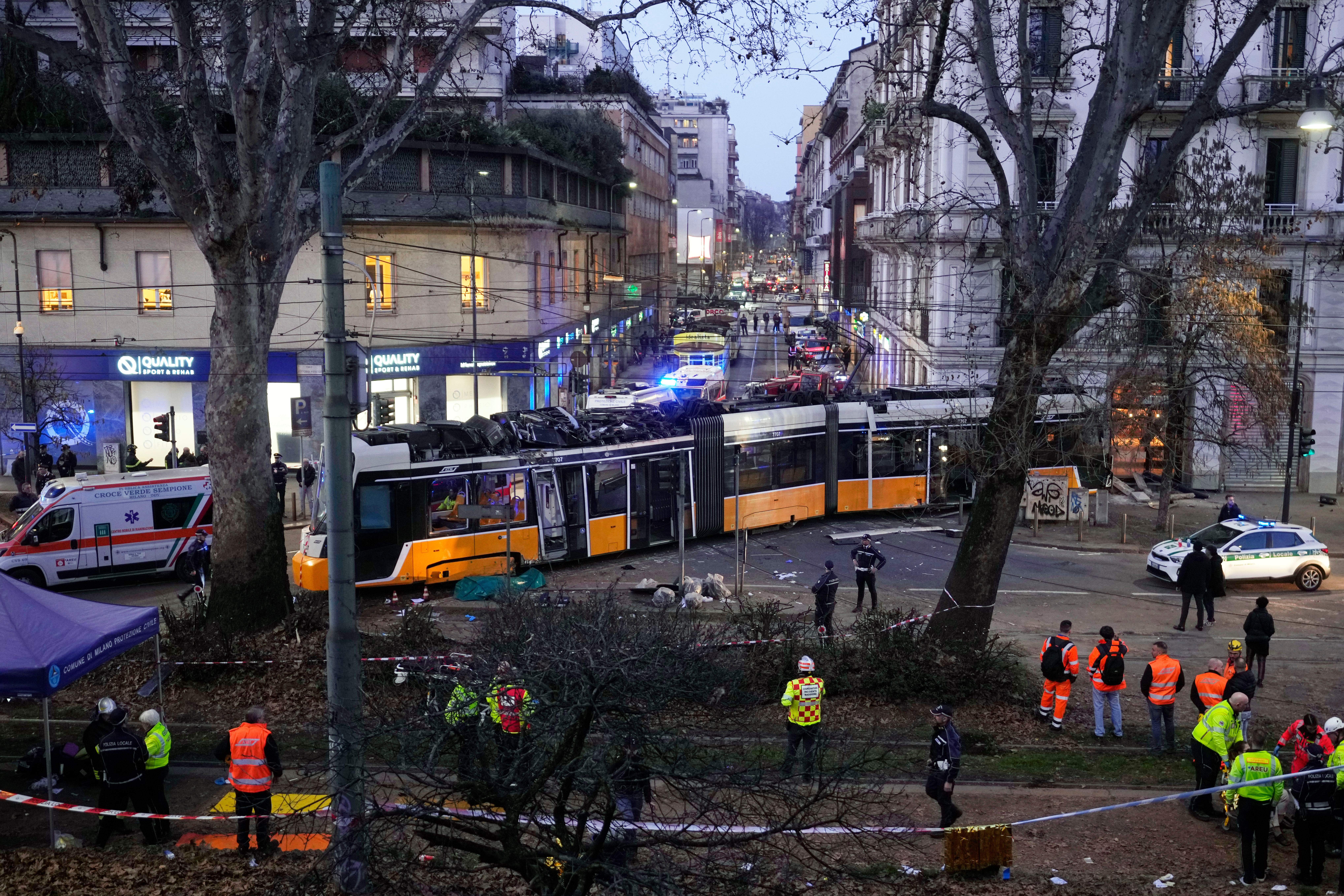
The collision of a Milanese tram into a residential building, resulting in a confirmed fatality, represents more than an isolated transit accident; it is a catastrophic failure of the kinetic management systems inherent to high-mass urban rail. When a vehicle weighing upwards of 40 tons deviates from its fixed guidance system, the transition from controlled rolling motion to uncontrolled structural impact follows a predictable, yet devastating, physical progression. Analyzing this event requires a deconstruction of the three critical variables: mechanical guidance integrity, operator-interface reliability, and the structural resilience of the urban envelope.
The Physics of Guided Path Deviation
A tram operates within a rigid constraints-based system. Unlike rubber-tired vehicles, which rely on friction and lateral vectoring for steering, a tram’s path is binary. It is either on the rail or it is a projectile. The derailment that preceded the building impact suggests a breach in the primary guidance logic.
The Mechanical Failure Vector
The point of divergence typically occurs at "special trackwork"—switches, frogs, or crossovers. If a switch blade is "floating" (not fully locked in position) or if foreign debris occupies the flangeway, the wheel flange climbs the rail head. At this millisecond, the vehicle ceases to be a guided transport unit and becomes a free-moving mass with significant linear momentum.
The Velocity-Mass Equation
The severity of the impact is a direct function of $E_k = \frac{1}{2}mv^2$. Because mass ($m$) is a constant in a fully loaded tram, the energy delivery to the building grows quadratically with velocity ($v$). A tram traveling at 30 km/h carries four times the destructive energy of one moving at 15 km/h. In the Milan context, the lack of "crumple zones" in historical masonry buildings means the kinetic energy is not dissipated by the structure but rather absorbed through catastrophic fracturing of load-bearing elements.
Human-Machine Interface and the Braking Bottleneck
Modern trams, including those operated by ATM (Azienda Trasporti Milanesi), utilize multi-stage braking systems designed to fail-safe. However, these systems are subject to the "latency of recognition."
- Electromagnetic Track Brakes: These are the final line of defense, using high-powered magnets to grip the rail directly, independent of wheel-to-rail friction.
- Sanders: Automated systems that drop grit onto the rails to increase the coefficient of friction during emergency deceleration.
- Dead-Man Switches: A psychological and physical safeguard requiring constant operator input to maintain motion.
If the derailment occurred due to excessive speed entering a curve, the "Human Factor" becomes the primary bottleneck. The gap between an operator perceiving an obstacle or a track anomaly and the engagement of the emergency magnetic brake is often between 1.5 and 2.5 seconds. At standard urban speeds, the vehicle will have traveled 20 to 40 meters before deceleration even begins. In dense European streetscapes like Milan, that distance often exceeds the gap between the tracks and the nearest storefront or residential facade.
Structural Vulnerability in Dense Urban Grids
The Milan incident highlights a systemic risk in "Integrated Street Running" where rail lines are placed in immediate proximity to high-occupancy buildings. This creates a zero-buffer environment.
The Zoning Failure
In modern light rail planning, a "Clear Zone" is maintained—a calculated distance where no permanent structures are permitted, allowing a derailed vehicle to slide to a stop without impacting a vertical load-bearing wall. Milan’s historic center, characterized by narrow 19th-century corridors, lacks this buffer. When the tram left the rails, there was no "run-off" space. The building acted as the primary decelerator.
Load-Bearing Interference
When a 40-ton vehicle strikes a building, the primary danger is not the impact itself but the compromise of the ground-floor pillars. Most Milanese buildings in the affected areas utilize masonry or early reinforced concrete. These materials are excellent under compression (holding up the floors above) but fail rapidly under lateral shear (the side-impact of a tram). If one pillar is removed by the impact, the "progressive collapse" mechanism is triggered, where the weight of the upper floors exceeds the capacity of the remaining supports.
Quantifying the Fatal Outcome
The fatality reported by officials is the result of "Energy Transfer Incompatibility." Human tissue cannot withstand the rapid deceleration of a high-mass impact. If the victim was a pedestrian or an occupant of the ground-floor unit, they were caught in the "Crush Zone" where the tram’s rigid steel frame met the building’s brittle masonry.
The investigation must now pivot to the "Black Box" or Event Data Recorder (EDR) of the vehicle. This device logs:
- Master Controller Position: Was the operator calling for power or braking?
- Line Voltage: Was there a power surge or drop that affected the braking logic?
- GPS and Wheel Tachometry: This identifies if the wheels were spinning or locked, indicating a "sliding" derailment versus a "jumping" derailment.
Systemic Risks in Aging Transit Networks
The Milan tram network is one of the oldest and most extensive in the world, utilizing a mix of "Peter Witt" 1920s-era cars and modern low-floor articulated units. Each presents different risk profiles. Older units have higher centers of gravity, making them more prone to tipping during a derailment. Modern units are heavier and articulated, meaning they can "accordion" upon impact, potentially trapping passengers within the vehicle's own structure.
The maintenance of track geometry is the most overlooked variable in urban safety. Over time, the "gauge" (the distance between the two rails) can widen due to thermal expansion and the constant lateral force of the trams. A widening of even 15mm can be enough for a wheel set to drop between the rails, leading to the exact type of deviation seen in this crash.
Strategic Response Requirements
To prevent a recurrence, the municipal transit authority must move beyond reactive maintenance and toward predictive spatial analysis.
Immediate Infrastructure Hardening
In areas where the track-to-building distance is less than 5 meters, the installation of reinforced "Bollard Arrays" is a tactical necessity. These are not standard decorative posts but deep-foundation steel pylons designed to arrest the motion of a 40-ton vehicle before it reaches a load-bearing wall.
Dynamic Speed Control (DSC)
The implementation of transponder-based speed limiters—similar to the European Train Control System (ETCS)—would remove the possibility of human error in high-risk zones. If a tram enters a curve or a switch at a speed exceeding the calculated safety threshold for that specific geometry, the system should automatically trigger the electromagnetic track brakes without operator intervention.
Vibration-Based Integrity Monitoring
By installing acoustic sensors on the track at major intersections, the transit authority can detect the "signature" of a failing bearing or a misaligned rail before it leads to a derailment. A wheel with a "flat spot" creates a specific frequency; identifying this via IoT sensors allows for the removal of the vehicle from service before the mechanical stress causes a guidance failure.
The Milan derailment is a stark reminder that in a high-density environment, there is no such thing as a minor mechanical failure. Every centimeter of track is a potential point of departure into a living space. The strategy moving forward must prioritize the isolation of kinetic energy from the built environment through a combination of automated speed enforcement and physical barriers.
Municipalities must audit every "Zero-Buffer" curve in their network. For every location where a tram's tangential path points directly at a residential or commercial structure, a rigorous risk-assessment must be conducted to determine if the current speed limits and track conditions provide a sufficient margin of safety. If the margin is found to be narrow, the only logical move is a permanent reduction in transit velocity or the installation of crash-rated structural reinforcements.
Identify every switch-point within 10 meters of a residential facade and install high-frequency automated inspection cameras to verify switch-blade closure in real-time. This is the only path to restoring the "Reliability-Safety" equilibrium in urban rail.