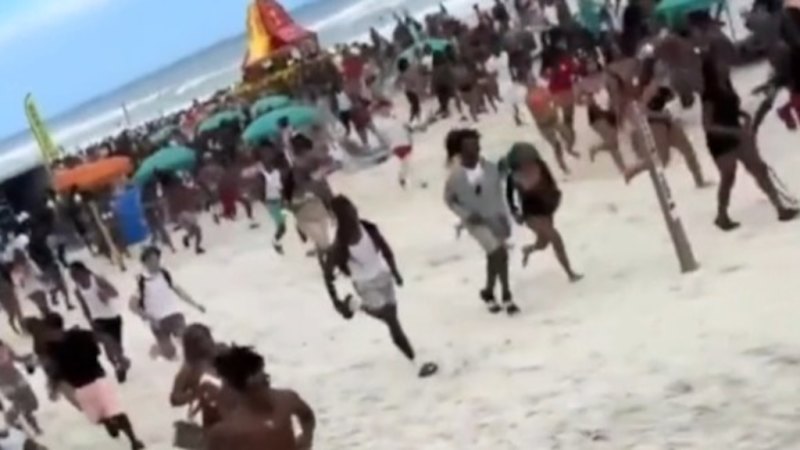
The sudden transition of a high-density public space from a leisure environment to a chaotic evacuation zone is not a random occurrence of panic but a predictable failure of spatial management and threat suppression protocols. When gunshots occur on a Florida beach, the resulting flight of thousands of civilians represents a breakdown in the "Security-Leisure Equilibrium." This analysis deconstructs the mechanics of public panic, the failure points in open-environment policing, and the economic fallout of kinetic violence in premium tourism zones.
The Triad of Open-Space Vulnerability
Public beaches present a unique set of variables that complicate traditional security frameworks. Unlike stadiums or commercial buildings, beaches are "porous perimeters" characterized by three specific structural weaknesses: For another view, see: this related article.
- Acoustic Ambiguity and Echo Mapping: In open-coastal environments, sound waves behave erratically due to wind resistance and the lack of vertical surfaces for reflection. This leads to "Directional Disorientation," where a crowd cannot accurately pinpoint the source of a kinetic threat, causing radial flight patterns that often lead people toward the danger rather than away from it.
- Topographical Impediment: Sand surfaces significantly degrade human velocity and increase the metabolic cost of movement. During an evacuation, this creates "Congestion Nodes" at the transition points between the beach and hard-surface boardwalks or parking lots.
- Visual Blind Spots: Low-lying obstacles—umbrellas, coolers, and chairs—create a fragmented line of sight. For law enforcement, this environment makes identifying a concealed weapon or an active shooter nearly impossible until the first discharge occurs.
The Mechanics of Crowd Kinematics
When a shot is fired, the crowd does not move as a single unit but as a series of cascading waves governed by the Reactionary Gap. This is the time delay between the auditory stimulus and the physical flight response.
The initial wave consists of those in the immediate "Kill Zone" (within 15–30 meters of the event). Their response is autonomic. The second wave, however, is driven by "Social Modeling"—people fleeing not because they heard the shots, but because they see others running. This creates a feedback loop where the density of the crowd becomes the primary danger. In the specific context of recent Florida beach incidents, the injury count often stems from blunt force trauma during the stampede rather than ballistic impact. Further coverage regarding this has been shared by The New York Times.
The failure of the "Safe Zone" perception triggers a rapid depreciation of the location's social capital. When a beach is perceived as a "High-Risk Perimeter," the demographic shift is immediate: high-spending families exit, and the area enters a cycle of "Security Decay," where the vacuum is filled by transient populations with lower stakes in the community's long-term stability.
Strategic Deficiencies in Rapid Response
Current municipal responses to beach-front violence rely heavily on reactive patrol units. This model is fundamentally flawed because it ignores the Time-to-Intercept Constant. On a crowded beach, a patrol officer’s movement is restricted by the same topographical impediments as the civilians.
Failure Point: The Communication Lag
Standard emergency communication involves a witness calling 911, a dispatcher processing the data, and a radio transmission to units. In a kinetic event on a beach, this 60–120 second delay is catastrophic. By the time an officer arrives at the GPS coordinates, the "Event Horizon"—the window in which the shooter is active—has usually closed, and the "Chaos Horizon"—the peak of the crowd stampede—has taken over.
Failure Point: Resource Misallocation
Many coastal cities prioritize "Visible Deterrence" (officers standing in high-traffic areas) over "Tactical Surveillance." While high visibility may deter petty theft, it does not prevent impulsive kinetic violence, which is often the result of interpersonal friction within a specific micro-group on the sand.
The Economic Cost of Perceived Insecurity
The impact of a single shooting incident on a beach extends far beyond the immediate crime scene. It initiates an Economic Contraction Cycle:
- Immediate Revenue Loss: Beachfront businesses (hotels, restaurants, rentals) see a 20-40% cancellation rate in the 72 hours following a widely publicized event.
- Insurance Premium Escalation: Repeated incidents reclassify the zone for commercial liability, increasing the overhead for small business owners.
- Brand Devaluation: For a state like Florida, where the "Beach Brand" is a multi-billion dollar asset, these incidents act as "Systemic Shocks" that drive tourists toward international competitors or inland alternatives.
The cost of a single event is not measured in medical bills alone; it is measured in the permanent shift of consumer behavior. Once a "Primary Destination" is flagged as "Volatile," the recovery period for its reputation can span years, regardless of subsequent safety improvements.
Engineering a Solution: The "Hardened Leisure" Framework
To mitigate these risks, municipal planners must move beyond the "More Boots on the Ground" fallacy. A more effective strategy involves the integration of technology and environmental design:
- Acoustic Shot Detection Arrays: Placing localized sensors along the beach that can triangulate the exact origin of a gunshot within three seconds. This data should be fed directly to the smartphones of on-site officers, bypassing the dispatch lag.
- Zonal Evacuation Lighting: Installing LED-integrated pylons that can change color (e.g., flashing red) to indicate the direction of the threat and green to indicate the safest exit route. This counters "Directional Disorientation."
- Density Management: Implementing "Soft Barriers" (landscaping, permanent seating) that prevent the formation of massive, monolithic crowds. By breaking the beach into smaller, manageable "Pods," the scale of a potential stampede is physically limited.
The current trend of "fleeing beachgoers" is a symptom of an outdated security philosophy. The beach is a high-risk environment masquerading as a low-risk one. Until the infrastructure reflects the reality of modern urban density and the potential for kinetic violence, the "Security-Leisure Equilibrium" will remain broken.
Municipalities must shift their investment from reactive policing to "Proactive Environmental Control." This means deploying high-resolution, AI-augmented surveillance that can detect "Aggressive Behavioral Clusters" before a weapon is even drawn. The objective is to identify the friction point—the argument, the posturing, the gathering of a hostile group—and intervene at the "Pre-Kinetic Stage." If the first point of contact is the sound of a gunshot, the security system has already failed.