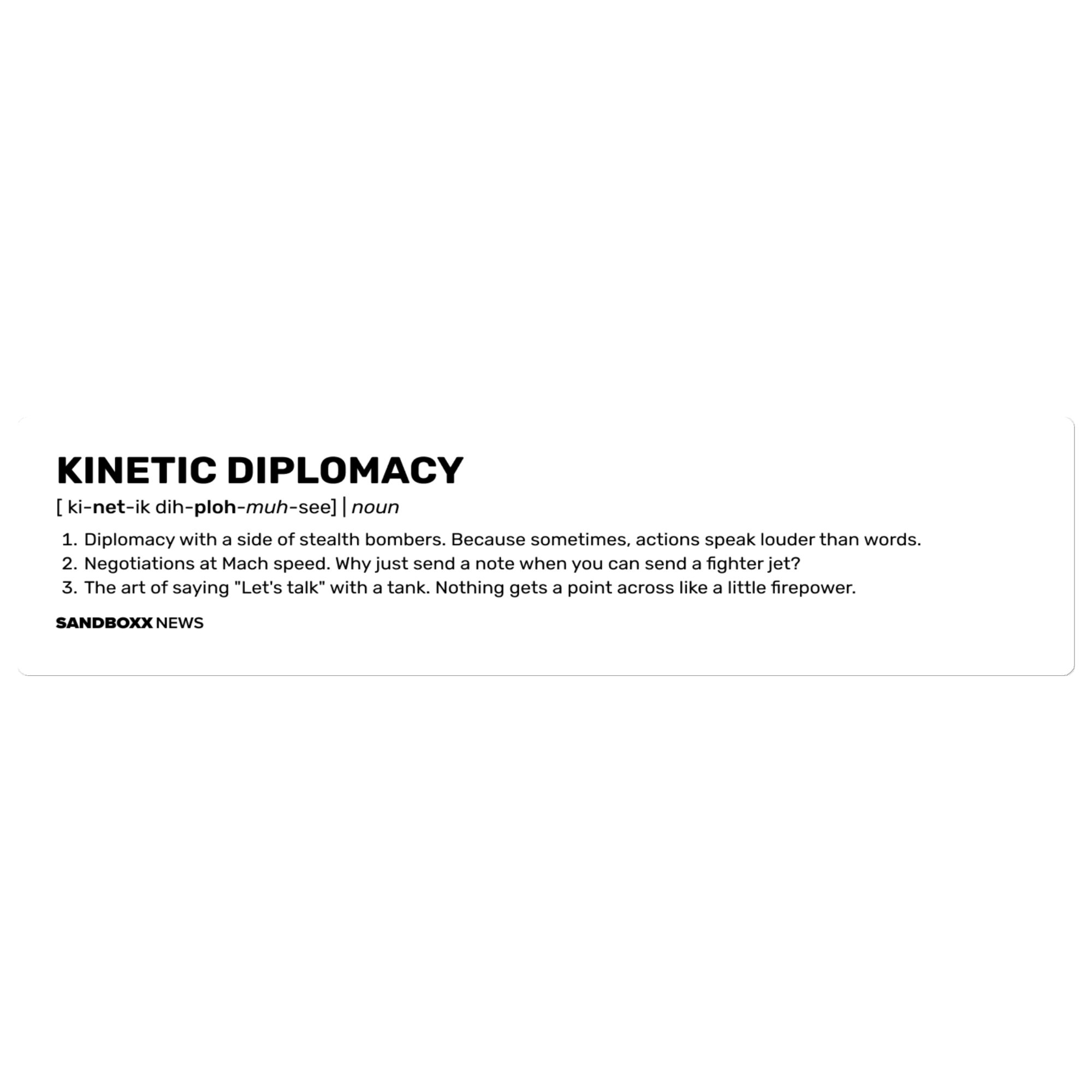
The foundational shift in American foreign policy under the current administration is the transition from institutionalized deterrence to Kinetic Signal Intelligence. While previous eras relied on the slow machinery of multilateral treaties and "strategic patience," the current doctrine operates on a shortened decision loop designed to compress the distance between a perceived provocation and a physical consequence. The core message—"We can reach you"—is not merely a rhetorical threat; it is an operational framework prioritizing unilateral precision over collective security frameworks.
The Triad of Reactive Force
To analyze the mechanics of this policy, we must deconstruct it into three functional pillars that define how the United States now projects power globally.
- Geography Independence: The utilization of long-range strike capabilities (UAVs, stealth platforms, and cyber-insertion) to decouple military action from regional basing requirements.
- Information Asymmetry as a Weapon: Leveraging superior surveillance to target specific high-value individuals or economic nodes, signaling to adversaries that "anonymity is not safety."
- The Unpredictability Premium: A deliberate departure from the "red line" philosophy of the Obama era or the "containment" logic of the Cold War. By removing the clear thresholds for intervention, the administration creates a high-variance environment that forces adversaries to over-allocate resources toward defensive contingencies.
The Cost Function of Precision Strikes
Traditional warfare involves high "sunk costs"—the deployment of carrier groups, the maintenance of overseas divisions, and the political capital required for a declaration of war. The current "reach out and touch" model shifts the burden from Total War to Calculated Attrition.
The mathematical advantage for the U.S. lies in the disproportionate cost ratio. A single targeted operation may cost several million dollars in munitions and intelligence man-hours, but it can neutralize assets that took decades and billions of dollars to develop (e.g., specialized command structures or illicit nuclear enrichment facilities). This creates a permanent state of Asymmetric Escalation, where the U.S. can escalate at a lower marginal cost than its opponents.
The Disruption of Institutional Multilateralism
For seventy years, the global order functioned on the assumption that American power was filtered through alliances like NATO or the UN Security Council. This created a "consensus lag"—a period during which adversaries could negotiate, obfuscate, or maneuver while the alliance debated a response.
The current administration views this lag as a strategic vulnerability rather than a stabilizing force. By bypassing these institutions, the U.S. recovers its Velocity of Action.
- NATO and the Burden-Sharing Mandate: The administration treats security as a fee-for-service model. This reclassifies allies not as permanent partners, but as stakeholders in a joint venture. If the "buy-in" (defense spending as a percentage of GDP) is insufficient, the U.S. reserves the right to prioritize its own strategic reach over collective defense.
- Economic Statecraft as Kinetic Support: The "reach" of this policy extends into the financial sector. The weaponization of the SWIFT system and secondary sanctions acts as the non-kinetic equivalent of a blockade. This "financial reach" ensures that even if a kinetic strike is not deployed, the threat of economic isolation remains a constant, looming variable in every diplomatic negotiation.
The Mechanism of Direct Engagement
The administration’s preference for direct leader-to-leader summits (e.g., North Korea, Russia) serves a specific tactical purpose: it collapses the bureaucratic layer that usually softens or interprets foreign policy. This creates a binary outcome environment. Negotiations either move toward a "grand bargain" or revert instantly to the threat of kinetic intervention. There is no middle ground of "diplomatic process."
Strategic Vulnerabilities and the Intelligence Bottleneck
While the "reach" doctrine is highly effective at short-term disruption, it contains inherent structural limitations that a rigorous analysis cannot ignore.
The Precision Paradox
The effectiveness of a "reach" strategy is 100% dependent on the quality of actionable intelligence. In a closed-loop system where the U.S. acts unilaterally, the margin for error is razor-thin. A strike based on faulty intelligence does not just result in "collateral damage"; it results in a massive loss of international credibility that cannot be mitigated by the collective "cover" of an alliance.
The Escalation Trap
By signaling that the U.S. can and will "reach" anyone, the administration risks incentivizing adversaries to adopt a "Use It or Lose It" posture. If an adversary believes their command structure is permanently at risk of a precision strike, they may be more likely to launch a preemptive strike or accelerate their pursuit of WMDs as the only viable deterrent against a "reach-capable" superpower.
Quantifying the Deterrence Shift
To measure whether this policy is actually succeeding, we must look beyond the news cycle and focus on three key metrics:
- The Proximity of Provocation: Is the distance between an adversary’s aggressive act and their withdrawal shrinking or expanding?
- Defense Spending Divergence: Are adversaries spending more on "active defense" (S-400 systems, hardened bunkers, cyber firewalls) than on "power projection"? A shift toward defensive spending indicates the "reach" doctrine is successfully pinning them down.
- Sanction Permeability: The degree to which targeted nations can find workarounds to U.S. financial "reach." If the BRICS nations successfully build a parallel payment system, the U.S.'s non-kinetic reach is effectively severed.
The Logic of Total Visibility
The psychological component of this foreign policy relies on the concept of Panoptic Deterrence. The goal is to make the adversary feel as though they are under constant observation. When the administration releases specific details about an adversary's movements or internal communications, they are performing a "soft strike"—demonstrating that the kinetic "reach" is primed and ready.
This is fundamentally different from the Cold War "Balance of Terror." In that era, the threat was total annihilation (MAD). In the current era, the threat is Surgical Removal. It is the difference between a sledgehammer and a scalpel. The scalpel is more terrifying to the individual leader because it can be used more easily and more often.
Macro-Economic Implications of the Reach Doctrine
The unpredictability of U.S. intervention creates a "Volatility Tax" on global markets. Supply chains that pass through contested waters (e.g., the South China Sea or the Strait of Hormuz) must now account for the possibility of rapid, unilateral U.S. military action.
- On-shoring as Defense: Corporations are increasingly moving manufacturing back to the U.S. or to "safe harbor" allies not to save on labor, but to escape the geopolitical crossfire of the "reach" doctrine.
- Commodity Hedging: The constant threat of a "surgical strike" on energy-producing regions keeps the risk premium on oil and gas higher than historical averages, despite shifts in supply and demand.
The strategy of "We can reach you" is a transition from a Global Policeman to a Global Hunter. It prioritizes the elimination of threats over the maintenance of order. For businesses and foreign governments, the strategic imperative is no longer to "wait out" the American election cycle, but to harden internal systems against a superpower that has decoupled its physical reach from its diplomatic constraints.
Governments must now decide whether to integrate into the U.S. security architecture at a higher cost or invest heavily in the "asymmetric denial" capabilities required to intercept a reach that no longer respects traditional borders. The era of the "safe zone" has ended; the era of universal vulnerability has begun.