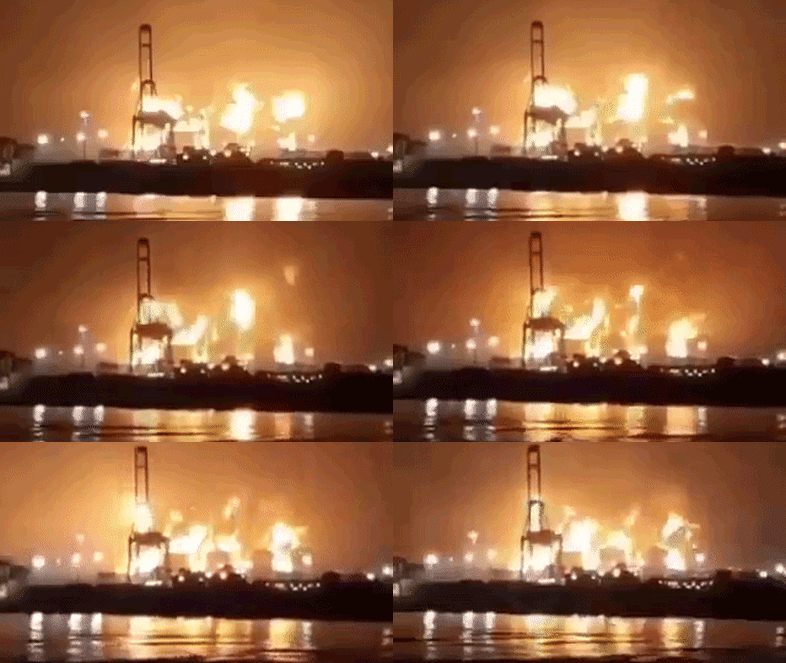
The physical injury of a civilian by falling ballistic debris in Abu Dhabi is not a random accident but the predictable output of a complex terminal-phase interception sequence. While headlines focus on the surface-level narrative of a "missile incident," a structural analysis reveals a sophisticated failure of the collateral damage mitigation protocols inherent in modern Integrated Air and Missile Defense (IAMD) systems. The event serves as a case study in the trade-offs between high-altitude probability of kill ($P_k$) and the inevitable kinetic fallout in hyper-urbanized environments.
The Mechanics of Interception and Residual Risk
The primary objective of a missile defense battery—such as the Terminal High Altitude Area Defense (THAAD) or the Patriot PAC-3 systems utilized in the UAE—is the neutralization of an incoming threat's kinetic energy and chemical payload. This is achieved through "hit-to-kill" technology, where an interceptor destroys the target via pure kinetic energy rather than a blast-fragmentation warhead.
However, the laws of physics dictate that mass is conserved. When a multi-ton ballistic missile traveling at Mach 5 is struck by an interceptor, the resulting fragmentation creates a "debris cloud." The geometry of this cloud is determined by the intercept altitude, the closing velocity, and the angle of impact.
- The Intercept Geometry: If the engagement occurs at a high altitude (exoatmospheric or high endoatmospheric), the debris has more time to burn up upon re-entry or disperse over a wider, less dense area.
- Terminal Phase Constraints: In the Abu Dhabi incident, the falling debris indicates a terminal-phase intercept. This means the engagement occurred within the atmosphere, closer to the protected asset. The proximity to the ground reduces the dispersion window, leading to high-velocity fragments landing within populated urban sectors.
The injury to an Indian national in this context represents a "leakage" of the defense umbrella—not a failure to stop the missile, but a failure to contain the secondary effects of a successful kinetic engagement.
The Three Pillars of Urban Missile Defense Vulnerability
Urban centers like Abu Dhabi present a unique "Target Value Map" that complicates defensive maneuvers. The vulnerability of a city during a missile strike is defined by three distinct variables:
Structural Density vs. Fragment Velocity
In a desert environment, debris often falls on uninhabited terrain, resulting in zero casualties. In a high-density urban environment, the probability of a fragment striking a human or a critical structure nears 100% as the "empty space" ratio decreases. Even small fragments, weighing less than a kilogram, retain enough terminal velocity to penetrate standard roofing or cause lethal blunt-force trauma.
The Probability of Kill (Pk) Paradox
To ensure a high $P_k$, defense operators often fire multiple interceptors at a single incoming threat (a "salvo" tactic). While this increases the likelihood of neutralizing the warhead, it also doubles or triples the amount of interceptor mass that must eventually return to earth. Every successful defense operation inherently creates a secondary "rain" of metallic hardware.
Sensor-to-Shooter Latency
The time between detecting a launch and committing an interceptor is measured in seconds. If the detection happens late, the "keep-out altitude"—the minimum height at which an intercept can occur without causing ground damage—is violated. The injury in Abu Dhabi suggests the intercept occurred below the optimal keep-out threshold.
Quantifying the Threat: Ballistic vs. Cruise Missile Debris
The nature of the debris depends entirely on the threat profile. Ballistic missiles, such as those fired by Houthi rebels toward the UAE, follow a parabolic trajectory and re-enter at extreme speeds.
- Ballistic Debris: Characterized by high-density metallic components (engine casings, fuel tank fragments) and unspent solid propellant. These fragments are difficult to track via radar once the main body is shattered.
- Cruise Missile/Drone Debris: These move slower and are composed of lighter materials (composites, small gasoline engines). While easier to intercept, their low-altitude flight paths mean they are almost always neutralized directly over the target city, ensuring the debris falls on the intended victim regardless of the intercept's success.
The Economic and Geopolitical Cost Function
Beyond the immediate medical and structural damage, these incidents trigger a cascade of economic shifts. The cost of a single THAAD interceptor is approximately $12 million. The cost of the incoming Houthi "Zulfiqar" or "Quds" variant missile is a fraction of that, often estimated in the low hundreds of thousands.
This creates an asymmetric attrition model. The defender (UAE) spends millions to prevent a strike, while the attacker (Houthi forces) achieves a strategic victory even if the missile is intercepted, because:
- They force the expenditure of expensive, limited-stock interceptors.
- They cause civilian injury and psychological terror via the falling debris.
- They disrupt international business confidence in a global financial hub.
The injury to a foreign national, specifically an Indian expatriate, adds a layer of diplomatic complexity. The UAE relies heavily on a massive expatriate workforce. If the perception of safety is compromised by "debris rain," the labor market faces potential volatility, increasing the "security premium" for companies operating in the region.
Mitigation Limits and Technical Constraints
There are no "clean" intercepts in missile defense. Suggestions that the military should "aim away from the city" ignore the reality of physics. An interceptor must fly a direct path to the predicted point of impact. If the incoming missile is aimed at the city center, the intercept will inevitably happen on a vector that leads back to that center.
The only technical mitigations include:
- Forward-Based X-Band Radar: Placing sensors closer to the launch site to allow for earlier intercepts at higher altitudes.
- Directed Energy (Lasers): Future systems like the "Iron Beam" aim to melt or structuraly weaken targets, but these are currently limited to short-range, low-mass threats like mortar shells and small drones. They are ineffective against heavy ballistic missiles.
Strategic Optimization for the Post-Intercept Environment
The Abu Dhabi incident confirms that the "Success" metric for missile defense must be redefined. Neutralizing the warhead is the minimum requirement; managing the debris field is the next frontier of IAMD.
For the UAE and its partners, the strategic priority must shift toward Pre-emptive Neutralization (Left-of-Launch). Waiting for a missile to reach the terminal phase over a city like Abu Dhabi is a high-risk gamble where even "winning" results in casualties.
Governments must invest in reinforced civilian shelters and automated public warning systems that account for debris zones, not just the primary impact point. The data from this specific injury should be used to model "Fragment Distribution Patterns" to adjust the positioning of mobile defense batteries. By shifting the intercept point just a few kilometers toward the coastline, the debris field can be redirected into the Persian Gulf, effectively decoupling the kinetic engagement from the civilian population.
The final strategic play is not the procurement of more interceptors, but the aggressive relocation of the "Engagement Zone" through forward-deployed naval assets and enhanced early-warning collaboration with regional neighbors. Relying on terminal-phase defense in a skyscraper-dense environment is a strategy of diminishing returns.
Would you like me to analyze the specific flight telemetry of the Zulfiqar missile series to determine the optimal maritime intercept coordinates?