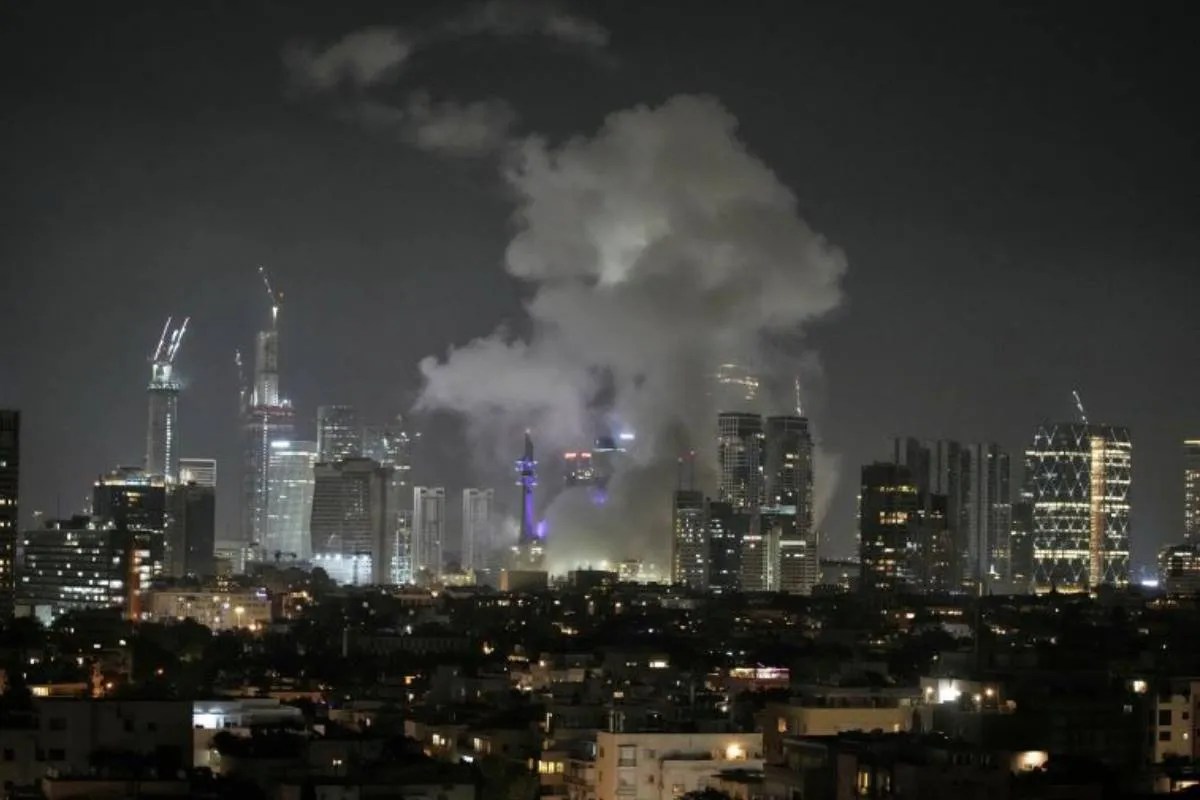
The shift from asymmetric proxy warfare to direct ballistic confrontation between nation-states represents a fundamental recalibration of Middle Eastern security architecture. When saturation-level missile salvos target densely populated urban centers like Tel Aviv, the tactical objective is rarely pure destruction; rather, it is the intentional overstressing of multi-layered interception logic. This analysis deconstructs the mechanics of such an assault, focusing on the physics of ballistic penetration, the economic attrition of defense, and the psychological signaling inherent in targeting "hard" versus "soft" zones.
The Triad of Penetration Saturation Velocity and Decoy Density
Modern missile defense operates on a probability-of-kill ($P_k$) calculus. To successfully defend a high-value asset, the defender must achieve a near-perfect interception rate. The attacker’s strategy relies on three specific variables to drive that $P_k$ toward zero. Meanwhile, you can explore other events here: The Cold Truth About Russias Crumbling Power Grid.
- Volumetric Saturation: By launching a high volume of projectiles simultaneously, the attacker seeks to exceed the "fire channel" capacity of the defense system. Every radar array has a finite limit on the number of targets it can track and engage at a single moment. Once this threshold is crossed, subsequent missiles enter a "leaked" state, traveling toward their coordinates unaddressed.
- Kinetic Velocity and Re-entry Maneuvers: Conventional interceptors like the Iron Dome are optimized for low-velocity, short-range rockets (Katyusha or Qassam types). Ballistic missiles, particularly those utilizing Solid-Fuel stages, reach hypersonic speeds during their terminal descent. The closing speed between an interceptor and a ballistic warhead reduces the decision-making window to milliseconds, forcing the defense to rely on mid-range systems like David's Sling or the high-altitude Arrow-3.
- The Decoy-to-Warhead Ratio: Advanced ballistic systems deploy "penetration aids"—balloons or metal fragments that mimic the radar signature of a warhead. If a defender spends a $2 million interceptor on a $10,000 piece of aluminized Mylar, the economic and inventory exhaustion of the defense begins.
The Geography of Impact Residential Proximity as a Defensive Tax
The targeting of Tel Aviv and its surrounding districts introduces a specific constraint on defensive operations: the "Debris Radius." When an interception occurs at low altitudes over a residential area, the resulting kinetic energy and unspent fuel from both the missile and the interceptor fall back to earth.
This creates a paradox for defense commanders. An "effective" interception—one that destroys the incoming warhead—can still result in significant civilian casualties and property damage due to falling wreckage. The attacker leverages this by aiming at military or intelligence hubs located within or adjacent to civilian clusters. This forces the defender to decide between engaging the threat early (risking debris over the city) or attempting a high-altitude intercept that may have a lower success rate due to the missile's velocity at that stage. To understand the bigger picture, check out the detailed analysis by NPR.
The Economic Attrition Function
The viability of a long-term defense strategy is governed by the cost-exchange ratio. In the context of the recent strikes on Tel Aviv, this ratio is heavily skewed in favor of the aggressor.
- Attacker Cost ($C_a$): Calculated as the manufacturing cost of a mid-range ballistic missile plus the fuel and mobile TEL (Transporter Erector Launcher) operation.
- Defender Cost ($C_d$): Calculated as the cost of two interceptors per incoming target (to ensure $P_k$), the operational cost of radar maintenance, and the secondary economic loss of a "shuttered" city (lost GDP during bunker hours).
Current estimates suggest a cost-exchange ratio of roughly 1:10 or 1:20. For every dollar spent by the attacker to launch a salvo, the defender must spend ten to twenty dollars to neutralize it. This is a deliberate strategy of financial bleeding. A defense system that successfully stops 99% of missiles can still be "defeated" if the cost of that 99% leads to the depletion of national reserves or the exhaustion of interceptor stockpiles provided by allies.
Structural Vulnerabilities in "Hardened" Urban Centers
While the public perceives the "Iron Dome" as a seamless shield, the architecture is actually a series of overlapping bubbles with specific gaps.
- The Sensor-to-Shooter Latency: The time required for a radar to identify a launch, categorize it as a threat, and authorize an interceptor launch. In a high-saturation environment, this latency increases.
- The Re-load Bottleneck: Interceptor batteries have a fixed number of canisters. In a sustained, multi-wave attack, the "dwell time" required to physically reload a battery creates a window of vulnerability that an intelligent attacker will exploit with a timed secondary wave.
- The Multi-Vector Problem: Attacks that arrive simultaneously from the North (Lebanon/Hezbollah) and the East (Iran) force the defense system to pivot its sensor focus. This split-attention maneuver reduces the effectiveness of the "early warning" phase, as the system must filter out thousands of smaller signatures to find the high-mass ballistic threats.
Psychological Warfare through Kinetic "Near-Misses"
The strategic value of a missile landing in a residential area, even if it fails to detonate or hits an empty street, is measured in psychological erosion. The "Safe Room" or "Mamad" architecture of Israeli homes provides physical protection, but the repeated breach of the "invincibility" myth serves a broader geopolitical purpose.
The attacker aims to trigger a flight of capital and human talent. If the economic center of a nation—Tel Aviv—is perceived as a front line, the long-term investment profile of that nation shifts from "Stable Tech Hub" to "High-Risk Conflict Zone." This transition is a core objective of the missile campaign, independent of the actual casualty count.
The Logistics of the Second Strike
A critical oversight in standard reporting is the assessment of "Empty Launchers." Following a major salvo, the immediate risk is not the missiles that landed, but the state of the defensive inventory.
Defense intelligence must prioritize the replenishment of interceptor stocks, which are often manufactured in low volumes compared to the "dumb" rockets they oppose. The logistical chain for these components is fragile and reliant on international supply lines. If an attacker can force a defender to expend its entire high-tier inventory (Arrow-3) in a single night, the nation remains "open" for several days while stocks are ferried in. This creates a "Strategic Gap" where the defender is forced to use de-escalatory diplomacy or pre-emptive strikes on launch sites, as the defensive shield no longer exists.
The Predictive Model for Future Engagements
The evolution of this conflict suggests that the era of "impenetrable" defense is ending. Attackers are moving toward hypersonic glide vehicles (HGVs) and swarm-based drone integration to further complicate the radar picture.
The defense must transition from a "Point Defense" model (protecting everything) to a "Value-Based Defense" model (protecting only critical infrastructure). This shift implies that residential areas will increasingly be de-prioritized in favor of airbases, power plants, and command centers. The political fallout of such a transition will be the defining internal struggle for any nation under a sustained ballistic threat.
The immediate strategic imperative is the development of Directed Energy Weapons (DEWs)—lasers—that can engage targets at the speed of light for pennies per "shot." Until these systems reach operational maturity, the kinetic exchange favors the entity willing to absorb the highest cost of aggression, rather than the entity with the most advanced shield. The next logical phase for the defender is a shift from reactive interception to "Left of Launch" operations—destroying the missiles and their command chains before they ever leave the ground, as the defensive math no longer supports a purely reactive posture.