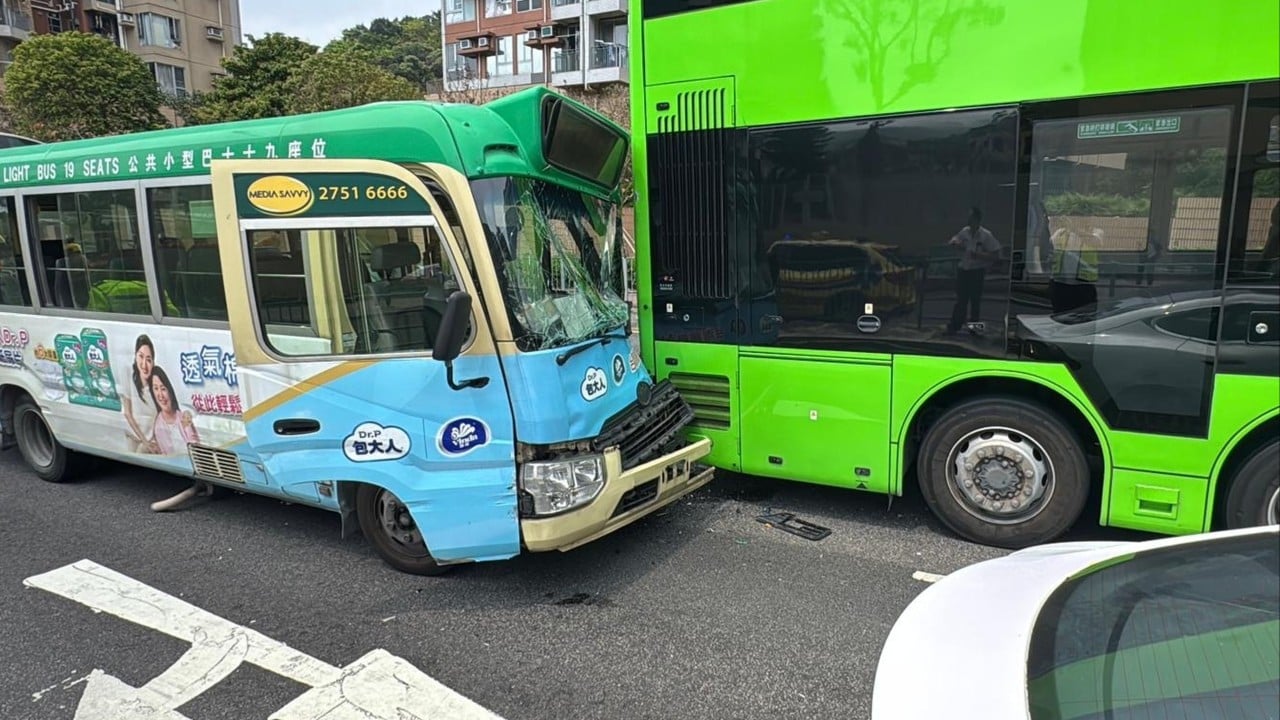
The collision involving a public light bus (minibus), a private vehicle, and a stationary object in Hong Kong is not merely an isolated traffic incident; it is a manifestation of systemic vulnerabilities in urban transit density and the ergonomics of an aging transport workforce. When seven individuals, including a driver in his late sixties, are injured in a three-vehicle chain reaction, the analysis must shift from "driver error" to the mechanical and physiological variables that govern the Hong Kong road network. This incident serves as a diagnostic case study for the intersection of geriatric occupational health, vehicle mass momentum, and the failure of secondary safety barriers in high-density urban corridors.
The Kinematic Chain of a Multi-Vehicle Event
To understand the severity of the injuries sustained, one must apply the principles of linear momentum and kinetic energy transfer. In a typical Hong Kong urban environment, the "green minibus" operates with a gross vehicle weight (GVW) significantly higher than the standard private sedan. The energy ($E_k$) dissipated during a collision is defined by: In similar updates, we also covered: The Sabotage of the Sultans.
$$E_k = \frac{1}{2}mv^2$$
Where $m$ represents the mass and $v$ the velocity of the vehicle at the point of impact. Even at a moderate speed of 50 km/h, the mass of a fully-loaded 19-seater minibus carries a momentum profile that cannot be absorbed by the crumple zones of a standard passenger car. The injury profile reported—six passengers and one driver—suggests a sudden deceleration (Delta-V) that exceeded the restraint capacity of standard lap belts, or in older minibus models, the lack of three-point seatbelts entirely. The New York Times has analyzed this important issue in extensive detail.
The structural geometry of a minibus (a high-center-of-gravity, cab-over-engine design) creates a specific failure mode in front-end collisions. Unlike private cars with long hoods that act as energy-absorbing structures, the minibus driver sits almost directly above the front axle. This proximity to the impact zone explains the higher vulnerability of the "elderly driver" mentioned in initial reports. The driver’s injuries are rarely just muscular; they are often the result of steering column intrusion or dashboard compression.
The Geriatric Occupational Risk Profile in Public Transport
The presence of a driver over the age of 65 is not a statistical anomaly in Hong Kong; it is a structural necessity of the labor market. This demographic shift introduces a specific "Reaction Time Variable" (RTV) into the urban safety equation. Cognitive and motor slowing is a biological certainty, yet the Hong Kong regulatory framework relies on periodic medical examinations that may not capture transient fatigue or sudden-onset medical episodes (e.g., cardiac arrhythmia or vasovagal syncope).
- Sensory Processing Latency: The ability to distinguish between a braking lead vehicle and a stationary obstacle decreases with age.
- Muscular Force Modulation: Emergency braking requires a specific "stomp" force ($F$) to engage the Anti-lock Braking System (ABS) effectively. Decreased bone density and muscle mass in older drivers can lead to sub-optimal brake pressure during the critical 0.5-second window of impact avoidance.
- Post-Impact Recovery: The "injured" status of the elderly driver is complicated by slower physiological recovery times. A 3-vehicle crash that results in minor bruising for a 30-year-old often results in rib fractures or internal hemorrhaging for a driver in their late 60s.
The Three Pillars of Urban Transit Failure
The incident in question can be decomposed into three primary failure pillars that characterize the current state of Hong Kong’s transit safety.
1. The Congestion-Density Multiplier
The probability of a three-vehicle collision is a direct function of "Following Distance" vs. "Traffic Density." In districts with high pedestrian and vehicle turnover, drivers frequently reduce the gap to less than two seconds to prevent other vehicles from merging. This behavior removes the buffer required to absorb a sudden stop from a lead vehicle. When the first vehicle brakes, the second vehicle (often the minibus in these scenarios) lacks the stopping distance, and the third vehicle becomes an "active mallet," compressing the middle vehicle from the rear.
2. Infrastructure Rigidities
Many Hong Kong roads are bounded by "Type 1" steel or concrete barriers. While these prevent vehicles from jumping onto sidewalks, they also redirect kinetic energy back into the vehicle cabin rather than allowing for a controlled, off-road runoff. If a minibus is pinned between a barrier and another vehicle, the passenger cabin becomes a "pressure cooker" of secondary impacts, where unbelted passengers are thrown against the interior hardware.
3. The Minibus Cabin Interior Hazard
The interior of many older minibuses is a landscape of hard surfaces, metal grab rails, and non-padded seating. While the exterior may sustain manageable damage, the interior kinematics often involve passengers striking the seat in front of them. The "six passengers injured" likely suffered from what is known as "Whiplash-Associated Disorders" (WAD) or facial trauma from impacting seat-back handles.
Assessing the Mechanism of Injury (MOI)
In medical triage, the MOI determines the level of trauma care required. For this specific three-vehicle crash, the MOI is characterized by "Multiple Impact Vectors."
- The Primary Vector: The initial impact of the first vehicle hitting the second.
- The Secondary Vector: The second vehicle (minibus) being struck from behind or hitting a third object.
- The Tertiary Vector: The internal organs of the occupants striking the skeletal walls (e.g., brain striking the skull, heart striking the sternum).
The reported injuries suggest that the crash involved significant "Shunt Energy." In a shunt, the vehicle is pushed forward into another object, doubling the forces exerted on the neck and spine. The elderly driver, likely bracing against the steering wheel, would have transferred the entire force of the impact through the radius and ulna bones of the forearms, often leading to wrist fractures that are not immediately visible at the scene.
The Technical Limitation of Current Safety Inspections
The "roadworthiness" of the vehicles involved is often cited as a factor, but this is a superficial metric. A vehicle can pass a standard inspection while still possessing antiquated safety architecture. The minibus fleet in Hong Kong suffers from a "Lagging Safety Standard" (LSS). Newer models include Electronic Stability Control (ESC) and Autonomous Emergency Braking (AEB), but the majority of the current fleet relies on purely manual inputs.
The disconnect lies in the "Human-Machine Interface" (HMI). An elderly driver operating a vehicle without power-assisted braking or lane-departure warnings is operating at a 20% to 30% higher cognitive load than a driver in a modern vehicle. This cognitive load peaks during the "Micro-Decision Window"—the 1.5 seconds between identifying a hazard and executing an evasive maneuver.
Structural Recommendations for Urban Risk Mitigation
Relying on driver caution is a failed strategy in high-density logistics. The mitigation of future three-vehicle collisions requires a hardware-first approach that removes the "Human Variable" from the safety equation.
- Mandatory AEB Retrofitting: All public light buses must be equipped with radar-based Autonomous Emergency Braking. This system calculates the rate of closure between the bus and the lead vehicle ($dV/dt$) and applies maximum braking force regardless of the driver's physical strength or reaction speed.
- Dynamic Work-Hour Telemetry: Drivers over 60 should be monitored via biometric sensors (Smart Watches or Seat Sensors) that detect "Micro-Sleeps" or heart rate variability indicative of acute stress.
- Passenger Restraint Enforcement: The "six injured passengers" is a number that could be reduced by 80% if three-point harnesses were integrated into all seats and coupled with a "No-Belt, No-Start" interlock system.
The Hong Kong transport department must move beyond the "accident report" and begin treating these incidents as data points in a failing kinetic system. The immediate strategic play is the phased decommissioning of all cab-over-engine minibuses that do not meet 2024 Euro-NCAP safety ratings for frontal and side impacts. Failing to modernize the fleet hardware ensures that the next collision will follow the exact same kinematic path, with the same predictable injuries to an aging workforce and its passengers.
Implement a mandatory 12-month phase-in for LiDAR-based forward collision warnings on all franchised minibus routes to compensate for the RTV gap in the aging driver demographic.