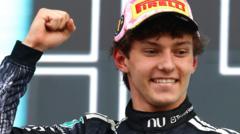
The headlines are screaming about a revolution. They say Kimi Antonelli’s victory at Suzuka marks the dawn of a new era. They call him the youngest title leader in history like it’s a meritocratic miracle. They are wrong.
What we witnessed in Japan wasn't the arrival of a generational savior. It was the final confirmation that Formula 1 has successfully engineered the "driver" out of the cockpit. If an eighteen-year-old can skip the traditional developmental meat grinder and lead the world championship in his debut season, we aren't watching a peak in human performance. We are watching a triumph of simulation over soul, and it’s killing the sport’s credibility.
The "lazy consensus" among the punditry is that Antonelli is simply "that good." They point to his karting records and his rapid ascent through the junior formulas. But they ignore the industrial-scale grooming that has turned a teenager into a high-precision biological component for Mercedes.
The Simulation Subsidy
Antonelli didn't win because he possesses some mystical "feel" that Ayrton Senna once described. He won because he has spent more hours in a $10 million dynamic simulator than most of the grid has spent in actual race cars over the last three years.
Modern F1 teams no longer look for racers; they look for operators.
The gap between the virtual and the physical has narrowed to the point of irrelevance. When Antonelli hits the 130R at Suzuka, he isn't reacting to the car. He is executing a pre-programmed script written by a bank of servers in Brackley. The "prodigy" narrative is a marketing mask for an engineering achievement. We are celebrating the software, not the boy.
I’ve sat in the debrief rooms where these kids are analyzed. The engineers don't care about their "gut instinct." They care about trace overlays. If a driver’s brake pressure deviates by 2% from the theoretical optimum calculated by the AI, they get coached out of it. Antonelli is the first of the "Pure Trace" generation—drivers who have never had to develop an organic style because they were taught the "correct" way to drive before they ever felt G-forces.
The Weight of the Invisible Hand
Everyone is obsessed with the age record. Being the youngest title leader is supposed to be a badge of honor. In reality, it’s a symptom of a broken ladder.
The FIA’s Super License system was designed to prevent "pay drivers" from clogging up the grid. Instead, it created a closed loop where only those backed by manufacturer academies—like Antonelli with Mercedes—can sniff a seat. By the time he arrived in Japan, the path had been surgically cleared.
- The Testing Loophole: Teams use "Previous Car Testing" (TPC) to bypass the ban on in-season testing. Antonelli ran thousands of kilometers in 2022-spec machinery before his debut. He arrived at the "pinnacle of motorsport" with more mileage than some veteran backmarkers.
- The Data Crutch: In Suzuka, Antonelli’s steering wheel was a tablet providing real-time delta updates. He wasn't managing his tires; he was following an algorithm's instructions on exactly how much energy to put into the surface.
- The Teammate Evisceration: George Russell’s role has shifted from lead driver to benchmark. He isn't there to win; he’s there to provide the data set for the prodigy to copy.
Imagine a scenario where we stripped away the telemetry. If we took away the real-time feedback loops and forced these drivers to rely on the seat of their pants—the way Niki Lauda or even Michael Schumacher did—the "youth movement" would evaporate overnight. Experience used to mean something because it represented a library of physical sensations. Today, experience is just a redundant database.
Why Suzuka Was a False Positive
The Japanese Grand Prix is technically demanding, yes. But it is also a "high-fidelity" track. It is smooth, predictable, and perfectly mapped. It is the exact type of environment where a simulator-bred driver excels.
The real test of a champion isn't hitting a 1:30.xxx lap time consistently on a pristine Sunday. It’s the chaos of a drying track at Spa, or the crumbling asphalt of a street circuit where the walls move.
The current hype ignores the "Antonelli Tax." To put him in that car, Mercedes sacrificed years of development and sidelined established talent. They are betting the house on a driver who has never had to struggle with a bad car. When the Mercedes W17 eventually has a handling quirk that the simulator didn't predict, we will see the real Kimi. My bet? He’ll look remarkably human, and the "youngest ever" stats won't save him from the wall.
The Myth of the Natural
We love the story of the "natural" talent because it makes the sport feel like magic. But F1 is now a branch of the aerospace industry.
- Carbon Fiber Conformity: The cars are more stable than ever. Aerodynamic maps are so sophisticated that "scary" corners don't exist for the top teams.
- Power Unit Management: The hybrid era shifted the skill set from throttle control to energy deployment management. It's a game of buttons, not balance.
- Tire Thermal Windows: Winning is no longer about being the fastest; it’s about being the most patient.
Antonelli didn't "outdrive" the field in Japan. He out-complied them. He followed the instructions better than the veterans who still have the audacity to try and influence the car with their own intuition.
The Cost of Our Celebration
By worshipping this youth movement, we’ve devalued the professional driver. We’ve turned the most elite athletic endeavor in the world into a "plug and play" exercise.
The industry insiders I talk to—the ones who aren't on the Mercedes payroll—are terrified. If an 18-year-old is the best in the world, what does that say about the 19 other guys on the grid? It says the cars are too easy to drive. It says the "pinnacle" is a plateau.
We aren't watching a "legend" being born. We’re watching a high-speed beta test of F1’s next-generation user interface.
The Japanese Grand Prix didn't prove that Kimi Antonelli is a god. It proved that F1 has finally succeeded in making the driver the most replaceable part of the car.
Stop calling it a win for the ages. It’s a funeral for the driver.