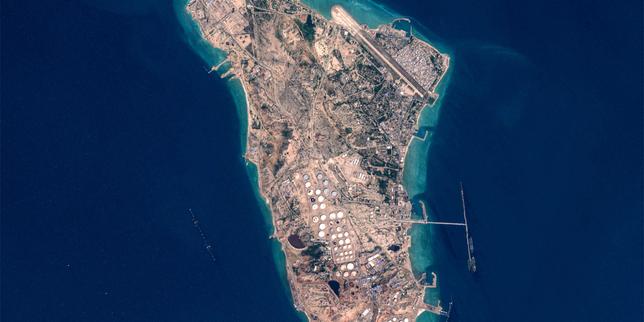
Kharg Island sits in the Persian Gulf like a loaded pistol pointed at the global economy. For decades, this rocky outcrop has served as the primary terminal for Iranian crude oil, handling roughly 90% of the country’s petroleum exports. Recent military posturing from Washington suggests that the United States possesses the capability to "neutralize" this facility at a moment’s notice. While the tactical reality of such a strike is undisputed, the strategic fallout would be a chaotic, multi-year reconfiguration of the global energy market that few nations are truly prepared to weather.
The threat to Kharg is not merely a localized military concern. It is a direct challenge to the flow of approximately 1.5 to 1.8 million barrels of oil per day. If those taps are shut off by kinetic force, the resulting supply gap would trigger an immediate and violent price correction in Brent Crude. We aren't just talking about a temporary spike at the pump. We are looking at a fundamental disruption of the maritime insurance industry, the collapse of regional security norms, and a desperate scramble by Asian refineries to replace the heavy sour crude they have spent years calibrating their equipment to process.
The Engineering of a Chokepoint
Kharg Island is not a sprawling industrial complex spread over hundreds of miles. It is a concentrated target. The facility relies on a series of T-head and L-head jetties that allow massive tankers to dock and load. Because the island is surrounded by deep water close to the shore, it can accommodate Very Large Crude Carriers (VLCCs), which are the workhorses of the international oil trade.
This deep-water access is Kharg’s greatest asset and its most significant liability. A precision strike does not need to level the entire island to be effective. By targeting the manifold systems, the loading arms, or the subsea pipelines connecting the island to the mainland gachsaran fields, an aggressor can render the terminal useless for months or even years. The repair of such specialized infrastructure requires parts and technical expertise that are currently under heavy sanction, making "neutralization" a potentially permanent state of affairs.
Why the Market Underestimates the Risk
Many analysts point to the current global spare capacity, largely held by Saudi Arabia and the UAE, as a safety net. They argue that if Iranian oil leaves the market, other OPEC+ members will simply turn on the valves. This is a dangerous oversimplification of how the physical oil market functions.
Oil is not a monolithic commodity. The crude coming off Kharg Island is specific in its sulfur content and density. Refineries in China and India are designed to "crack" this specific grade of Iranian light and heavy crude. Switching to a different feedstock is not like flipping a light switch. It requires complex chemical adjustments and often results in lower yields of high-value products like diesel and jet fuel. If Kharg goes dark, the immediate physical shortage of specific crude grades will create a localized panic in Asian markets that will eventually bleed into the global price index.
The Asymmetric Response Strategy
Tehran is well aware of its vulnerability. The Iranian military doctrine has shifted from trying to defend Kharg at all costs to ensuring that if Kharg falls, nobody else in the Gulf gets to export oil either. This is the "scorched sea" policy.
The Strait of Hormuz remains the ultimate trump card. While the US Navy can undoubtedly protect individual convoys, it cannot 100% guarantee the safety of every commercial tanker in a body of water that is only 21 miles wide at its narrowest point. The use of "swarm" tactics involving fast attack craft, sea mines, and shore-based anti-ship missiles creates a risk profile that commercial insurers simply will not touch. When the cost of insuring a hull exceeds the profit of the cargo, the oil stops moving, regardless of whether the taps are open or closed.
The Shadow Fleet Factor
A significant portion of the oil moving through Kharg Island today travels via the so-called "shadow fleet." These are aging tankers with opaque ownership structures that operate outside the traditional maritime regulatory framework. Because these vessels often turn off their AIS (Automatic Identification System) transponders and engage in ship-to-ship transfers, they are difficult to track and even harder to deter through conventional sanctions.
A military strike on Kharg would effectively dismantle this shadow network by removing its primary source of cargo. However, this creates a secondary problem. Thousands of sailors and hundreds of vessels would suddenly be "unemployed" and operating in a high-tension combat zone. The potential for accidents, environmental disasters, or desperate acts of piracy increases exponentially when a multi-billion dollar illicit industry is destroyed overnight.
The Illusion of a Clean Strike
There is a recurring fantasy in some policy circles that a strike on Kharg Island could be "surgical"—a clean hit that takes out the regime's checkbook without triggering a wider war. History suggests otherwise. In the 1980s, during the "Tanker War" phase of the Iran-Iraq conflict, attacks on oil infrastructure led to a decade of instability that eventually drew in global superpowers and resulted in the largest convoy operations since World War II.
Today, the interconnectedness of the global economy makes the stakes much higher. We are no longer in an era where the US is the sole arbiter of Middle Eastern security. China is now the primary customer for the oil flowing out of Kharg. A strike on this facility is not just an attack on Iranian sovereignty; it is a direct blow to Chinese energy security. This introduces a geopolitical variable that wasn't present thirty years ago. The potential for a diplomatic or economic retaliatory response from Beijing adds a layer of risk that goes far beyond the price of a barrel of oil.
Beyond the Immediate Explosion
If the US or its allies decide to move against Kharg, the engineering challenge of rebuilding is the real long-term story. The "Sea Island" loading platform at Kharg is a massive structure of steel and concrete. Replacing it requires heavy-lift vessels and specialized maritime construction crews that are in short supply globally.
Iran has attempted to mitigate this by developing the Jask terminal, located outside the Strait of Hormuz. However, Jask currently lacks the scale and the pipeline connectivity to replace Kharg. For the foreseeable future, Kharg remains the indispensable heart of the Iranian economy. Its destruction would be an act of economic decapitation.
The Domestic Pressure Cooker
Inside Iran, the loss of oil revenue would force the government to make impossible choices. With the currency already in a tailspin, the sudden disappearance of hard currency from oil exports would likely trigger hyperinflation. While some might argue this would lead to the collapse of the current leadership, historical precedents in places like North Korea or Cuba suggest that regimes often become more insular and aggressive when backed into a corner.
The social cost of a Kharg strike would be borne by the Iranian population, but the security cost would be shared by the entire world. A desperate regime with a depleted treasury is more likely to engage in high-risk external provocations to distract from domestic misery.
The Insurance Market Meltdown
Perhaps the most overlooked factor in the "neutralization" of Kharg Island is the reaction of the London insurance market. Lloyd’s of London and other major underwriters set the "War Risk" premiums for the Persian Gulf. If Kharg is struck, those premiums will skyrocket instantly.
For a VLCC carrying two million barrels of oil, a massive hike in insurance costs can add millions of dollars to the cost of a single voyage. This "security tax" is passed directly to the consumer. Even if not a single drop of oil is actually lost to the sea, the mere threat of continued kinetic action in the Gulf will keep energy prices artificially high for a prolonged period. The psychological impact on the market is often more durable than the physical damage to the infrastructure.
Gravity and Reality
The United States likely can "neutralize" Kharg Island whenever it chooses. The technology for such an operation exists, and the tactical superiority is absolute. But military capability is not the same as strategic wisdom. Neutralizing a site is the easy part; managing the vacuum that follows is where the real difficulty lies.
The global energy transition is already underway, but the world remains tethered to the Persian Gulf by a thousand threads of petroleum and finance. Snapping the most important of those threads at Kharg Island would send a shockwave through the system that would be felt from the boardrooms of Shanghai to the gas stations of the American Midwest.
The question isn't whether the island can be taken out of the equation. The question is whether the global economy can survive the answer.
Map out the specific refinery dependencies in the Shandong province of China to understand which regional players would be most aggressively hit by a Kharg shutdown.


