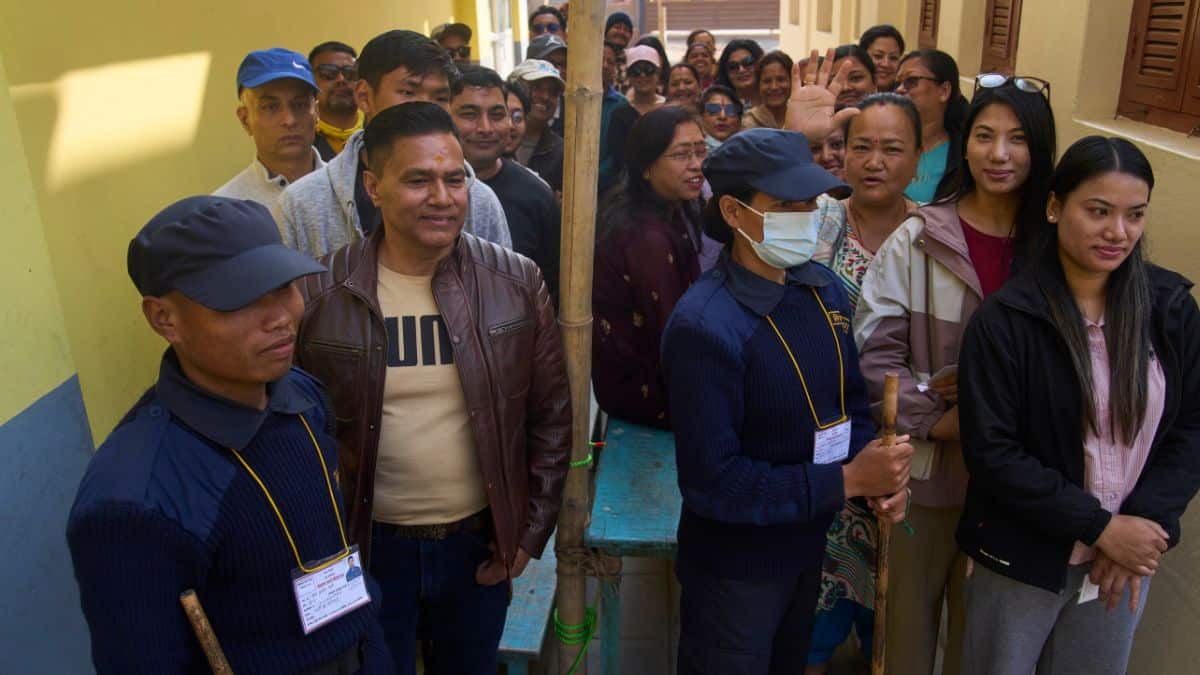
The dust in Kathmandu doesn’t just settle; it narrates. It clings to the colorful prayer flags strung across narrow alleys and coats the windshields of the micro-buses navigating the chaotic pulse of New Road. For decades, that dust carried the scent of a stagnant political machine—a revolving door of familiar faces who spoke of revolution but delivered the status quo.
Then came the shift. It wasn't a loud explosion, but a quiet, digital hum that turned into a roar at the ballot box. Meanwhile, you can find related developments here: The Cold Truth About Russias Crumbling Power Grid.
When the final tallies began to crystallize, showing Balendra Shah’s nascent political movement heading toward a landslide victory, the air in the capital changed. This wasn't just another internal administrative shuffle. It was a tectonic plate moving in the Himalayas, and the vibrations were felt instantly in the power corridors of New Delhi. Prime Minister Narendra Modi’s congratulatory message to Nepal wasn't merely a diplomatic formality. It was an acknowledgment that the old maps of Himalayan politics had been folded up and tucked away.
The Architect and the Asphalt
To understand why a local election in Nepal warrants the undivided attention of the world’s most populous democracy, you have to look at the man at the center of the storm. Balendra "Balen" Shah didn't come from the groomed ranks of the political elite. He is a structural engineer. He is a rapper. To the youth of Kathmandu, he represents the first time they saw their own reflection in the polished wood of a government office. To see the complete picture, we recommend the detailed article by NBC News.
His landslide isn't a fluke of luck. It's the result of a generation that grew tired of waiting for the mountain to move. They realized they were the mountain.
When Balen's party began to sweep through the wards, it wasn't just about his charisma or his signature sunglasses. It was about the way he spoke of the city's bones—its infrastructure, its heritage, its garbage. He stripped away the flowery rhetoric of the old guard and replaced it with a blueprint. It was a language the young, the restless, and the disenfranchised understood.
A Neighboring Eye
Across the border, the eyes of the South Asian giant never blink.
For New Delhi, Nepal is not just a neighbor; it is a shared history, a buffer, and a deeply intertwined partner. When Prime Minister Modi reached out to congratulate Nepal on the successful conduct of these polls, the message was clear: stability is the currency of the region.
But beneath the diplomatic gloss lies a complex reality. For years, the traditional political dynasties of Nepal were the primary points of contact for India. There was a rhythm to the relationship, a predictable cadence of summits and treaties. The rise of a third force—a populist, tech-savvy, and fiercely independent movement—introduces a new variable into the equation.
Consider a hypothetical scenario where a young entrepreneur in Pokhara wants to export local handicrafts to the markets of Uttar Pradesh. Under the old system, that entrepreneur was at the mercy of bureaucratic gatekeepers and the slow-turning wheels of patronage. In a new Nepal, led by figures who value efficiency and direct engagement, that path could become a highway.
This is why the congratulate-and-collaborate approach is so vital. India knows that a prosperous, modernizing Nepal is a more reliable partner than one mired in internal strife.
The Digital Mandate
The landslide victory for Balen Shah’s party was built on a foundation of pixels as much as it was on physical presence. While traditional candidates were busy organizing massive rallies and printing expensive banners, the new movement was dominating the screens of every smartphone from Kathmandu to the Terai.
They bypassed the filters. They spoke directly to the fears of the middle class and the hopes of the students.
This shift in communication is something that resonates with the modern Indian political experience as well. Both nations are navigating a period where the traditional gatekeepers of information are losing their grip. The message from New Delhi was an acknowledgment of this shared digital reality. It was a nod to the fact that the way leaders are chosen and the way they govern is being rewritten by the people, one swipe at a time.
The Invisible Stakes
It’s easy to look at election results as just numbers on a screen. But for the people living in the shadow of the Himalayas, the stakes are deeply personal.
It's about the mother who wants her children to have access to a school that doesn't collapse in an earthquake. It's about the shopkeeper who is tired of paying bribes just to keep his lights on. It's about the vibrant youth who want to stay and build their country rather than catching a flight to the Gulf for manual labor.
The landslide for Balen Shah is a manifestation of these invisible stakes. It is a collective sigh of relief and a sharp intake of breath for what comes next.
When India’s leadership congratulates Nepal on this success, it’s not just about the winner of the race. It’s about the fact that the race happened at all—peacefully, democratically, and decisively. In a region where stability can sometimes feel fragile, the successful conduct of these polls is a victory for the very idea of a modern South Asia.
The Rhythm of the Border
The border between India and Nepal is one of the most unique in the world. It’s an open border, a porous membrane where people, culture, and commerce flow with a natural rhythm. The festivals of one side are celebrated on the other. The languages bleed into each other at the edges.
This closeness means that a political shift in Kathmandu is never "just" a Nepalese issue. It affects the security of the region. It affects trade routes and water-sharing agreements. It affects the millions of Nepalese citizens who live and work in India, and the Indians who do the same in Nepal.
The rise of a new political force in Nepal presents both a challenge and an opportunity for this relationship. The old playbooks may not apply anymore. New bridges need to be built—both literal and metaphorical.
Beyond the Balconies
As the celebrations in Kathmandu's streets continue, and the new representatives take their seats, the world watches. The landslide has provided a clear mandate, but a mandate is just a permission slip to begin the real work.
The transition from a protest movement to a governing body is notoriously difficult. The same passion that fuels a campaign can sometimes burn out in the slow, grinding machinery of municipal and national governance. But there is a sense this time that it's different. The engineering mindset of the new leadership suggests a focus on measurable outcomes rather than grand ideologies.
India’s prompt congratulation signals a readiness to engage with this new reality. It’s an invitation to move past the grievances of the past and focus on a shared future of connectivity and growth.
The New Himalayan Morning
The dust in Kathmandu is still there, but today it feels a little less heavy.
There is a new song playing on the radios of the taxis and the speakers of the cafes. It’s not just a rap song by a popular mayor; it’s the sound of a country finding its voice. The landslide victory and the subsequent diplomatic outreach from New Delhi are chapters in a larger story about a region that is finally deciding to write its own destiny.
The mountains remain the same, stoic and unchanging, but the people living in their valleys have decided that they no longer have to be defined by the shadows. They are stepping out into the light, and they are bringing their neighbors with them.
The phone call from New Delhi wasn't just a courtesy. It was the first chord of a new symphony.
Would you like me to analyze the specific economic implications of this political shift on the India-Nepal trade corridor?