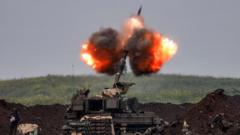
The headlines are screaming about "decisive action" and "expanding the ground offensive." Most analysts are nodding along, treating a full-scale invasion of Southern Lebanon as a simple math problem of superior firepower versus a non-state actor. They are wrong. They are falling for the same linear thinking that has mired regional powers in "forever wars" for forty years.
Expanding the ground and air campaign against Hezbollah isn't a show of strength. It is a predictable response to a tactical stalemate that ignores the fundamental shift in 21st-century attrition. If you think more boots on the ground and more sorties in the air will yield a "total victory" or a stable northern border, you haven't been paying attention to the last two decades of asymmetric warfare. Discover more on a similar issue: this related article.
The Myth of the Buffer Zone
The lazy consensus suggests that pushing Hezbollah back to the Litani River creates a safety net for northern Israeli communities. This is a 1982 solution for a 2026 problem.
In the 1980s, geography mattered because rockets had limited range and guidance systems were non-existent. Today, a ten-mile or twenty-mile buffer zone is irrelevant to a group possessing precision-guided munitions (PGMs) and long-range suicide drones. Hezbollah isn't a conventional army waiting to be pushed off a hill; it is a decentralized network integrated into the very topography and civilian infrastructure it defends. Further analysis by BBC News delves into comparable views on the subject.
When the IDF moves in, they aren't "clearing" a zone. They are entering a kill box specifically designed for them over the last 18 years. Hezbollah has spent nearly two decades digging. We aren't talking about primitive tunnels; we are talking about sophisticated, reinforced underground fortresses equipped with internal communications and power grids that air strikes cannot touch.
The High Cost of "Superior" Technology
I have seen military planners fall in love with their own spreadsheets. They see the Iron Dome's interception rates or the F-35’s stealth capabilities and assume invincibility. But technology has a diminishing return in a high-intensity ground war against a peer-level insurgent force.
- The Interceptor Deficit: Every time Hezbollah fires a "dumb" rocket or a cheap $20,000 drone, Israel spends over $100,000 on a Tamir interceptor. In a sustained, expanded conflict, the math is brutal. You cannot win a war where your defensive expenditures outpace the enemy's offensive costs by a factor of five.
- The Urban Jungle: Tanks and armored personnel carriers are magnificent on an open plain. In the narrow, debris-strewn alleys of Southern Lebanese villages, they are targets for the Kornet-EM and other advanced anti-tank guided missiles (ATGMs).
- Electronic Warfare Limits: We hear a lot about GPS jamming and signal disruption. It works—until the enemy switches to hard-wired fiber optics and pre-programmed inertial navigation for their drones.
Stop Asking "When Will They Be Defeated?"
People keep asking when the "tipping point" will occur. This is the wrong question. In asymmetric warfare, the "winner" isn't the one with the most kills; it's the one who can endure the most pain for the longest period.
Hezbollah’s leadership doesn't answer to a nervous electorate. They don't have a stock market to protect. They thrive in the chaos that an expansion brings because it validates their reason for existing. By expanding the war, Israel isn't finishing the job; it is giving Hezbollah exactly what it needs to recruit the next generation and cement its status as the "defender of Lebanon."
The "Decapitation" Delusion
The competitor article suggests that targeting high-level commanders will cripple the organization. This is a fundamental misunderstanding of decentralized command structures.
I’ve watched organizations lose their entire C-suite and be back to full operational capacity within a week. Why? Because Hezbollah operates on a "mission command" philosophy. Local commanders have the autonomy to act without waiting for orders from Beirut. Killing a general in a suburban apartment might feel like a win on the evening news, but on the ground, the guy with the RPG in the basement doesn't care. He has his orders, his supplies, and his sector. He is waiting.
A Better Way: The Tech-Intelligence Pivot
Instead of a massive ground expansion that drains the treasury and costs lives for temporary territorial gains, the strategy should shift toward a persistent, tech-heavy containment that doesn't require a permanent footprint.
- Autonomous Border Defense: Replace massed infantry with AI-driven sensor-to-shooter grids.
- Economic Attrition: Focus on the financial lifelines that allow Hezbollah to pay its fighters. A ground war is expensive for the invader; a financial war is expensive for the defender.
- Diplomatic Realism: Acknowledge that you cannot "kill" an ideology with a 155mm artillery shell.
The downside to this approach? It isn't satisfying. It doesn't offer the catharsis of a "victory" parade. It requires patience and a tolerance for low-level friction. But the alternative—a deep dive into the Lebanese quagmire—is a gift to every adversary Israel has in the region.
The Brutal Reality of the Litani
Let’s talk about the Litani River. Everyone treats it like a magical line. It’s not. If the IDF reaches the Litani, Hezbollah will simply fire from the other side. Then what? Do you push to the Awali? Do you push to Beirut? Again?
We’ve seen this movie before. In 1982, the goal was to "uproot" the threat. It resulted in an eighteen-year occupation and the very birth of Hezbollah. Expanding the war now isn't a new strategy; it's a recycled failure dressed up in modern camouflage.
The true test of a superpower isn't knowing how to start a war, but knowing which wars are traps. Expansion is the bait. If the IDF takes it, they are trading long-term strategic stability for a short-term tactical sugar high.
Don't look at the map for the solution. Look at the ledger. Look at the logistics. Look at the history of every army that thought "just a few more miles" would bring peace. It never does.
The smartest move isn't to expand the front. It’s to change the game entirely.
Would you like me to analyze the specific economic impact of a sustained northern mobilization on Israel's tech sector?