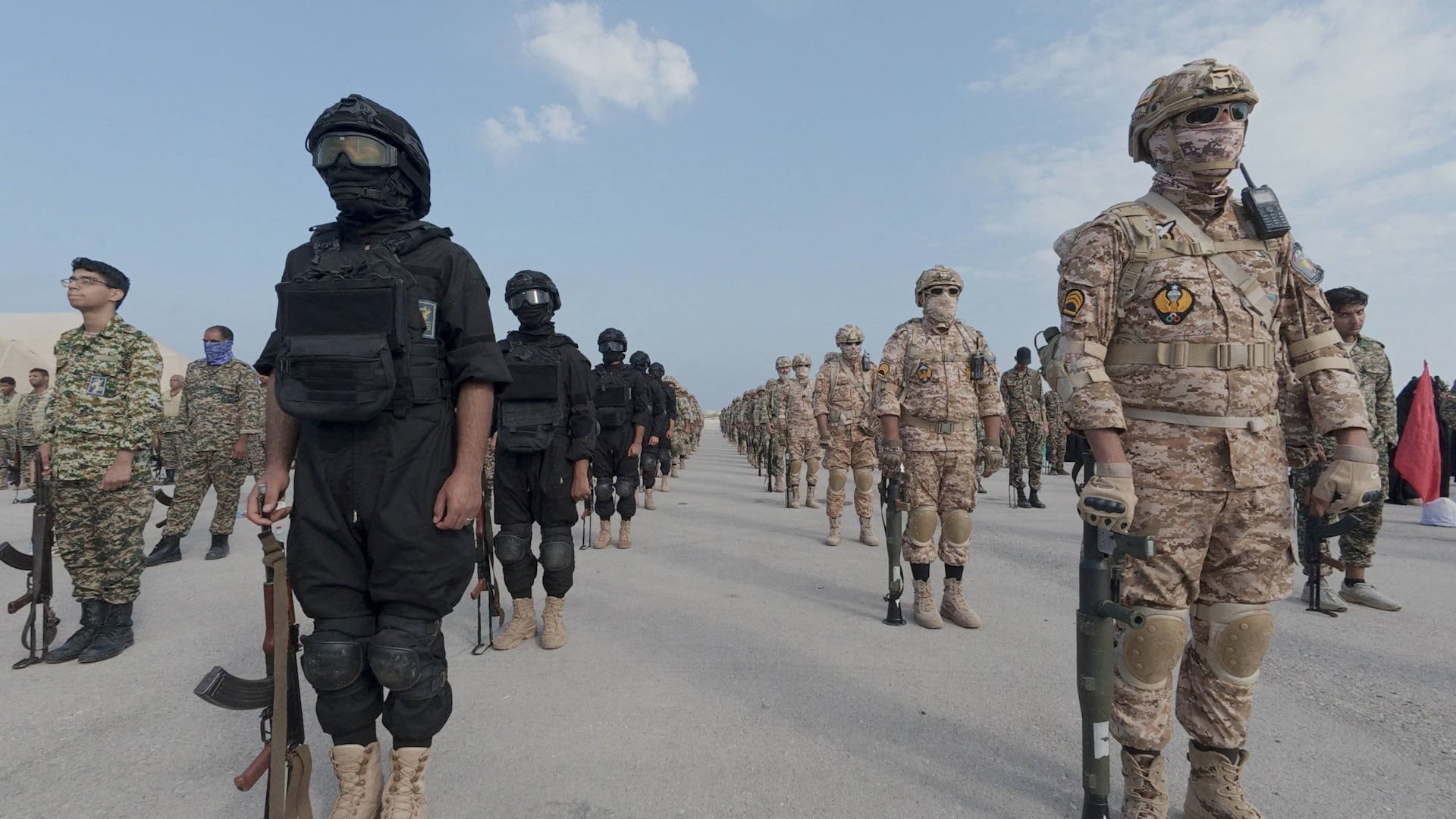
Western analysts love a good boogeyman. For decades, they have painted the Islamic Revolutionary Guard Corps (IRGC) as a monolithic, invincible shadow state—a cross between the Praetorian Guard and a Fortune 500 conglomerate. The standard narrative is tired: a fanatical military elite holding a nation hostage while masterminding a regional "Axis of Resistance."
It is a convenient story. It justifies massive defense budgets and sanctions regimes. But it is fundamentally wrong.
The IRGC is not a hyper-competent elite force. It is a bloated, decentralized holding company with a shrinking ideological core, struggling to manage a massive internal portfolio while its external "proxies" increasingly treat Tehran like a gullible venture capitalist. If you want to understand why Iran is actually stumbling, you have to stop looking at the IRGC as a military threat and start looking at it as a failing conglomerate.
The Myth of the Monolith
The biggest "lazy consensus" in geopolitical circles is that the IRGC is a unified block of steel-eyed loyalists. In reality, the Corps is a fractious mess of competing interest groups. The organization is split between the "Old Guard" who fought in the Iran-Iraq War and a younger generation of "Business Guards" who care more about their construction contracts in Iraq and Syria than they do about the finer points of Velayat-e Faqih.
I have seen the internal rot of state-run monopolies in dozens of emerging markets, and the IRGC follows the pattern perfectly. When a military starts running the telecommunications sector, the airports, and the dams, it stops being a military. It becomes a bureaucracy concerned with protecting its margins.
The 2008-2009 acquisition of the Telecommunication Company of Iran (TCI) for roughly $8 billion was not a strategic masterstroke for surveillance; it was a desperate cash grab. By anchoring its survival to the economy, the IRGC has made itself vulnerable to the very thing it claims to despise: the global market.
The Proxy Venture Capital Model
We are told the IRGC "commands" groups like Hezbollah, the Houthis, and various Iraqi militias. This is a misunderstanding of the power dynamic.
Think of the IRGC’s Quds Force not as a general staff, but as a venture capital firm. They provide the "seed funding" (drones, IED components, and cash) to regional startups. But as any VC will tell you, the founders eventually start ignoring the board of directors.
The Houthis in Yemen frequently take actions that catch Tehran off guard. Iraqi militias often prioritize their own local political survival over IRGC regional dictates. The "Axis" is less a chain of command and more a loose franchise agreement where the franchisees are increasingly powerful enough to renegotiate the terms. The IRGC is paying the bills for a regional strategy it can no longer fully control.
The Artesh Ghost
While everyone focuses on the 190,000 IRGC personnel, they ignore the Artesh—the regular Iranian military. The dual-military system was designed by Khomeini to prevent a coup. It worked for 40 years, but it has created a massive, systemic inefficiency.
- Resource Cannibalization: The IRGC gets the shiny new toys—the ballistic missiles and the sophisticated drones. The Artesh is left with 1970s-era American hardware held together by duct tape and prayers.
- Command Paralysis: In a high-intensity conflict, the friction between the "ideological" IRGC and the "professional" Artesh would be catastrophic. We saw glimpses of this during the Iran-Iraq war, where the IRGC’s "human wave" tactics collided with the Artesh’s conventional military logic.
Imagine a scenario where a major regional conflict breaks out. You have two separate navies in the Persian Gulf—the IRGC Navy with its fast-attack boats and the Artesh Navy with its aging frigates. They don’t share the same comms; they don't share the same philosophy. That isn't "asymmetric strength." That is a recipe for a friendly-fire disaster.
The Economic Death Spiral
The IRGC is estimated to control between 30% and 50% of the Iranian economy through its engineering arm, Khatam al-Anbiya, and various bonyads (charitable foundations). This is often cited as a source of strength. It is actually their greatest liability.
By monopolizing the economy, the IRGC has killed competition and innovation. They have turned the Iranian state into a giant, inefficient SOE (State-Owned Enterprise). Every time the Iranian people protest over the price of eggs or water shortages, they aren't just protesting the "theocracy"—they are protesting the IRGC as their landlord, their employer, and their grocery store owner.
The IRGC has a "protection racket" problem. They need the economy to function to pay their rank-and-file, but their very presence prevents the economy from functioning. Sanctions don't just "hurt" the IRGC; they expose the fact that the IRGC is a terrible business manager.
The Succession Trap
The aging Supreme Leader, Ali Khamenei, is the only thing keeping the various factions of the IRGC from each other's throats. There is a popular theory that the IRGC will "take over" after he dies, turning Iran into a pure military dictatorship.
The nuance missed here is that the IRGC is too divided to act as a single political successor. A military dictatorship requires a "Man on Horseback." The IRGC has a committee of guys in suits who are worried about their offshore bank accounts.
When the succession crisis hits, the IRGC won't consolidate power; it will fragment. The "provincialization" of the IRGC—intended to make it resilient against a decapitation strike—has actually created 31 different local power centers. Each provincial commander has his own local business interests and his own local grievances.
Stop Asking if They are Dangerous
The question isn't whether the IRGC is dangerous. Of course, a group with thousands of missiles is dangerous. The real question is whether they are stable.
They are an aging, corrupt, divided organization trying to manage a 21st-century resistance with a 1970s ideological playbook. They are more like the late-stage Soviet Politburo than a rising revolutionary force.
The next time you hear a "threat assessment" about the IRGC’s grand strategy, remember that the guy in charge of that strategy probably spent his morning worrying about why a shipment of smuggled car parts is stuck at the border.
Would you like me to analyze the specific financial holdings of Khatam al-Anbiya to show you where the next internal collapse is likely to start?