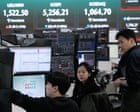
The screen glowed a clinical blue in the pre-dawn stillness of a suburban kitchen. Somewhere in Ohio, a logistics manager named Sarah reached for her phone before her first sip of coffee. She wasn’t looking for international intrigue or the shifting tectonic plates of Middle Eastern diplomacy. She was checking the price of diesel. One notification changed the math of her entire week. A warning had been issued from the highest office in the United States, directed toward Tehran, and thousands of miles away, the digital tickers in London and New York began to bleed red.
The world feels vast until you realize it is held together by a single, fraying thread of oil. Read more on a similar subject: this related article.
When Donald Trump issued a sharp, public warning to Iran regarding their regional provocations, he wasn't just speaking to a foreign adversary. He was pulling on that thread. The immediate reaction wasn't found in a boardroom or a bunker, but in the frantic flickering of West Texas Intermediate (WTI) and Brent Crude prices. Oil jumped. Markets slid. This is the story of how a few words can reset the cost of living for a global population.
The Friction of a Sentence
Geopolitics is often treated as an abstract game played by people in suits behind heavy doors. It feels distant. But for the global economy, the Strait of Hormuz is a jugular vein. Roughly a fifth of the world’s total oil consumption passes through this narrow stretch of water. When tensions spike between Washington and Tehran, the "risk premium"—the extra cost traders tack on to account for the possibility of a catastrophe—balloons instantly. Additional reporting by Financial Times explores comparable perspectives on the subject.
Money is a coward. It flees from uncertainty.
The moment the warning hit the wires, the algorithms took over. Thousands of automated trades executed in milliseconds, betting that the supply of oil would soon be strangled. Within an hour, Brent crude climbed toward the $70 mark. This isn't just a number on a chart. It is a tax on every human being who moves, eats, or stays warm.
Consider a hypothetical truck driver, let’s call him Elias. He operates out of a port in Greece. When oil prices spike because of a diplomatic spat, the cost of the fuel in his tank rises before the news has even finished scrolling across the bottom of his television. He has to decide whether to eat that cost or pass it on to the grocery store chain that hired him. The chain, in turn, passes it to the family buying milk. The warning in Washington becomes a price hike in Athens.
The Ghost of 1973
History isn't a straight line; it’s a series of echoes. To understand why the markets reacted with such visceral fear to the warning, one has to look back at the scars of the past. The 1970s taught the Western world that energy independence is a fragile illusion. We have spent decades building a global infrastructure that assumes a steady, predictable flow of hydrocarbons.
When that flow is threatened, the market doesn't just react to what has happened. It reacts to what might happen.
The sliding stock markets were a direct reflection of this collective anxiety. The S&P 500 and the Dow Jones Industrial Average aren't just lists of companies; they are barometers of confidence. If oil becomes too expensive, manufacturing slows down. Airlines see their profit margins evaporate. Consumer spending, the engine of the modern economy, begins to sputter as people realize they are spending more at the pump and less at the mall.
The warning to Iran acted as a sudden gust of wind in a house of cards. It didn't take a physical strike or a naval blockade to cause the damage. The mere suggestion of conflict was enough to wipe billions of dollars in valuation off the books of global corporations.
The Iranian Equation
From Tehran’s perspective, the pressure is a constant weight. Iran sits on some of the world’s largest oil and gas reserves, yet its ability to monetize them is hampered by a web of sanctions. When a U.S. President issues a specific warning, it signals a potential escalation in that "maximum pressure" campaign.
The market looks at Iran and sees a cornered player. If the rhetoric turns into action, the fear is that Iran might attempt to close the Strait of Hormuz. It is a move often called the "nuclear option" of oil trade. It would be a desperate act, one that would likely lead to open conflict, but the market doesn't wait for the first shot to be fired. It prices in the fear of the shot.
This is the psychological theatre of modern power. You don't need to sink a tanker to change the price of a gallon of gas. You only need to make the world believe you might.
The Ripple in the Pond
Why does a tech company in Silicon Valley see its stock price drop because of a tension in the Persian Gulf? It seems nonsensical on the surface. Google doesn't run on crude oil; it runs on data and electricity. But the global economy is an ecosystem.
When energy prices spike, everything becomes more expensive to produce and transport. Inflation, that invisible thief of purchasing power, gains momentum. Central banks, already walking a tightrope, have to consider raising interest rates to keep prices from spiraling. Suddenly, the cost of borrowing money to build a new data center or hire a new team of engineers goes up.
The "market slide" reported in the headlines is the sound of thousands of different industries all exhaling at once, bracing for a hit.
The Human Toll of Volatility
We speak in percentages and barrel prices to distance ourselves from the reality of the situation. But volatility is a human problem.
Think of a small business owner in India, struggling to maintain a delivery service. Or a retiree in the UK whose heating bill is tied to the wholesale price of gas. For them, a headline about "Trump's warning" isn't a political debate. It’s a threat to their monthly budget.
The global financial system is designed to absorb shocks, but it is the people at the bottom of the pyramid who feel the vibration most intensely. When the markets slide, it’s not just "investors" who lose. It’s the pension funds that hold the savings of teachers and firefighters. It’s the stability of the middle class.
The invisible wire is vibrating.
The Language of Power
There is a specific cadence to these diplomatic warnings. They are designed to be firm enough to deter action, but vague enough to allow for a graceful exit. However, the modern news cycle and the hyper-reactivity of high-frequency trading have stripped away the nuance.
In the past, a diplomatic cable might take days to be analyzed. Today, a tweet or a televised statement is ingested by an AI trading bot in a fraction of a second. The sentiment is analyzed, the "threat level" is categorized, and the sell orders are triggered before a human diplomat has even had time to draft a clarification.
We have built a world where our machines are more sensitive to our anger than we are.
The Fragility of the Status Quo
As the day progressed following the warning, the initial shock began to settle into a grim realization. The world remains dangerously dependent on a region that has been a powder keg for generations. We talk about the transition to green energy, about electric cars and solar grids, but the reality of 2026 is that we are still tethered to the ancient, buried carbon of the Middle East.
The jump in oil prices is a reminder of our collective vulnerability. We are spectators in a high-stakes poker game where the chips are our own livelihoods.
The markets eventually found a floor, as they always do. The panic subsided into a low-level thrum of anxiety. But the prices didn't return to where they were before the warning. A new baseline was established. The "risk" had been updated.
Somewhere, Sarah in Ohio is looking at her budget for the month. She sees the extra twenty dollars she’ll spend on fuel, and the extra few cents on every item in her grocery cart. She doesn't think about the Strait of Hormuz or the nuances of the 1979 revolution. She just feels the squeeze.
The warning was heard. The message was delivered. And the bill was sent to all of us.
The sun rises over the Persian Gulf, glinting off the hulls of massive tankers that move like slow, iron whales through the narrow passage. On the bridge of one such ship, a captain looks at the horizon, knowing that a single sentence uttered in a room thousands of miles away has made his cargo more valuable and his journey infinitely more dangerous.
The thread remains taut, humming in the wind.