The air in New Delhi during a diplomatic summit doesn't feel like the air anywhere else. It is thick. It tastes of exhaust, heavy jasmine, and the electric, static charge of secrets being kept in rooms where the windows are three inches thick. When world leaders descend upon the capital, the city doesn't just host them. It holds its breath.
I remember standing near the barricades of the Lutyens’ zone once, watching a motorcade blur past. To the casual observer, it’s just a fleet of black sedans. But to those watching the shifting tectonic plates of global power, those cars represent the movement of a very specific kind of gravity. On one side, you have the brash, loud, and transactional energy of Washington. On the other, the ancient, calculated, and often defiant posture of Tehran. And in the center, navigating a tightrope that shouldn't logically exist, is India.
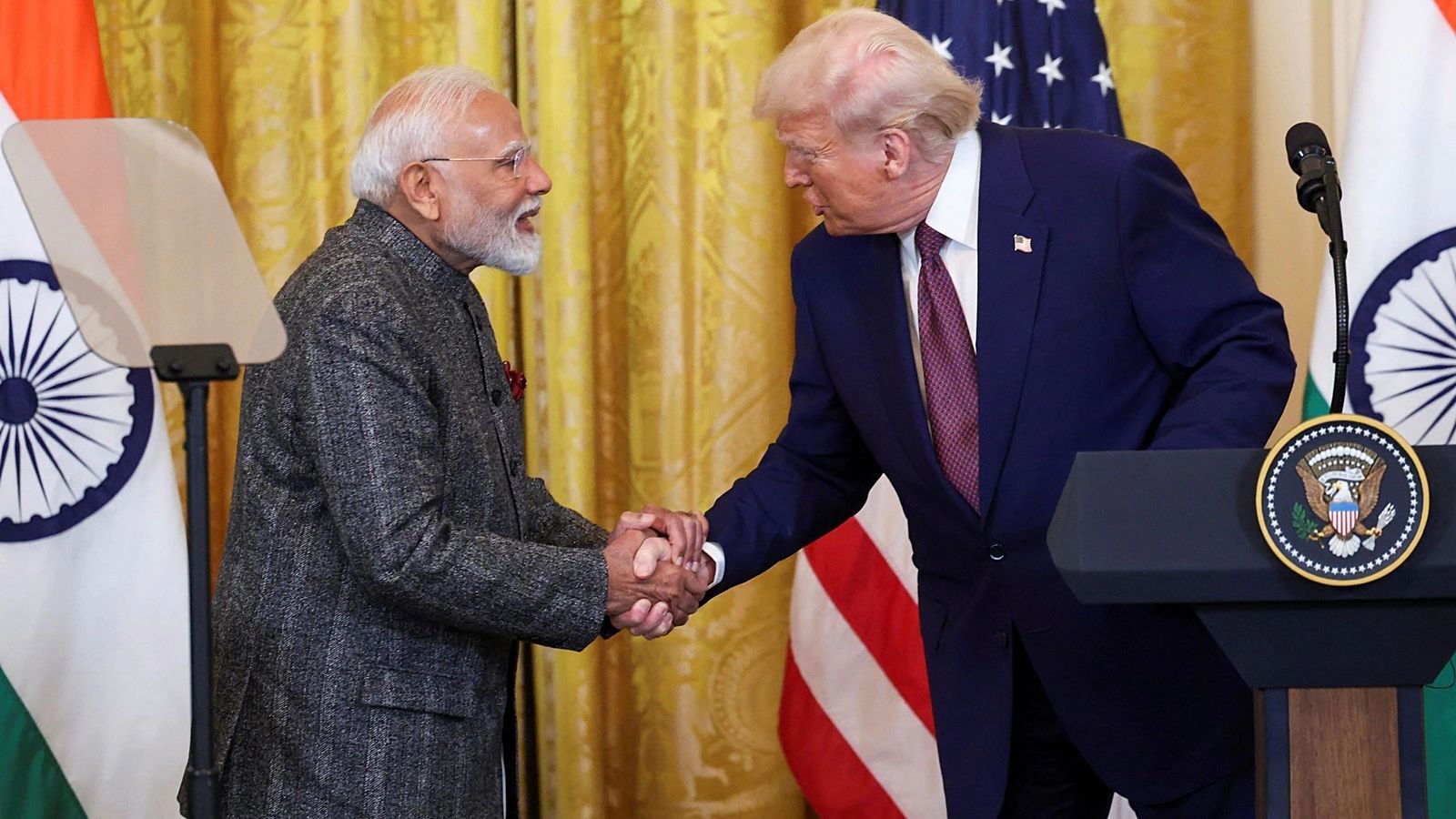
Recent headlines have painted this as a simple matter of optics. Donald Trump, never one for subtlety, claims a unique brotherhood with Narendra Modi. "PM Modi and I get things done," he says, with the breezy confidence of a man who views international relations as a series of handshakes and golf games. Almost simultaneously, Iran offers a public "thank you" to India for its support following a US-led strike.
It sounds like a contradiction. It sounds impossible. In a world of "with us or against us," India is choosing a third, far more complicated door.
The Art of the Impossible Handshake
Imagine a dinner party where the two most bitter rivals in the neighborhood are both toasted by the host. The host doesn't just keep the peace; they make both rivals feel like the guest of honor. This isn't just politeness. It’s survival.
When Trump speaks of "getting things done," he isn't talking about abstract philosophy. He is talking about the cold, hard currency of the 21st century: trade, defense contracts, and the containment of a rising China. For the United States, India is the essential anchor in the Indo-Pacific. It is the only democracy with the scale, the military potential, and the geographic position to balance the scales. Trump recognizes strength. He sees in Modi a leader who speaks his language—a nationalist who prioritizes his own borders and his own people above the fuzzy "globalist" ideals of the previous century.
But then, look across the Arabian Sea.
Tehran’s gratitude toward India isn't a fluke or a momentary lapse in judgment. It is rooted in the soil of the Chabahar Port. While the West sees Iran as a pariah or a puzzle to be solved through sanctions, India sees a gateway. Without Iran, India is effectively blocked from reaching Central Asia and Russia by land, thanks to the jagged reality of its borders with Pakistan.
Consider a merchant in Mumbai. For him, the geopolitics of the White House are distant. What matters is whether a container of grain or tea can reach a market in Uzbekistan without being held hostage by regional instability. To make that happen, India must remain on speaking terms with the Ayatollahs, even as it buys American predator drones and hosts "Howdy Modi" rallies in Texas.
The Human Stakes of the Tightrope
We often talk about "nations" as if they are monolithic blocks of granite moving across a map. They aren't. They are collections of people with very real fears.
There is a hypothetical student in Tehran, let's call her Maryam. She is brilliant, studying engineering, and watching her currency lose value every time a new headline flashes from Washington. For her, India’s "support" isn't about endorsing a regime’s military actions; it’s about a lifeline. It’s about the hope that her country won't be completely throttled by isolation. India’s refusal to fully join the chorus of Western condemnation provides a sliver of breathing room. It suggests that the world isn't just a binary choice between American hegemony and total darkness.
Now, consider an aerospace engineer in Bengaluru. We’ll call him Arjun. He works for a firm that is increasingly integrating with American supply chains. For Arjun, the "Modi and Trump" relationship is the reason his company just secured a contract that will fund his children’s education for the next decade. He needs the American alliance to be "robust"—a word I hate, but one that fits the mechanical strength of a jet engine.
India’s challenge is to ensure that Maryam’s world doesn't collapse while Arjun’s world thrives.
This isn't just "balancing." It’s a high-stakes performance of strategic autonomy. It is the realization that in a multi-polar world, being a "junior partner" to anyone is a death sentence for a country of 1.4 billion people.
The Ghost in the Room
The elephant—or perhaps the dragon—in the room is the one force that makes both the US and Iran look to India with such intensity.
China’s shadow over the Himalayas and the South China Sea creates a gravity that pulls Washington and Delhi together. But China’s growing influence in the Middle East through the Belt and Road Initiative also makes India’s presence in Iran a necessity for Tehran. Iran doesn't want to be a Chinese client state any more than it wants to be an American one. India offers a middle path. A democratic partner that doesn't preach, but does provide investment.
But how long can you walk this line before the wind picks up?
Trump’s "get things done" mantra usually comes with an invoice. He expects loyalty to be transactional. If the US provides the hardware and the intelligence to counter China, there is an unspoken expectation that India will distance itself from "the bad actors."
On the other side, Iran’s gratitude is a heavy gift. It ties India to a regional power play that is increasingly violent and unpredictable. When an American strike hits an Iranian target, and India offers "support" or "understanding" to the victim, it risks the very relationship that Trump prizes.
The Weight of the Middle Path
The beauty of this narrative, if you can call the brutal reality of power "beautiful," is that India is effectively trying to redefine what it means to be a superpower.
Historically, a superpower is a country that can force others to choose. You are with Rome, or you are a barbarian. You are with the Soviets, or you are with the West. India is proposing a different model: the superpower as the ultimate bridge.
It is a terrifying gamble.
One wrong move, one statement that is a little too warm toward Tehran during an election year in the US, and the "special relationship" with Washington could cool. One shipment of American-made components through a port that the US wants to see closed, and the sanctions hammer could fall on Indian firms.
The complexity is staggering. We live in an era where we want our news in 280 characters. We want "good guys" and "bad guys." We want to know if we should cheer for the Trump-Modi bromance or be wary of the Tehran-Delhi connection.
The truth is far more human and far more fragile.
India’s diplomacy is driven by the gut-level necessity of fueling a massive, growing population. It is driven by the memory of colonial rule, which left a deep, ancestral scar that says: Never let another capital decide your fate.
When you see the photos of the handshakes, don't just look at the smiles. Look at the eyes. There is a calculation happening there that goes beyond the next election cycle. It is the calculation of a nation that has survived for millennia by being the crossroads of the world.
The "support" Iran thanks India for isn't a political endorsement. It’s a refusal to let the world become a desert of absolutes. And the "getting things done" that Trump admires isn't a sign of India joining the American team. It’s a sign of India using the American team to build its own stadium.
In the end, the most compelling stories aren't about who wins or who loses. They are about who manages to stay in the game when everyone else is trying to force them off the field.
The motorcade in Delhi moves on, the jasmine scent fades into the smell of diesel, and the world continues its chaotic, spinning dance. India is still on the tightrope. The crowd is watching, some hoping for a fall, some cheering the balance. But the tightrope walker doesn't look down. They can't afford to. They just keep moving, one calculated, impossible step at a time, toward a horizon that they alone have chosen.