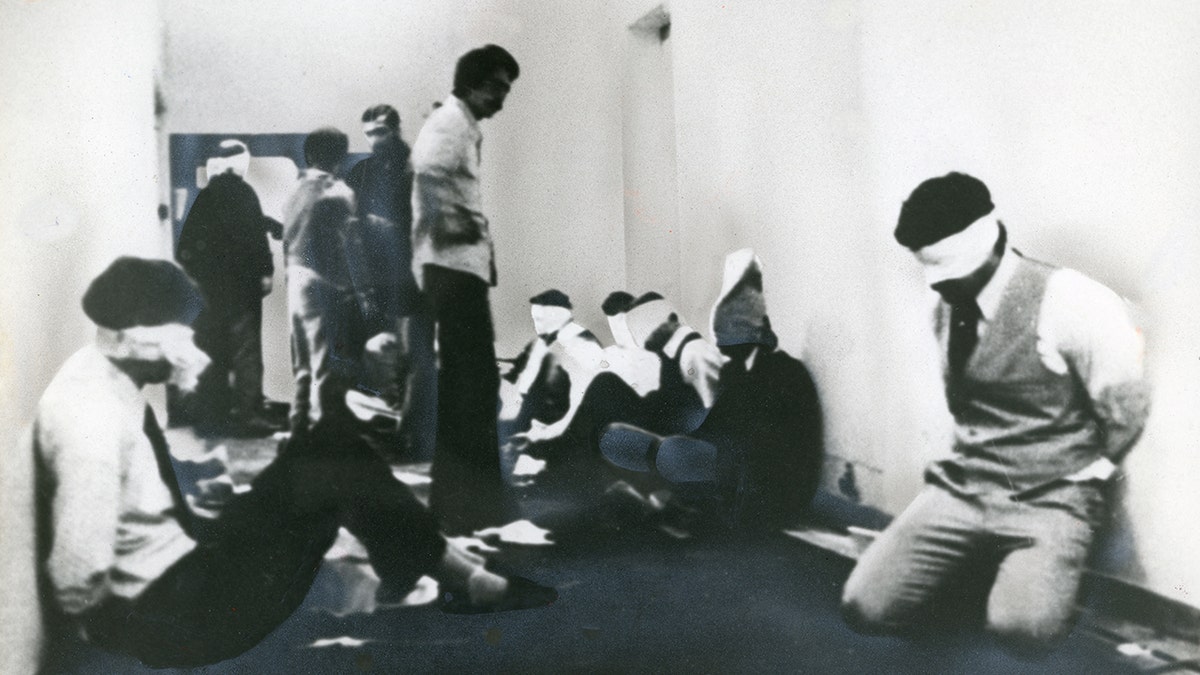
The current wave of regional escalation between Israel and Iran has done more than just destabilize oil markets; it has effectively turned every American passport holder in the Middle East into a high-yield asset for the Islamic Revolutionary Guard Corps (IRGC). For decades, the "hostage diplomacy" playbook was a slow-burn strategy used to extract frozen assets or swap convicted operatives. Now, as missile exchanges become the new baseline for diplomacy, that playbook has been weaponized into a rapid-response insurance policy. The threat to Americans currently in Iran, or those with dual citizenship, is no longer a theoretical risk of long-term detention. It is a mathematical certainty of the IRGC's defensive doctrine.
The logic is brutal and transactional. When the U.S. or its allies strike Iranian proxies or sovereign territory, Tehran’s most effective asymmetric response isn't always a drone swarm. It is the televised "confession" of an academic, a consultant, or a tourist. This isn't just about leverage for a specific deal. It is about creating a domestic human shield that forces Washington to weigh every kinetic action against the life of a schoolteacher from California or a tech executive from New York.
The Architecture of the Hostage Economy
The Iranian security apparatus does not operate on the whims of rogue agents. It functions as a sophisticated, state-sanctioned kidnapping enterprise with its own internal accounting. To understand the peril facing Americans today, one must look at the Ghershe-e-Etemad, or the "Circle of Trust" within the intelligence wings. They identify targets months in advance, often allowing them to enter and exit the country several times to build a false sense of security before the trap finally snaps shut.
This is not a failure of intelligence; it is a feature of the system. The IRGC’s Intelligence Organization (SAS) specifically tracks dual nationals because they represent the ultimate "zero-cost" asset. By arresting a dual citizen on vague charges of "collaboration with a hostile state," Iran gains a chip that can be traded for billions of dollars in blocked oil revenue or the release of high-level arms dealers held in Western prisons.
Historically, these detentions followed a predictable cycle of quiet diplomacy. But the recent shift toward direct military confrontation has compressed the timeline. In the past, a hostage might be held for years before a deal was brokered. In the current climate, advocates warn that the IRGC is looking for "live collateral" to deter the next wave of strikes. This turns the detention centers, such as the notorious Evin Prison, into strategic nodes in a larger regional war.
Beyond the Official Warnings
The State Department’s Level 4 "Do Not Travel" advisory is often dismissed by those with deep family ties to the region. They believe their personal history or lack of political involvement protects them. They are wrong. In the eyes of the IRGC, your intent is irrelevant. Your value is determined solely by the color of your passport and the current price of regional stability.
Advocacy groups are now seeing a shift in the profile of those being targeted. It is no longer just the high-profile journalist or the outspoken human rights activist. The net is widening to include anyone who can serve as a conduit for pressure. This "democratization of risk" means that the average dual citizen visiting an elderly relative is now a high-priority target for a regime that feels increasingly cornered.
- Financial Extraction: Detainees are often used to unlock specific tranches of humanitarian funds or sanctioned accounts.
- Political Deterrence: The presence of American prisoners in Tehran acts as a psychological brake on U.S. military planners.
- Intelligence Swaps: Hard-line factions use prisoners to force the return of operatives caught in the West.
The reality is that the U.S. government has limited tools to intervene once the cell door closes. The "Special Presidential Envoy for Hostage Affairs" (SPEHA) can negotiate, but they are playing a game where the opponent moves the goalposts every time a new sanction is leveled or a new strike is launched. It is a cycle of desperation where the human cost is the only currency that doesn't depreciate.
The Mirage of De-escalation
There is a dangerous school of thought suggesting that a return to formal nuclear negotiations would alleviate the pressure on detainees. This ignores the internal friction within the Iranian power structure. Often, the IRGC escalates hostage-taking specifically to sabotage the diplomatic efforts of the more "moderate" elements of the Iranian foreign ministry. When an American is grabbed, it isn't always a message to Washington; sometimes it’s a message to the Iranian President that the hard-liners still hold the keys to the kingdom.
This internal power struggle makes the situation for current detainees even more precarious. If they are seen as a "moderate's" project, the hard-liners have every incentive to keep them in a 2x2 meter cell to prove that engagement with the West is a fool’s errand. This leaves the American government in an impossible position: negotiate and reward the behavior, or hold the line and leave citizens to rot.
The "Redline" has become a gray zone. When the U.S. sends a carrier strike group to the Persian Gulf, it is a show of force. When Iran moves an American prisoner to a new, undisclosed location, it is a counter-move of equal weight. We are no longer talking about individual cases of injustice; we are looking at the integration of human lives into the tactical order of battle.
Logistics of a Premeditated Capture
The mechanics of these arrests are chillingly consistent. It usually begins at Imam Khomeini International Airport. A passport is flagged. A short "interview" in a side room turns into a six-hour interrogation. By the time the sun goes down, the individual has been moved to a safe house or a dedicated wing of a state prison.
The initial weeks are designed to break the psychological link to the outside world. Solitary confinement, sleep deprivation, and the constant threat of "revolutionary justice" are standard. For the IRGC, the goal is to produce a video or a signed statement that can be used in the state-controlled media to justify the arrest to the Iranian public and provide the legal cover needed for a multi-year sentence.
Critics of the U.S. response argue that the 2023 deal, which saw $6 billion in Iranian funds moved to Qatar in exchange for five Americans, set a dangerous precedent. While the families of those five individuals were understandably relieved, the broader policy community warned that it put a "bounty" on every remaining American in the country. The math is simple for Tehran: if five people are worth $6 billion, then the next five are worth at least that much, if not more, given the increased military tensions.
The Strategy of Forced Errors
Washington's current strategy is largely reactive. It waits for the arrest, designates the individual as "wrongfully detained," and then begins a slow, agonizing process of back-channel communication. This is exactly what the IRGC wants. It forces the U.S. to engage on Tehran’s terms, in a theater where the U.S. military advantage is neutralized by the moral imperative to save a civilian.
To break this cycle, the focus must shift from "recovery" to "denial of opportunity." This requires a cold-eyed assessment of the dual-national community's vulnerability. There is a point where personal choice ends and national security begins. If the U.S. cannot protect its citizens inside Iran, it must find more aggressive ways to prevent them from becoming assets in the first place. This includes not just warnings, but the aggressive dismantling of the financial networks that benefit from these "trades."
The looming threat of a full-scale conflict between Israel and Iran only heightens this urgency. If the regional "shadow war" steps into the light, the Americans currently held—and those who might be grabbed tomorrow—will find themselves at the absolute center of the storm. They are the ultimate "asymmetric weapon" in a conflict where conventional rules no longer apply.
Every American currently considering travel to Iran, or remaining there despite the warnings, must understand that they are not just tourists or visiting family. They are potential line items in a high-stakes geopolitical ledger. The IRGC is not looking for spies; it is looking for leverage. And in a world of growing strikes and collapsing treaties, leverage is the only thing that keeps the regime in the game.
Contact the State Department's Bureau of Consular Affairs to report any dual nationals who have gone silent or been detained immediately, as the first 48 hours of a disappearance are the only window where local intervention might still be possible before the IRGC takes formal custody.