The phone rings in a small kitchen in Berehove, a town where the street signs speak two languages and the air smells of paprika and damp earth. A mother reaches for it, her fingers trembling. For eighteen months, her son has been a ghost. He disappeared into the gray smoke of Eastern Ukraine, wearing a uniform that bore the trident of Kyiv but carrying a name that echoed the plains of Hungary.
He is one of the thousands caught in the tectonic grind between empires. But for him, the war isn't just about territory or NATO expansion. It is a crisis of identity, a geographic trap where being a minority means being a pawn in a game played by men in gilded offices a thousand miles away. For a deeper dive into similar topics, we suggest: this related article.
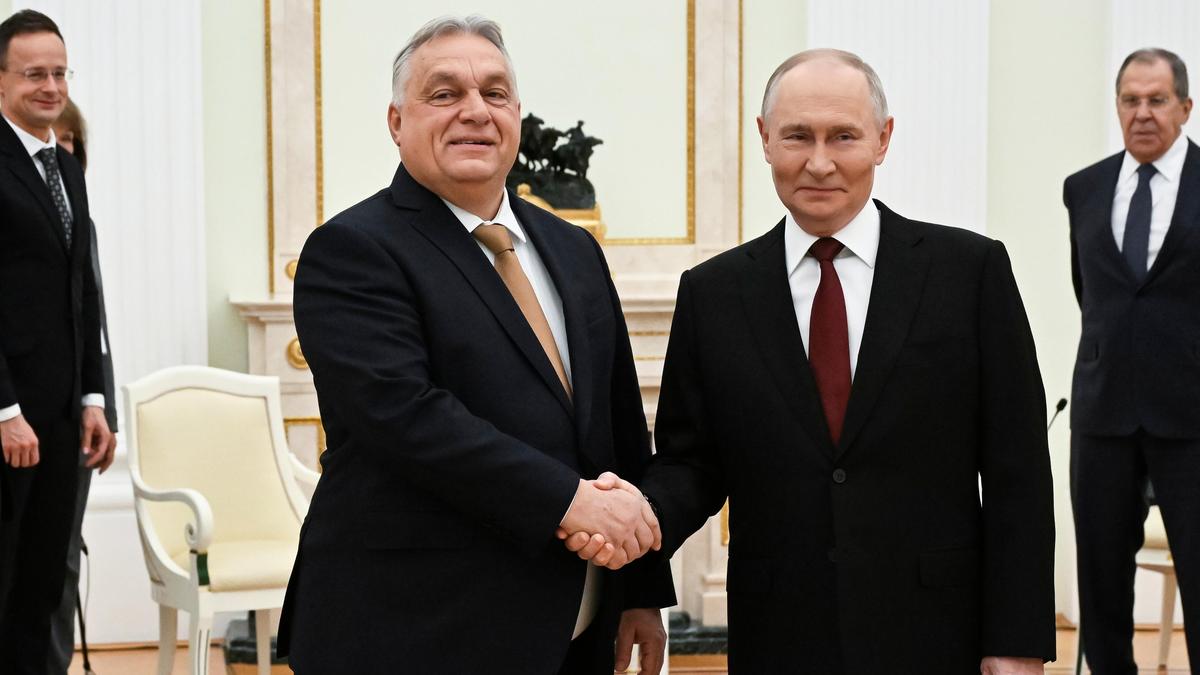
Recently, two of those men—Vladimir Putin and Viktor Orban—sat down to discuss the fate of men exactly like him. The headlines called it a diplomatic meeting. The families of the captured call it a prayer.
The Border That Moved
To understand why Hungarian soldiers are fighting and dying in Ukrainian trenches, you have to look at the map—not as it is today, but as it has been felt for a century. Transcarpathia is a slice of land that has belonged to five different countries in the last hundred years. People there say they haven't moved, but the borders have moved over them. For further details on this issue, comprehensive reporting can be read on Associated Press.
When the full-scale invasion began, the ethnic Hungarian minority in Ukraine, numbering roughly 150,000, faced a brutal reality. They were Ukrainian citizens. They were subject to mobilization. Suddenly, men who grew up speaking Hungarian at the dinner table were sent to the Donbas to face Russian artillery.
They became the 128th Mountain Assault Brigade. They became the "Transcarpathian Dragons." They also became a unique kind of political currency.
A Dialogue of Shadows
When Putin and Orban speak, the room is thick with subtext. Orban occupies a lonely position in Europe, a bridge-builder who often seems to be standing on the wrong side of the river according to his EU peers. He has been vocal about the "forced mobilization" of ethnic Hungarians, painting a picture of a minority being used as cannon fodder by Kyiv.
Putin listens. He understands the power of a wedge.
The recent discussions regarding Hungarian prisoners of war (POWs) captured by Russian forces are not merely humanitarian gestures. They are precision-engineered political tools. By negotiating the release of these men directly with Budapest—sometimes bypassing Kyiv entirely—the Kremlin sends a deafening message: Your true protector isn't the government in Ukraine. It’s us. And it’s Orban.
Consider the transfer of eleven POWs to Hungary last year, facilitated by the Russian Orthodox Church. No one told Ukraine they were leaving. One day they were in a Russian camp; the next, they were on Hungarian soil.
It was a miracle for the families. It was a diplomatic hand grenade for everyone else.
The Weight of the Choice
Imagine being one of those soldiers. You are hunkered down in a frozen treeline near Bakhmut. You are fighting for Ukraine because it is your home, your legal obligation, and perhaps because you believe in the sovereignty of the land you walk on. But you also know that your mother tongue is being restricted by new language laws in Kyiv. You know that the leader of your ancestral homeland, Hungary, is the only one calling for an immediate ceasefire that your current commanders say would be a surrender.
You are pulled in three directions at once.
Then, the flash of a grenade. The ringing in your ears. The heavy boots of Russian infantry standing over you. In that moment, you aren't a political symbol. You are a cold, terrified man who wants to see the sunflowers in Berehove again.
When Russia captures an ethnic Hungarian, they don't see just another soldier. They see an opportunity to reward a "friendly" EU nation and simultaneously embarrass a "hostile" one.
The Cost of Protection
The tension lies in the price of this special treatment. Every time a Hungarian soldier is plucked from a Russian prison camp through a side deal, the cracks in European unity widen. Orban’s critics argue he is trading Ukrainian sovereignty for the safe return of "his" people. His supporters argue that a leader’s first duty is to his blood, regardless of what a passport says.
But what of the men still in the camps?
There are reports of hundreds of ethnic Hungarians still held in Russian custody. For them, the high-level meetings between Putin and Orban are a source of both hope and horror. They know their freedom depends on a delicate dance of favors. If Orban stops blocking EU aid to Ukraine, does the door to the prison cell slam shut? If Putin decides the "Hungarian card" no longer has value, do these men vanish into the Siberian gulag system?
It is a marketplace of human lives.
The Language of the Heart
In the villages along the Tisa River, the war feels both distant and suffocatingly close. You see it in the black ribbons tied to gateposts. You see it in the empty chairs at the local cafes. The Hungarian government has invested millions in schools and churches in this region, creating a state-within-a-state feel that complicates the narrative of national loyalty.
The Ukrainian government views this influence with suspicion, fearing a "Crimea scenario" where a minority population is used as a pretext for intervention. This suspicion often trickles down into the trenches. An ethnic Hungarian soldier might face the distrust of his Ukrainian comrades by day and the shells of Russian guns by night.
This is the "invisible stake" of the Putin-Orban dialogue. It isn't just about a few dozen or a few hundred men. It is about the definition of loyalty in a fractured world. It is about whether a person’s ethnicity can be used to exempt them from the horrors of a war their neighbors must endure.
The Silence After the Call
Back in the kitchen in Berehove, the phone call eventually ends. Sometimes it’s good news. Sometimes it’s a blurry video from a Telegram channel showing a son in a Russian basement, forced to recite a script about how well he is being treated.
The dialogue between Moscow and Budapest continues. It is a conversation conducted in whispers and shadows, far removed from the mud and blood of the front lines. To the world, it is a headline about geopolitics and POW counts. To the people of Transcarpathia, it is the sound of a heartbeat in the dark.
They are waiting for the day when their sons are no longer pawns, no longer "ethnic assets," and no longer ghosts. Until then, they live in the silence between the moves of two powerful men, wondering if the next shift in the border will finally bring their children home, or if the map will simply swallow them whole.
The sun sets over the Carpathians, casting long, jagged shadows that do not care for the names of kings or the colors of flags. In the end, the earth doesn't ask what language you spoke before you bled into it.