In a quiet suburb of Ahmedabad, a woman named Sunita turns a plastic knob on her stovetop. A soft hiss, a click of the igniter, and a steady blue ring of fire blooms. To Sunita, this is the simplest act in the world. It is the morning tea. It is the comfort of a routine that replaced the heavy, unpredictable clatter of steel LPG cylinders being dragged up three flights of stairs.
But that blue flame is not a local miracle. If you liked this piece, you might want to read: this related article.
It is the end of a gossamer thread that stretches thousands of miles, crossing scorched deserts and diving beneath the churning, grey-green waters of the Arabian Sea. That thread is currently vibrating with the frequency of war. As tensions escalate between Israel and Iran, the quiet hum of India’s piped natural gas (PNG) network is beginning to sound like a countdown.
We often talk about war in the language of geopolitics—of "strategic depth" and "maritime corridors." These words are cold. They don't capture the anxiety of a fleet manager in Delhi wondering if his 500 CNG buses will have fuel by Friday. They don't reflect the calculations of a ceramic factory owner in Morbi who knows that a $2 spike in gas prices isn't just a line item; it is the difference between keeping his staff or turning off the lights. For another look on this event, refer to the latest coverage from MarketWatch.
The Geography of Vulnerability
India is an energy sponge. It absorbs everything it can get its hands on to keep its economy spinning at 7 percent growth. While the world looks at oil, the real story of India’s modernization is written in methane. The government has spent billions of dollars weaving a web of pipelines across the subcontinent, aiming to move the country toward a "gas-based economy."
The problem is that the sponge is dry. India imports roughly half of its natural gas. Much of this arrives as Liquified Natural Gas (LNG), super-cooled and carried on massive tankers that must navigate the world’s most dangerous chokepoint: the Strait of Hormuz.
Imagine a needle’s eye. Now imagine 20 percent of the world’s liquefied gas trying to pass through it every single day. Iran sits on the northern bank of this needle’s eye. If the conflict spills over into a full-scale maritime blockade, the "bridge" of ships bringing gas from Qatar, the UAE, and even further afield doesn't just slow down. It stops.
Why Piped Gas is Different
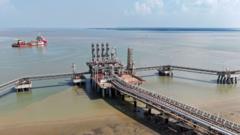
You might think that because the gas is in a pipe, it is safe. That is a common misunderstanding. When we talk about "piped gas" in Indian kitchens, we are talking about the final delivery mechanism. The source, however, is often that same LNG that arrived by ship, was regasified at a terminal on the coast, and then pushed through the domestic grid.
If the tankers stop arriving at Dahej or Hazira, the pressure in the domestic pipes drops.
Physics is unforgiving. A gas grid requires constant, high-pressure flow to function. It is not like a coal pile that you can let sit for a month. If the supply at the entry point flickers, the entire system feels the shock. For the millions of households that have transitioned to PNG, there is no "Plan B." You cannot keep a spare bag of gas in the cupboard. You are either connected to the world, or you are cold.
The Ghost of the IPI Pipeline
There was once a dream of a literal pipe—the Iran-Pakistan-India (IPI) project. It was dubbed the "Peace Pipeline." It was meant to be a 2,700-kilometer artery of steel that would pump Iranian gas directly into the heart of Indian industry.
It remains a ghost.
Years of sanctions, diplomatic friction with Pakistan, and the looming shadow of U.S. displeasure turned the project into a monument of what might have been. Today, that failure looks like a missed opportunity to some and a bullet dodged to others. Had India become dependent on a physical pipe through Iranian territory, the current war footing would be a literal chokehold. Instead, India opted for the flexibility of the sea.
But flexibility comes with a premium. When the Middle East catches fire, the spot market for LNG goes parabolic.
The Ripple in the Kitchen
Let’s look at the math, though the math is really about human behavior. Most of India’s long-term gas contracts are indexed to the price of oil. When a missile is launched in the Levant, oil prices jump. A few weeks later, the city gas distribution companies—the ones who send the bills to Sunita and the bus drivers—look at their rising costs.
They have two choices. They can absorb the loss and risk going bankrupt, or they can pass it on.
Last year, when global energy markets were upended by the situation in Ukraine, we saw what happens. CNG prices in Mumbai and Delhi climbed to record highs. For a taxi driver, that extra 5 or 10 rupees per kilogram isn't just a statistic. It’s the price of a gallon of milk. It’s the school fees. The "macro" becomes "micro" very quickly.
The current tension is more intimate. Iran is not just a distant supplier; it is a neighbor in the energy sense. If Israel targets Iranian energy infrastructure, or if Iran retaliates by mining the Strait, we aren't just looking at a price hike. We are looking at a physical shortage.
The Strategic Shell Game
The Indian government is not sitting still, but their options are limited. They are currently trying to diversify, buying gas from the United States, Australia, and Mozambique. They are building massive underground storage facilities, trying to create a "battery" of fossil fuels that can last for a few weeks of crisis.
But you cannot build a warehouse for a nation’s breath overnight.
Consider the sheer scale of the transition. The goal is to increase the share of natural gas in India's energy mix from 6 percent to 15 percent by 2030. That is a staggering amount of infrastructure. Every kilometer of pipe laid is a bet on global stability. It is a gamble that the world will remain open enough for molecules to move freely across borders.
War is the ultimate "de-globalizer." It turns interdependencies into liabilities.
The Invisible Stakes
What is truly at stake is the trust of the Indian consumer. For decades, the Indian household relied on the cylinder. It was cumbersome, but you could see it. You could shake it to see how much was left. It was tangible.
The shift to piped gas is a shift toward a more sophisticated, "first-world" infrastructure. It requires a belief that the system will always work. If the war in the Middle East causes the blue flame to flicker or fail, that trust evaporates. People will go back to the old ways. The momentum of the green transition—natural gas is significantly cleaner than coal or oil—could stall.
The cost of the war, therefore, isn't just measured in the price of a BTU. It is measured in the lost years of environmental progress. It is measured in the hesitation of an investor who was about to fund a new pipeline but now sees only risk.
A Midnight Calculation
Deep in the Ministry of Petroleum in Delhi, there are rooms where the lights stay on all night. They are running simulations.
Scenario A: A limited strike. Prices rise 15 percent. Manageable.
Scenario B: Closing of the Strait. Prices rise 300 percent. Cargoes are diverted. Mandatory rationing for industry to keep the kitchen fires burning.
They know that the "invisible" gas line is actually the most visible part of the social contract. A government that cannot keep the stoves lit is a government in trouble.
Sunita doesn't know about Scenario B. She only knows that her tea is boiling. She doesn't see the tankers hovering off the coast of Fujairah, waiting for an escort. She doesn't see the frantic diplomatic cables being traded between New Delhi and Tehran. She sees the blue flame. It looks steady. It looks permanent.
But the flame is only as strong as the peace that allows it to travel. As the horizon in the Middle East glows orange with the light of explosions, the blue light in the Indian kitchen looks increasingly like a luxury we can't quite guarantee.
The thread is fraying. We are all just waiting to see if it snaps.
Would you like me to look into the specific contingency plans the Indian government has drafted for a potential Strait of Hormuz blockade?